Affordable Yacht Ownership: What Buyers Can Expect from €50,000 to €500,000
The yacht market offers far more opportunities than many first-time buyers realize. From sailing yachts and motor boats at €50,000 to luxury cruising yachts and catamarans approaching €500,000, buyers today have access to a wide range of ownership options. Understanding what each budget level delivers and how ownership structures work has become one of the most important decisions in modern yacht acquisition.
The Evolution of the Global Yacht Market
Over the past decade, the global yachting landscape has undergone a profound structural shift, dismantling the long-held perception that maritime leisure is an exclusive sanctuary for ultra-high-net-worth individuals. This democratization has been driven by a confluence of factors: the maturation of the global brokerage industry, unprecedented transparency in vessel valuation, and the exponential growth of a highly liquid secondary market. Today’s buyers benefit from immediate digital access to international listings, allowing them to compare assets across continents and identify the true market value of vessels. Consequently, the barriers to entry have been significantly lowered. The modern buyer is no longer navigating a closed ecosystem; rather, they are entering a dynamic marketplace where older, well-constructed vessels are systematically refitted, and modern production yachts transition into the pre-owned sector with their contemporary technologies fully intact. This environment empowers first-time buyers to acquire formidable vessels at a fraction of their original replacement cost, shifting the paradigm from aspirational dreaming to strategic, calculated acquisition.
The Epicenter of Demand: The Mediterranean Context
The pulse of this evolving market is most vividly felt across the Mediterranean, which remains the undisputed global epicenter for both entry-level and premium yachting. The strategic distribution of vessels across this region shapes how buyers approach their acquisition journeys. The glamorous, high-capacity marinas of the French Riviera and Italy continue to serve as the premier destination for sleek motor yachts and sophisticated family cruisers, where proximity to world-class shipyards ensures a steady supply of meticulously maintained brokerage inventory. Simultaneously, the rugged, dramatic coastlines of Spain and the Balearic Islands offer an ideal testing ground for high-performance day boats and versatile family cruisers that thrive in vibrant coastal waters.
Further east, the geographic realities of the sea dictate different vessel preferences. The expansive, island-dense archipelagos of Greece, the historic waters of Croatia, and the pristine bays of Turkey have become the global capital for catamaran sailing and long-range cruising monohulls, where buyers prioritize immense fuel autonomy and shallow drafts for secluded anchorages. Meanwhile, the strategic maritime hubs of Montenegro and Malta have emerged as critical logistical pillars. Montenegro attracts discerning buyers with its state-of-the-art superyacht infrastructure and favorable economic conditions, while Malta remains a vital crossroads for yacht registration, corporate structuring, and technical refits. This diverse Mediterranean tapestry ensures that whether a vessel is sourced from a quiet harbor in the Aegean or a prestigious shipyard in Genoa, the regional infrastructure stands ready to support its operational lifecycle.
The Romantic Core: The Emotional Reality of Ownership
Yet, behind the sophisticated market metrics and geographical strategies lies the true, immutable driver of the maritime industry: the profound emotional transformation that yacht ownership delivers. Beyond a mere financial transaction, purchasing a yacht is the acquisition of an alternative lifestyle, defined by an unparalleled sense of personal sovereignty and absolute freedom. It is found in the quiet, visceral luxury of a dawn departure from a bustling Mediterranean marina, before the rest of the world has awakened, when the water mirrors the sky and the coastline fades into a soft horizon. It is realized in the absolute serenity of dropping anchor in a secluded, translucent cove in the Cyclades or the Dalmatian Islands, far removed from crowded tourist corridors, where the vessel becomes a private sanctuary for family connection and undistracted reflection.
This lifestyle rewrites the rules of travel; it replaces rigid schedules with the rhythm of the tides and the direction of the wind. A yacht offers the unique luxury of a moving home where the view changes at the owner's whim, yet the comfort remains completely uncompromised. The shared experiences built on deck—whether teaching a child the fundamentals of navigation, hosting intimate dinners under a canopy of stars, or navigating a challenging coastal passage with a trusted crew—create a lasting emotional currency that cannot be measured by traditional financial metrics. It is this profound sense of boundless liberation that transforms the rational business of yacht buying into a deeply passionate, life-affirming pursuit.
Entering the Market: The €50,000 to €100,000 Threshold
The notion that entering the yachting lifestyle requires a multi-million-euro commitment is swiftly dispelled when analyzing the €50,000 to €100,000 segment. This tier remains one of the most vibrant and heavily transacted entry points in the industry, offering substantial opportunities for pragmatic, hands-on buyers. Within this budget, the market is rich with well-maintained, thirty-to-forty-foot sailing yachts from heritage European shipyards, robust family day cruisers, and older but mechanically sound motor boats. Buyers in this category are often seeking an introduction to the maritime lifestyle—utilizing their vessels for weekend coastal hops, learning the intricacies of navigation, and enjoying intimate family getaways. However, success in this segment requires realistic maintenance expectations. While the acquisition cost is highly accessible, buyers must anticipate investing in periodic upgrades, such as modernizing outdated navigation electronics, replacing running rigging, or addressing cosmetic wear. This budget favors the educated owner who understands that acquiring a fundamentally solid hull and reliable propulsion system provides a secure foundation for gradual, manageable improvements.
The Core Market: Opportunities from €100,000 to €200,000
As the budget expands into the €100,000 to €200,000 range, buyers enter the absolute backbone of the European brokerage market. This financial threshold unlocks a vast inventory of highly capable vessels, including forty-to-fifty-foot sailing yachts with contemporary layouts, early-generation cruising catamarans, and deeply comfortable twin-engine motor yachts. The leap in onboard comfort at this stage is exponential. Buyers can expect vessels equipped with multiple en-suite cabins, fully appointed galleys, integrated climate control systems, and onboard generators, fundamentally transforming the yacht from a weekend retreat into a viable floating home for extended seasonal living. This segment holds immense appeal for families and long-term cruisers who require the autonomy to explore island chains and distant coastlines without the constant necessity of returning to a marina. The vessels available here represent the intersection of modern design philosophy and proven seaworthiness, offering an exceptional quality of life on the water.
The Sweet Spot: Capability and Value Between €200,000 and €300,000
Many experienced owners and industry professionals consider the €200,000 to €300,000 bracket to be the definitive "sweet spot" of the secondary market, representing the strongest possible balance between capital outlay and genuine maritime capability. In this tier, the compromises between a vessel's age, size, and technological sophistication narrow significantly. Buyers are presented with late-model performance cruisers, heavily upgraded expedition-style motor yachts, and highly desirable catamarans boasting immense interior volume. The technology integrated into these yachts—ranging from digital switching systems and advanced autopilot networks to watermakers and high-capacity lithium battery banks—allows for true off-grid autonomy. This budget enables owners to confidently plan long-distance passages, cross the Mediterranean, or embark on multi-month sabbaticals, secure in the knowledge that their vessel possesses the structural integrity, range, and advanced systems required for serious bluewater exploration.
A compelling reason this specific segment remains so attractive to seasoned buyers is the inherent liquidity of the assets. Well-maintained yachts within this price range naturally attract a significantly broader pool of prospective purchasers when it comes time to upgrade or exit the market. Unlike highly specialized, bespoke superyachts or extreme racing vessels that require a niche buyer, a high-quality production cruiser or catamaran in the €250,000 range ensures strong future resale opportunities. This liquidity provides owners with the financial agility to transition between different vessels as their maritime ambitions evolve.
Premium Ownership: Exploring the €300,000 to €500,000 Segment
Approaching the half-million-euro mark elevates the acquisition process into the realm of premium luxury ownership. The €300,000 to €500,000 segment caters to buyers with exacting standards, unveiling late-model flybridge motor yachts featuring expansive entertainment decks, contemporary semi-custom builds, and modern cruising catamarans that resemble floating luxury apartments. The aesthetic standards, material finishes, and architectural layouts at this level are designed to mirror high-end residential living. Beyond mere comfort, this is the precise price point where the crossover between private enjoyment and commercial operation becomes a highly viable strategy. Yachts in this tier possess the sheer presence, cabin configurations, and luxury amenities required to successfully enter the boutique charter market. For many buyers, acquiring a vessel in this category represents their first step toward superyacht ownership, introducing them to the complexities of crew management and commercial maritime standards.
The Strategic Dilemma: New Build vs. Brokerage Market
A pivotal decision facing buyers in the upper echelons of this budget spectrum is whether to pursue a brand-new vessel directly from a shipyard or navigate the pre-owned brokerage market. The allure of a new build is undeniable: it offers the pristine appeal of zero engine hours, comprehensive manufacturer warranties, and the ability to customize interior fabrics, layout options, and technical specifications down to the smallest detail. Furthermore, new yachts incorporate the absolute latest innovations in fuel efficiency, eco-friendly propulsion, and smart-home marine automation.
However, this perfection comes with a premium. New vessels carry a significant upfront capital premium and face steep initial depreciation the moment they leave the shipyard. Additionally, global supply chain realities mean that ordering a new yacht often involves lengthy waiting lists, sometimes delaying delivery by several seasons.
Conversely, the brokerage market presents an argument of immediate gratification and superior financial efficiency. Buyers can step aboard and take delivery of a pre-owned vessel almost immediately, bypassing shipyard lead times. More importantly, the secondary market allows buyers to acquire a significantly larger, more powerful, or more luxurious vessel for the exact same budget, as the first owner has already absorbed the most punishing phase of the asset's depreciation curve.
Evaluating Vessel Dynamics: Motor, Sail, and Catamaran
A critical phase of the acquisition journey involves aligning the vessel's fundamental architecture with the buyer's specific cruising goals, family dynamics, and lifestyle aspirations. The choice between a motor yacht, a monohull sailing yacht, and a catamaran dictates the entire rhythm of the ownership experience. Motor yachts appeal to buyers prioritizing interior volume, climate-controlled comfort, and the ability to transit rapidly between destinations regardless of wind conditions. They turn travel time into an efficient process, allowing owners to maximize their days at their destination.
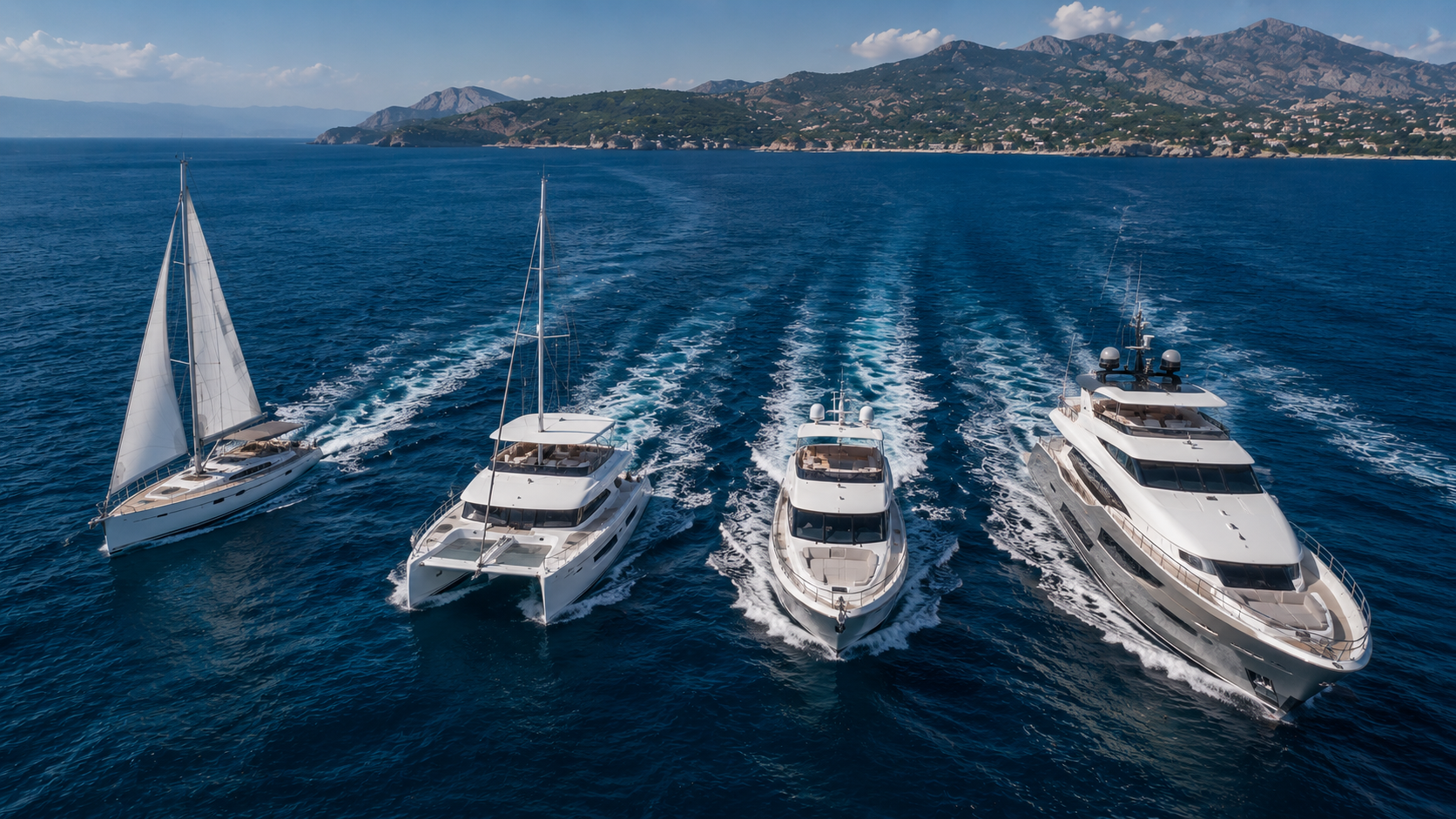
Conversely, monohull sailing yachts attract purists drawn to the romance of the sea, offering unparalleled bluewater capability, kinetic engagement, and vastly superior fuel efficiency for global navigation. The catamaran, however, has experienced an explosive surge in popularity across all budgets. By offering immense lateral stability, shallow drafts for secluded anchorages, and sprawling, single-level living spaces, catamarans have become the ultimate platform for families and charter guests who prioritize comfort, social areas, and panoramic views over windward sailing performance.
Strategic Acquisition: Lifestyle Asset Versus Investment Strategy
Modern yacht buyers must clearly define their underlying financial philosophy before initiating a search: is the vessel purely a lifestyle asset, or does it form part of a broader investment and yield-generating strategy? Purchasing a yacht as a lifestyle asset is an investment in quality of life, family bonding, and absolute freedom. In this scenario, the owner accepts the inherent depreciation and operational costs as the price of unrestricted, spontaneous access to the water.
Alternatively, purchasing with a charter strategy transforms the yacht into a performing asset. By committing the vessel to a professional charter management program for ten to fifteen weeks during the peak Mediterranean or Caribbean seasons, owners can generate substantial revenue that aggressively offsets annual maintenance, berthing, and insurance liabilities. This approach requires treating the yacht as a business entity, prioritizing layouts, cabin counts, and standard amenities that appeal to the charter demographic over highly personalized, idiosyncratic designs.
Navigating Ownership Structures: Private vs. Commercial Registration
The operational reality of a yacht is inextricably linked to its legal ownership structure. Private registration is the most straightforward pathway, offering the ultimate luxury of unrestricted personal use. A privately registered vessel is free from the burdensome regulatory oversight required for commercial operations, simplifying insurance, crewing, and administrative compliance.
However, commercial registration is mandatory for any owner intending to generate charter revenue. Operating a commercial yacht introduces rigorous compliance with international maritime coding systems (such as the MCA), demanding higher specifications for safety equipment, mandatory operational procedures, and strict adherence to crew qualification standards. While establishing a commercial structure via a Special Purpose Vehicle (SPV) involves upfront legal complexity and ongoing administrative costs, it frequently unlocks vital tax efficiencies, including the potential mitigation of VAT on the hull and subsequent operational expenditures. Long-term planning considerations must weigh these regulatory demands against the projected charter income to ensure the structure remains viable.
The Reality of Operating Costs and Lifecycle Maintenance
A hallmark of successful yacht ownership is a profound understanding of long-term operational costs, which extend far beyond the initial purchase price. Financial unpreparedness regarding maintenance is the leading cause of owner dissatisfaction. Marina availability and berthing fees represent a substantial fixed cost, particularly in high-demand regions like the French Riviera, the Balearic Islands, or the Amalfi Coast, where slips are both scarce and priced at a premium. Insurance considerations are equally critical, with premiums influenced by the vessel's age, cruising grounds, and the owner's maritime resume.
Beyond fixed costs, owners must implement a preventative maintenance lifecycle. This involves budgeting for cyclical, capital-intensive upgrades, such as the complete overhaul of marine diesels, the replacement of standing rigging every decade, updating obsolete navigation suites, and managing periodic antifouling and hull treatments. Equipment replacement cycles must be anticipated rather than handled reactively. Strategic owners amortize these costs annually, viewing them not as sudden financial shocks, but as the essential cost of preserving the asset’s value and ensuring paramount safety at sea.
Moreover, many successful owners choose to reframe the concept of ongoing maintenance. Rather than viewing technical upgrades and periodic refits purely as depreciating expenses, they recognize them as strategic investments that actively preserve the vessel's capital value. Engaging in a comprehensive refit—whether upgrading the interior aesthetics, installing state-of-the-art navigation electronics, or replacing decking—not only improves reliability and onboard enjoyment but drastically enhances the yacht's future marketability. A meticulously maintained vessel with a documented history of professional refits will always command a premium on the secondary market.
Jurisdiction and Compliance: Registration, Flag Selection, and VAT
The legal and financial footprint of a yacht is largely determined by its flag state and its Value Added Tax (VAT) status. Flag selection is a highly strategic decision that dictates the maritime laws governing the vessel, the nationality requirements for the crew, and the ease of navigating international waters. Jurisdictions such as Malta, the Cayman Islands, the Marshall Islands, and Delaware are frequently utilized for their favorable legal frameworks, robust maritime registries, and corporate flexibility.
Concurrently, European VAT presents a formidable landscape of regulations. Whether a yacht is VAT-paid, VAT-not-paid, or operating under a temporary admission regime fundamentally impacts where the vessel can cruise within European waters, the duration of its stay, and its ultimate resale value. Making incorrect assumptions about tax compliance can significantly affect future operations and severely hinder resale opportunities. Navigating these international ownership structures requires specialized legal counsel to prevent punitive tax liabilities or the impounding of the vessel by local customs authorities.
Protecting the Investment: Surveys, Sea Trials, and Due Diligence
No yacht acquisition, regardless of the budget or the impeccable reputation of the shipyard, should ever proceed without an exhaustive program of technical due diligence. Engaging an independent, accredited marine surveyor is the ultimate safeguard against acquiring a compromised asset. A comprehensive pre-purchase survey extends far beyond a visual inspection; it mandates a haul-out to assess the hull's integrity below the waterline, moisture readings to detect latent osmosis, ultrasonic testing of metal thicknesses, and the drawing of fluid samples for laboratory oil analysis to determine the internal health of engines and generators.
This technical scrutiny culminates in rigorous sea trials, where the vessel’s systems are tested under maximum load to verify performance metrics, thermal stability, and structural acoustics. The findings from this due diligence not only protect the buyer from inheriting catastrophic technical failures and unexpected future costs but also serve as a critical instrument for negotiating final price adjustments or mandatory pre-delivery repairs.
The Hidden Market: Confidential Sales and Off-Market Transactions
A significant and highly lucrative segment of the global yacht market operates entirely out of the public eye. Off-market transactions—also known as confidential or "whisper" sales—involve high-quality vessels that are actively for sale but deliberately withheld from public brokerage portals, print magazines, or social media. Owners opt for off-market strategies for a myriad of reasons: to maintain absolute corporate or personal privacy, to avoid alerting financial markets, or to prevent the devaluation of a specific vessel model by flooding the market with public listings. Accessing this shadow inventory is impossible for an unrepresented buyer. It requires retaining an entrenched, exceptionally well-connected international broker who possesses the industry intelligence and the trusted network necessary to source these hidden assets, providing buyers with exclusive access to premium opportunities before they ever reach the open market.
The Role of International Brokerage in Modern Acquisitions
The complexities detailed above underscore why a premium yacht acquisition is rarely executed independently. Modern international yacht brokerage goes far beyond the mere matching of buyers with inventory. An elite broker serves as a fiduciary advocate, a master negotiator, and a project manager who orchestrates the entire lifecycle of the transaction. Their expertise is deployed to analyze historical sales data to ensure the buyer never overpays, to draft ironclad purchase agreements that protect the buyer's capital during escrow, and to navigate the labyrinth of international title transfers and deletion certificates across competing global jurisdictions. Transaction management requires meticulous documentation review to verify the validity of historical ownership chains and tax certifications. By leveraging a worldwide network, professional brokers grant their clients total global market access, ensuring the search is dictated by the precise needs of the client, rather than the limitations of local geography.
Conclusion
The dream of commanding your own vessel across the world’s oceans or coastal waters is more attainable today than at any point in maritime history. The transition from aspiring enthusiast to successful owner is achieved not by focusing myopically on the lowest purchase price, but by adopting a comprehensive, strategic approach. True success in yacht acquisition is defined by perfectly aligning your available budget with the appropriate vessel architecture, establishing a robust and tax-efficient ownership structure, and planning meticulously for the vessel's long-term operational lifecycle. Whether acquiring a modestly priced coastal cruiser or a magnificent ocean-going luxury vessel, the water makes no distinction regarding the price tag of the hull that rides upon it.
In addition to brokerage opportunities available on the international market, buyers today can choose between both new-build yachts and pre-owned vessels depending on their budget, delivery timeline, and ownership objectives. While some owners prefer the customization, warranty protection, and latest technologies offered by a new yacht, others prioritize the value, immediate availability, and larger vessel options often found within the brokerage market.
Through its international broker network, industry partnerships, shipyard relationships, and access to both public and confidential off-market opportunities, Master Ocean assists clients in sourcing motor yachts, sailing yachts, catamarans, luxury yachts, boats, tenders, commercial vessels, and custom yacht construction projects worldwide. Whether a client is searching for a yacht within a €50,000 budget or pursuing a significantly larger acquisition, suitable opportunities can often be identified through professional market access, negotiation expertise, and global industry connections. From entry-level boats and family cruisers to luxury yachts, new-build projects, and confidential off-market transactions, Master Ocean acts as a trusted partner, supporting clients throughout the entire acquisition process worldwide.