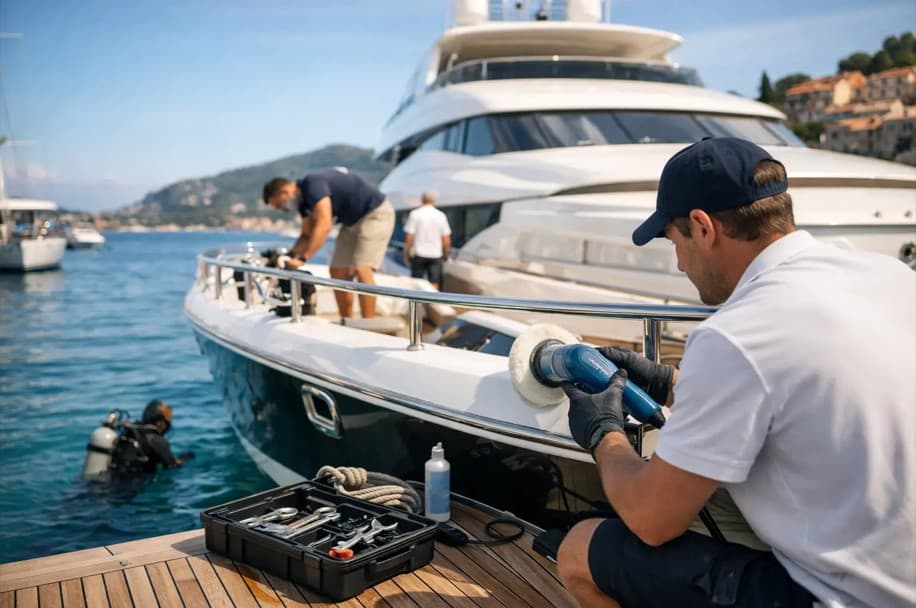
A yacht rarely shows early neglect in dramatic ways. More often, it appears in small signals - a finish that no longer presents sharply at the quay, systems that begin to underperform under load, or service records that raise questions during a sale or charter review. That is why yacht maintenance services are not a background expense for serious owners. They are a core part of protecting asset value, preserving onboard reliability, and maintaining the standard expected of a premium vessel.
For private owners, family offices, charter operators, and investors, maintenance is where operational discipline meets brand-level presentation. A yacht may be designed for luxury, but ownership outcomes are shaped by care, timing, and the quality of technical oversight behind the scenes.
What yacht maintenance services really cover
The phrase is often reduced to cleaning and routine engine checks, but professional yacht maintenance services are broader than that. They typically include technical inspections, preventive servicing, seasonal preparation, detailing, hull and paint care, machinery support, safety equipment checks, electrical and plumbing review, refit coordination, class and compliance support where relevant, and follow-up documentation.
On a well-managed vessel, these services are scheduled rather than improvised. The goal is not only to fix visible problems. It is to identify wear patterns before they disrupt a season, a charter schedule, or a sale process.
This is where owners often see the difference between casual support and a full-service maintenance structure. One reacts to issues after they surface. The other manages the yacht as a moving asset with technical, cosmetic, and operational priorities that need coordination.
Why yacht maintenance services matter beyond appearance
Presentation matters in yachting, especially in high-visibility destinations and premium charter markets, but appearance is only one part of the equation. The deeper value of maintenance lies in continuity. Mechanical reliability, system efficiency, guest comfort, and resale confidence all depend on how consistently the vessel has been cared for.
A yacht with irregular maintenance may still look impressive for a time. Yet deferred servicing has a way of surfacing at the least convenient moment - during peak season, before an owner trip, during survey, or when charter guests are already onboard. In those situations, the issue is not just repair cost. It is disruption, reputation, and avoidable pressure on owners and crew.
For resale, buyers and brokers pay close attention to maintenance history. A yacht with organized service documentation and evidence of professional oversight usually inspires stronger confidence than one with uncertain records, even when both appear similar on first inspection. In practical terms, maintenance supports value retention because it reduces doubt.
Preventive care is where value is protected
The most effective yacht maintenance services are preventive by design. That means service intervals are based on operating hours, manufacturer guidance, environmental exposure, and the vessel's actual use profile. A yacht based in the Mediterranean for an active summer season will not have the same maintenance rhythm as a vessel moving between the Caribbean and the UAE with charter utilization in play.
It also means understanding that not every system ages at the same pace. Exterior finishes may show UV and salt exposure quickly, while internal systems can decline more quietly through vibration, moisture, or irregular load cycles. A proper maintenance plan accounts for both the visible and the hidden.
This is one of the most common ownership mistakes in the upper market. Owners assume a yacht that is used less requires minimal oversight. In reality, inactivity can be just as hard on certain systems as heavy use. Batteries, seals, pumps, air conditioning units, and water systems can all suffer when a vessel sits for long periods without active management.
The core areas every serious maintenance plan should address
A refined maintenance program usually begins with machinery and propulsion, because engine health, generators, drive systems, and associated components are central to safety and performance. That said, a yacht's onboard experience depends just as much on secondary systems. Climate control, watermakers, navigation electronics, lighting, entertainment infrastructure, and galley equipment all affect how the vessel functions in real conditions.
Exterior care deserves equal attention. Gelcoat, paint, teak, stainless steel, and glass surfaces require specialized treatment if the yacht is expected to present at a premium standard. Detailing is not simply aesthetic upkeep. It helps preserve materials that are expensive to restore once deterioration becomes advanced.
Interior maintenance follows a similar principle. Upholstery, fine woodwork, stone, carpeting, and custom finishes need controlled cleaning and preservation methods. On luxury vessels, improper treatment can create damage that is more costly than neglect itself.
Then there is safety and compliance. Depending on the yacht's flag, class status, operational profile, and cruising area, service schedules may need to align with inspection requirements, equipment certification, and operational documentation. Owners do not always need to manage this directly, but they do benefit from having a team that does.
Choosing between ad hoc support and managed yacht maintenance services
Some owners prefer to arrange service tasks individually through local contractors in each destination. That approach can work for smaller ownership structures or vessels with limited movement. It may also seem efficient when the immediate need is straightforward.
The trade-off is consistency. Different contractors may apply different standards, documentation may become fragmented, and no single party may be tracking the yacht's long-term service picture. That can lead to duplicated work in one area and overlooked issues in another.
Managed yacht maintenance services provide a more centralized model. Service intervals are monitored, vendors are coordinated, records are maintained, and maintenance priorities are evaluated within the context of the yacht's overall operating plan. For owners with busy schedules or globally mobile vessels, that level of oversight is often more valuable than arranging tasks one by one.
This does not mean every yacht requires a large management structure. It depends on size, usage, crew profile, and owner expectations. A privately used day yacht has different needs than a charter-focused motor yacht or a superyacht moving between multiple regions. The key is fit, not excess.
Seasonal planning makes a noticeable difference
Many costly service events are less about the complexity of the issue and more about poor timing. Seasonal planning reduces that risk. Before a major cruising period, the yacht should be reviewed with enough lead time to address parts sourcing, yard availability, and technical sequencing.
This matters especially in high-demand markets such as Monaco, Miami, or the French Riviera, where service capacity can tighten quickly during active periods. Waiting until the yacht is needed often narrows options and increases pressure on both price and scheduling.
Off-season periods are usually the right time for more involved works, whether that means cosmetic correction, equipment replacement, survey preparation, or refit coordination. A yacht that enters the season fully prepared performs better operationally and presents better commercially.
Documentation is part of the service
A premium vessel should have a maintenance record that is clear, current, and easy to review. This is not just an administrative preference. Documentation supports warranty discussions, survey preparation, insurance communication, resale positioning, and continuity when crew or service providers change.
Well-kept records also help identify recurring issues. If a component is repeatedly serviced without lasting resolution, the problem may be diagnostic rather than routine. Without documentation, those patterns are easy to miss.
For owners considering future sale or charter activity, records become even more important. Buyers and charter stakeholders look for evidence that the yacht has been professionally managed, not just occasionally serviced.
What to look for in a maintenance partner
The right provider should understand more than technical tasks. They should understand yacht operations, owner expectations, scheduling realities, presentation standards, and the importance of discretion. Technical skill is essential, but coordination is what turns individual service actions into a reliable ownership experience.
That includes transparent reporting, realistic timelines, access to trusted specialist networks, and the ability to manage work across multiple locations when needed. For internationally active owners, global coordination is often where true service quality becomes visible. A premium support structure should be able to adapt whether the yacht is in Antibes, Dubai, Fort Lauderdale, or preparing for a Mediterranean season.
Master Ocean operates in that full-service space, where maintenance, management, operational support, and broader yacht services are handled with the same expectation of quality clients bring to brokerage and charter decisions.
A well-maintained yacht does more than avoid problems. It holds its standard, protects its market position, and remains ready for the experiences it was acquired to deliver. The best time to invest in that outcome is before the yacht asks for it.