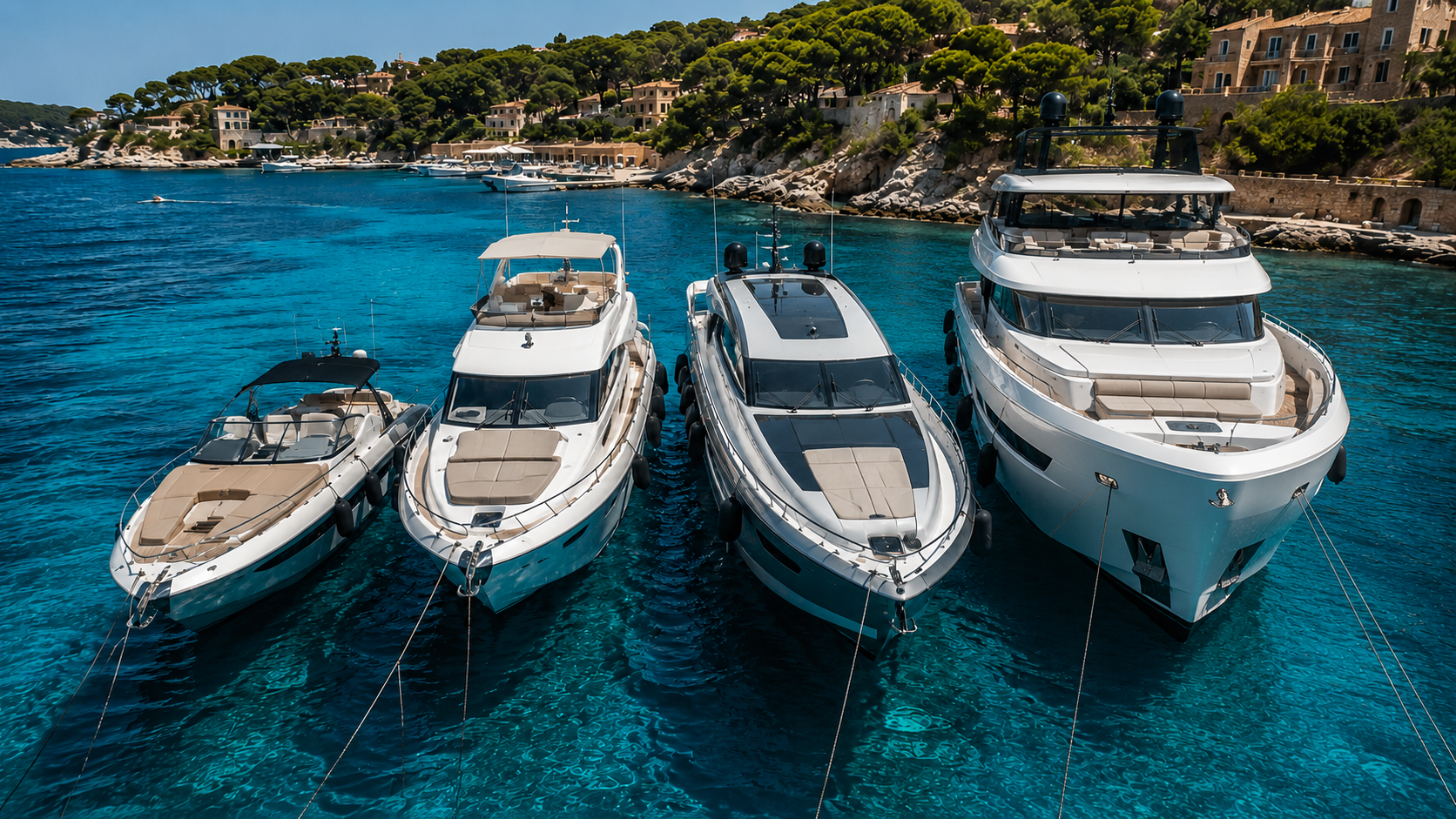
Motor Yachts for Sale: The Complete Guide to Buying, Registering, Owning and Operating a Motor Yacht Worldwide
Discover motor yachts for sale worldwide, from family cruising yachts and flybridge models to luxury motor yachts and superyachts. Explore new and pre-owned vessels with expert guidance from Master Ocean. Access selected public listings, private opportunities, professional brokerage services, yacht management support and confidential off-market motor yacht transactions worldwide.
Introduction
The motor yacht market stands as one of the most dynamic, high-value segments of the global luxury asset economy. Regardless of macroeconomic shifts, the desire for bespoke maritime freedom ensures that motor yachts remain highly liquid and intensely sought after by high-net-worth individuals (HNWIs) and institutions globally. Far from being simple recreational vessels, modern motor yachts have evolved into private floating sanctuaries, self-sustaining remote estates, high-security mobile executive offices, and sophisticated corporate assets.
Understanding the demographic profile of a motor yacht owner is essential to mapping the right asset to the correct operational framework:
• Private Owners and Family Cruising: For individuals seeking total liberation from commercial constraints. These vessels act as multigenerational retreats where security, privacy, and curated family experiences are paramount. Advanced gyroscopic and fin stabilization systems ensure comfort, while sprawling beach clubs and wellness decks redefine coastal living.
• Corporate and Hospitality Platforms: Large motor yachts provide an unmatchable environment for ultra-exclusive corporate hospitality, high-stakes board meetings, and discreet diplomatic or business negotiations well away from public scrutiny.
• Wealth Preservation and Strategic Investment: While yachts are traditionally depreciating lifestyle assets, highly calculated acquisitions of premium hulls from elite shipyards act as excellent vessels for capital preservation, enjoying reliable residual value on the secondary market.
• Commercial Operations and Charter Businesses: Transforming a multi-million-euro yacht into a high-yielding charter enterprise allows owners to offset significant operational overheads, exploit major structural tax advantages, and run a fully optimized maritime business.
What Is a Motor Yacht?
A motor yacht is a luxury vessel propelled exclusively by mechanical propulsion systems—traditionally high-horsepower marine diesel engines, and increasingly modern diesel-electric hybrid configurations—engineered specifically for recreational or commercial pleasure voyages, offering residential-grade luxury and advanced autonomous cruising capabilities.
• Compared to Sailing Yachts: Motor yachts do not rely on wind or complex sail-handling rigging, which dramatically lowers the barrier to entry for owner-operators and guest comfort. More importantly, for identical overall lengths (LOA), a motor yacht delivers an exponentially higher internal volume, measured in Gross Tonnage (GT). This volume translates directly to massive full-beam owner suites, multi-deck saloons, tender garages, and extensive crew quarters. Furthermore, their shallower drafts allow them to enter pristine, shallow anchorages completely inaccessible to deep-keeled sailing vessels.
• Compared to Catamarans: While multihulls have gained traction for their stability and beam width, a classic monohull motor yacht retains an unyielding dominance in prestige, aesthetic elegance, and absolute speed. A monohull cuts through heavy head seas with superior dynamic comfort and occupies a single standard berth. Conversely, catamarans face intense logistical resistance in premium Mediterranean marinas, where double-width berths are scarce and command astronomical surcharges.
• Compared to Explorer Yachts: True explorer yachts (expedition vessels) feature heavy displacement hulls—frequently constructed from high-tensile steel with ice-class reinforcement—and boast transoceanic ranges exceeding 4,000 to 6,000 nautical miles. Standard motor yachts utilize planing or semi-displacement fiberglass (GRP) hulls optimized for rapid, luxurious coastal cruising and island hopping across areas like the French Riviera, the Balearics, or the Florida Keys.
• Compared to Superyachts: In maritime law and international conventions (such as the MCA codes), the boundary line for a superyacht typically begins at a load line length of 24 meters, or an overall length (LOA) exceeding 30 meters. Crossing this threshold shifts the vessel into a highly regulated operational ecosystem, demanding formal flag state compliance, classification society oversight (e.g., Lloyd's Register, RINA, ABS), and a permanent roster of highly certified professional maritime crew.
Main Types of Motor Yachts
Selecting the right structural blueprint dictates how you experience the water, your operational costs, and your cruising geography:
• Sports Yachts (Open / Sportfly): Designed for owners who prioritize adrenaline, speed, and aggressive, low-profile design. These vessels feature high-performance propulsion systems (frequently coupled to surface drives or IPS pods) capable of speeds exceeding 35 to 40 knots. They are characterized by seamless indoor-outdoor living spaces, large sunpads, and retracting glass roofs.
• Flybridge Yachts: The undisputed cornerstone of the luxury yacht market. By integrating a permanent upper deck, these designs effectively double the exterior living area without increasing the vessel's marina footprint. The flybridge acts as an elevated secondary helm station, alfresco dining saloon, and sun lounging deck.
• Coupe Yachts (Hardtop): Sleek, sporty, and exceptionally climate-flexible. Coupe designs feature an enclosed main deck saloon protected by a rigid hardtop, making them ideal for regions with volatile weather or intense heat where high-capacity HVAC systems must keep the living spaces perfectly cooled.
• Trawler Yachts: Designed for the patient long-distance cruiser. These full-displacement or semi-displacement vessels prioritize extreme fuel efficiency, immense storage capacity, and traditional, rugged seaworthiness over raw speed. They crawl comfortably at 8 to 12 knots but consume a fraction of the fuel used by planing hulls.
• Explorer Yachts: A fusion of commercial-grade oceanic engineering and five-star luxury. They feature ultra-thick plating, long-range tankage, high bows to deflect heavy seas, and massive open aft decks engineered to carry large tenders, submersibles, helicopters, and heavy water-sports equipment.
• Long Range Cruisers: The bridge between a traditional trawler and a luxury flybridge. They offer semi-displacement capabilities, allowing owners to cruise economically at low speeds across vast distances, yet retain the power to plane at 20+ knots when trying to outrun an incoming weather front.
• Luxury Motor Yachts: Semi-custom vessels ranging from 20 to 30 meters. These yachts offer bespoke interior architecture, high-end materials (such as hand-selected marbles and custom leathers), and a structural layout that strictly separates guest circulation from crew working corridors to guarantee uncompromised service and privacy.
• Semi-Custom Motor Yachts: Built on pre-engineered, proven hull platforms from prestigious shipyards, allowing the buyer to radically customize interior layouts, non-structural bulkheads, engine packages, and decorative finishes, shaving years off the delivery timeline of a pure custom build.
• Custom Motor Yachts: Pure bespoke creations where the owner brings their own naval architect and interior designer. Every structural line, engineering choice, and luxury amenity is built from scratch, usually restricted to vessels starting at 40 meters and requiring a dedicated build-management team over a multi-year construction cycle.
Market Segments & Best Motor Yacht Brands
The global motor yacht market is strictly stratified by budget, build quality, and operational complexity. Navigating these tiers requires deep asset valuation intelligence.
Entry Level Motor Yachts (€50,000 – €500,000)
This segment is dominated by production volume dayboats, cabin cruisers, and weekenders up to 15 meters. These vessels are designed primarily for owner-operators who navigate without professional crew and store the boat on a trailer or dry-stack facility during winter.
• Primary Brands: Beneteau (Swift Trawler / Gran Turismo series), Jeanneau (Leader / NC lines), Bavaria, Galeon (renowned for innovative "transformer" drop-down balconies), and Quicksilver.
Premium Segment (€500,000 – €2,000,000)
Encompassing production and semi-custom vessels from 15 to 20 meters. These yachts feature sophisticated multi-cabin layouts, advanced engineering spaces, complex electrical grids, and frequently require either a permanent skipper or a highly experienced owner-operator.
• Primary Brands: Prestige Yachts, Absolute (leaders in maximizing interior volume via vertical bows), Princess Yachts, Sunseeker International, Fairline, and Azimut Yachts.
Luxury Segment (€2,000,000 – €5,000,000+)
This elite category consists of vessels over 20 meters up to superyacht scale. These yachts are built with high-grade composites, feature complex stabilization tech (gyro and fin arrays), independent crew quarters with dedicated mess areas, and require a professional maritime crew to maintain warranty and insurance compliance.
• Primary Brands: Ferretti Yachts, Sanlorenzo (highly prized for architectural minimalism and bespoke configurations), Riva (the ultimate icon of Italian luxury and jet-set style), Pershing (high-speed, gas-turbine/surface-drive rockets), Mangusta (over-engineered open and maxi-yachts), and Custom Line.
Which motor yacht brands hold their value best?
Capital preservation on the secondary market depends entirely on the pedigree of the builder. Shipyards that strictly control their annual production volume and maintain unwavering quality standards insulate their buyers from aggressive asset depreciation.
Historically, Riva commands an almost cult-like premium on the secondary market due to its timeless design heritage and brand status. Sanlorenzo exhibits exceptional value retention because every vessel is semi-custom, preventing the market saturation common to high-volume production builders. In the British production market, Princess Yachts consistently outperforms its direct competitors in residual value due to its exceptional build consistency, rigorous in-house manufacturing, and a highly active, globally standardized brokerage network that ensures secondary market buyers feel secure.
New Motor Yacht vs Used Motor Yacht
The strategic choice between commissioning a new shipyard build or acquiring a brokerage vessel dictates your immediate capital outlay, tax posture, and operational deployment timeline.
Advantages of a New Yacht
• Bespoke Tailoring: The owner controls the narrative from day one—selecting wood veneers, stone accents, AV packages, and specific layouts tailored to their family or charter goals.
• Warranty Insulation: Backed by a comprehensive manufacturer's warranty (typically 2 years for all systems, and up to 5 to 10 years for structural hull integrity), minimizing unpredictable maintenance spikes in early ownership.
• Technological Superiority: Delivery with zero-hours engines compliant with the latest environmental mandates (IMO Tier III), next-generation navigation displays, and highly efficient hull forms.
• Clean Legal Provenance: Zero risk of historic maritime liens, undisclosed groundings, or complex cross-border ownership tax disputes.
Advantages of a Used Yacht
• Immediate Deployment: Avoids the standard 12-to-36-month shipyard build backlog. A brokerage transaction can close in 30 days, putting the owner on the water for the upcoming season.
• Depreciation Shield: The initial owner absorbs the brutal asset write-off. Buyers of 3-to-5-year-old brokerage vessels step into the asset at a stabilized market price point.
• System Stabilization: New builds invariably suffer from initial teething issues ("snags"). A well-maintained used yacht has already had these system integration bugs ironed out by a professional crew.
• Substantial Negotiating Margin: Brokerage pricing is flexible, subject to market conditions, seller motivation, and survey findings, offering savvy buyers significant arbitrage opportunities.
Depreciation & Resale Value Dynamics
A factory-new production motor yacht suffers a swift depreciation hit of 15% to 25% within its first 12 to 18 months of water immersion. Between years 2 and 5, the depreciation curve flattens significantly to roughly 5% to 7% per annum, contingent upon pristine maintenance logs. When a premium yacht reaches its 5th year, its market value stabilizes, tracking macro-economic replacement costs and inflation.
Hidden Costs Exposed
Buyers of new vessels frequently overlook "outfitting capital expenditure"—shipyards deliver boats surprisingly bare, requiring an additional 5% to 10% investment in tenders, water toys, loose exterior furniture, custom linens, safety gear, and custom galley ware. Conversely, used yacht buyers face immediate capital expenditure for mandatory technical updates: replacing outdated navigation electronics, upgrading old satellite communications to modern high-speed arrays, and performing major overhauls on high-hour engines or generators.
Resale Strategy Before You Buy
Experienced buyers always think about the exit strategy before signing the purchase agreement. Buying a yacht without a clear path to resale is one of the most common ways to lock up capital in an illiquid asset.
• Brand Dominance Matters: Mainstream premium and luxury brands (such as Princess, Sunseeker, Sanlorenzo, and Azimut) have built massive international broker networks. A secondary market buyer in Florida or Asia is far more likely to buy a recognized global brand than a niche regional build.
• The Liquidity Sweet Spot: Motor yachts between 15 and 24 meters represent the most active secondary market. Vessels in this size bracket can still operate with a minimal crew (or as owner-operators), keeping operational expenses attractive for the next buyer.
• Market-Preferred Flags: Keeping your vessel registered under an internationally white-listed flag (e.g., Cayman Islands, Malta, Marshall Islands) signals to prospective buyers that the yacht has been held to high regulatory and technical standards.
• The Power of Service Logs: A yacht with spotty maintenance records can face a 20% to 30% discount on the market. Continuous, stamped service history logs from authorized engine dealers (MAN, MTU, Volvo Penta) are non-negotiable for preserving residual asset value.
The Real Cost of Yacht Ownership (OPEX)
The structural underestimation of annual Operational Expenditure (OPEX) is the single most common cause of premature asset liquidation. A prospective owner must operate under the institutional assumption that running a luxury motor yacht demands a baseline annual budget equivalent to 10% of the vessel's initial capital value.
Operational Cost Breakdown
• Marina Berths: The cost of real estate on the water. Premium Mediterranean and Caribbean marinas charge by total square meters (LOA × Beam) per day, with seasonal premiums. A home-port lease in a tier-one marina (e.g., Ibiza Magna, Port de Cannes, Porto Cervo) represents a significant line item, with transient summer night rates scaling to thousands of euros for larger hulls.
• Fuel Consumption: Planing hulls equipped with high-horsepower diesel engines run highly intensive fuel-burn profiles. At cruising speeds, a twin-engine 24-meter yacht can easily consume 300 to 500 liters of marine gas oil (MGO) per hour. Running generators 24/7 to sustain climate control adds to this baseline.
• Hull & Machinery (H&M) and Protection & Indemnity (P&I) Insurance: Premium underwriter coverage mandates a comprehensive risk profile assessment. Expect annual premiums to hover between 1% and 1.5% of the hull value, escalating if the vessel engages in commercial chartering or crosses high-risk hurricane zones.
• Technical Maintenance and Systems Servicing: Routine operational servicing of main engines, gearboxes, generators, watermakers, black-water treatment plants, and air conditioning compressors. This includes a mandatory annual haul-out for pressure washing, zinc sacrificial anode replacement, and high-grade antifouling hull paint application.
• Crew Remuneration and Logistics: For luxury vessels, professional crewing is the single largest OPEX category. This includes competitive monthly base salaries for a licensed Captain, qualified engineers, deckhands, and interior stews, supplemented by mandatory maritime health insurance, uniform provisioning, crew training, and employment taxes.
• Winterization and Dry Storage: In seasonal markets like the Mediterranean, yachts are either winterized in-water with reduced crew operations or hauled out into dry shipyards, where shrink-wrapping and climate-controlled storage shield components from winter degradation.
• Safety Inspections and Compliance: Flag state and classification society mandates require annual re-certification of all safety equipment, including multi-person life rafts, hydrostatic release units (HRUs), automated fire suppression systems, lifejackets, and emergency beacons (EPIRBs).
Marina Berths and Availability in Europe
The global expansion of the luxury motor yacht fleet has triggered an acute, structural shortage of premium marina berths across Europe’s primary cruising hubs. Owning a yacht without a secured, guaranteed berth is a high-risk operational error.
• France and Monaco (The Western Mediterranean Center): The absolute epicentre of logistical pressure. Marinas such as Port Vauban (Antibes)—historically the largest yachting port in Europe—Port de Cannes, Nice, and the Port of Monaco operate at maximum capacity. Long-term berth leases (amodiations) are virtually unobtainable on the open market, forcing owners into highly competitive transient rental markets where summer peak rates are premium. Securing a berth here requires deep institutional brokerage connections.
• Italy (The Glamour Coastline): The Italian Riviera and the Tyrrhenian Sea present severe capacity constraints during the summer months. Marinas such as Portofino (offering only a handful of superyacht berths), Porto Cervo (Sardinia), and Marina di Capri command astronomical night rates. Savvy owners utilize the exceptional, ultra-modern networks of continental Tuscany and Liguria (e.g., Sanremo, Mirabello, Porto di Livorno) as strategic long-term home ports, executing short, targeted runs to the islands.
• Spain (The Hub of the Balearics): Palma de Mallorca stands as a global superpower for year-round yacht infrastructure, refit yards, and berthing, but its marinas are highly saturated. Ibiza Magna and Marina Ibiza cater to the ultra-high-net-worth crowd, with berth values mirroring the world's most expensive real estate. On the mainland, OneOcean Port Vell (Barcelona) has emerged as a premier, deep-water mega-yacht haven offering exceptional security and winterization facilities.
• Croatia and Montenegro (The Adriatic Rise): Croatia boasts a highly organized, government-backed infrastructure network through ACI Marinas, offering reliable shelter for vessels up to 25 meters, though large superyacht berths remain rare. Neighboring Montenegro solved this by building Porto Montenegro (Tivat)—a state-of-the-art, deep-water luxury home port outside the EU customs zone. It offers duty-free, tax-free fuel, long-term berth investments up to 30 years, and elite crew amenities, making it a key strategic hub in the region.
• Greece and Malta (The Central Crossroads): Greece offers an expansive maritime landscape, but luxury marina infrastructure remains underdeveloped outside of Athens (Flisvos Marina, Zeas). Most Greek islands rely on public town quays with limited power and water hookups, demanding highly self-sufficient yachts. Malta, via Grand Harbour Marina, provides exceptional deep-water berths enclosed within historic fortifications, serving as the perfect, high-security pitstop for vessels transitioning between the Eastern and Western Mediterranean.
Private Ownership vs Commercial Ownership
The structural destination of your motor yacht is dictated by a critical operational choice: Will the asset be operated strictly for private pleasure or structured as a commercial charter enterprise? This fundamental decision weighs heavily on an owner's priorities regarding operational freedom versus financial mitigation.
Private registration guarantees maximum privacy, simplified safety regimes, flexible crewing requirements, and 100% owner autonomy, but it comes with absolute asset liability and no pathway for tax recovery. Conversely, commercial registration unlocks title VAT deferral or exemption, provides access to duty-free fuel, and allows for significant charter income generation, but it subjects the vessel to strict technical survey audits and mandates commercially licensed crew.
Private Yacht Registration
Private registration is the ultimate expression of luxury independence. The owner enjoys absolute autonomy over the vessel’s itinerary, guest list, and operational schedule.
• Pros: Minimal regulatory interference. The vessel is exempt from aggressive port state control inspections, commercial safety code audits, and strict manning level mandates. Crew hiring criteria are highly flexible, focusing on personal chemistry rather than commercial licenses.
• Cons: The owner assumes 100% of the operational financial burden. There are zero paths to reclaiming or mitigating input VAT on the hull purchase, fuel, or supplies within the European Union. Legally, a private yacht is strictly prohibited from accepting any form of financial compensation or charter fee for guest accommodation.
Commercial Yacht Registration
Structuring the yacht as a commercial entity transforms a luxury asset into an active business enterprise registered to conduct commercial charters.
• Pros: Significant fiscal insulation. In the EU, a commercial yacht can be imported with a formal deferral or outright exemption from the multi-million-euro import VAT. Furthermore, all operational goods, shipyard refits, spare parts, and marine gas oil (MGO) can be purchased completely duty-free and tax-free.
• Cons: The regulatory burden escalates exponentially. The vessel must be built and continuously maintained to strict commercial safety codes (such as the UK Maritime and Coastguard Agency - MCA Large Yacht Code). It is subject to random, aggressive technical audits by Port State Control. The crew must hold STCW commercial endorsements, and the owner’s personal use of the yacht is legally constrained; the owner must formally lease their own vessel via a standard charter agreement (e.g., MYBA terms) and pay the prevailing local VAT rate on that charter to maintain commercial integrity.
Yacht Ownership Structures & Buying Through a Company
Holding a motor yacht in an individual’s personal name is a severe legal and financial vulnerability. Sophisticated yacht acquisitions utilize bespoke corporate holding structures to shield wealth, preserve privacy, and optimize global tax exposures.
Personal Ownership (The Direct Asset Trap)
Registering a high-value motor yacht directly to a physical individual exposes that person to direct, unshielded maritime liability. If the vessel is involved in a catastrophic environmental spill, collision, or guest injury, the owner’s entire global asset portfolio can be targeted in maritime litigation. Furthermore, personal ownership offers zero operational anonymity, exposing the owner's identity on open-source public ship registries.
Company Ownership (The Standard Corporate Shield)
The baseline international standard involves incorporating a corporate entity—typically a Limited Liability Company (LLC) or International Business Company (IBC)—whose sole purpose is the legal ownership and operation of the yacht.
• Corporate Jurisdictions: Wildly popular vehicles include Delaware LLCs (for US and non-EU operations), UK Limited Companies (highly favored for clean banking rails), and Maltese companies.
• The Transactional Arbitrage: When a yacht is held inside a clean, dedicated single-asset company, a future sale of the vessel does not require a physical change of ownership on the ship registry. Instead, the buyer simply acquires the corporate shares of the holding company. This transaction occurs completely outside the jurisdiction of local tax authorities, bypassing asset transfer taxes, state sales taxes, and heavy administrative deletion/re-registration delays.
Offshore Ownership (The Special Purpose Vehicle - SPV)
For luxury assets operating globally across multiple customs zones, incorporating an offshore Special Purpose Vehicle (SPV) remains a vital strategy.
• Elite Jurisdictions: The Cayman Islands, British Virgin Islands (BVI), and Marshall Islands are the global gold standard.
• Strategic Deployment: An offshore SPV shields the Ultimate Beneficial Owner (UBO) from public visibility, provides a neutral legal framework recognized by all international marine banks, and allows the asset to seamlessly transition between international customs regimes under the umbrella of asset protection laws.
Family Office Integration
For ultra-high-net-worth individuals (UHNWIs), the yacht corporate structure is rarely standalone. It is woven into a multi-tiered asset allocation model managed by a Family Office. Here, the yacht-owning SPV is typically owned by a discretionary trust or a foundations structure. This layout insulates the yacht from personal inheritance disputes, wealth taxes, and marital dissolution assets, while ensuring seamless generational transition of the asset.
Beneficial Ownership Disclosure (The Transparancy Reality)
Modern yacht buyers must understand that the era of absolute, hidden corporate anonymity from global authorities is over. Under international Anti-Money Laundering (AML) and Common Reporting Standard (CRS) frameworks, banks, ship registries, and insurance underwriters are legally mandated to extract a clean, verifiable trail to the Ultimate Beneficial Owner (UBO). While this data is strictly insulated from public view, it must be completely transparent to financial institutions and maritime regulators during compliance vetting.
Best Countries for Yacht Ownership & Regional Specifics
The regulatory and fiscal landscape of yachting varies significantly by country. Selecting where your yacht is corporate-domiciled and where it physically operates dictates your overhead and legal peace of mind.
France (The Rigid Riviera)
• Fiscal Profile: Imposes a strict 20% VAT on hull importations and luxury services. French maritime authorities are famously aggressive in auditing yacht tax compliance along the Côte d'Azur.
• Commercial Advantages: Offers the French Commercial Exemption (FCE). If a commercial yacht satisfies the "70% rule" (meaning 70% of all its charter voyages cross outside French territorial waters into international or non-French zones), it is granted a 100% exemption from VAT on its hull purchase, shipyard maintenance, and fuel supplies.
• Infrastructure: Exceptional, world-class shipyards and technical sub-contractors stretching from La Ciotat to Monaco, though marina berth scarcity is severe.
Italy (The Dynamic Bureaucracy)
• Fiscal Profile: Standard marine VAT is set at 22%. Italy enforces rigid nautical laws, requiring meticulous onboard documentation, including formal crew stability logs and immediate declaration of cash assets.
• Commercial Advantages: Italy features a highly active, professional network of maritime agents who excel at structuring commercial charters. Italian commercial registrations allow structured VAT reductions for charters that navigate into international waters, though these algorithms face constant legislative updates.
• Infrastructure: The undeniable global capital of luxury motor yacht manufacturing (home to Azimut-Benetti, Sanlorenzo, Ferretti Group). Exceptional refit infrastructure exists in Viareggio, Livorno, and Genoa.
Spain (The High-Tax Paradigm Shift)
• Fiscal Profile: Historically feared as the most expensive European destination due to a dual-tax barrier: a 21% standard VAT combined with a localized 12% Matriculation Tax (Impuesto de Matriculación) levied on any vessel operating under the Spanish flag or owned by Spanish residents.
• Commercial Advantages: Significant modern liberalization. Spain formally eliminated the 12% Matriculation Tax for genuine commercial charter yachts over 14 meters. This has unlocked the Balearic Islands (Ibiza and Mallorca) into an explosive, highly profitable luxury charter market, operating under a standard 21% charter VAT rate.
• Infrastructure: STP Shipyard Palma is one of Europe’s premier open-refit facilities, allowing owners to bring their own technical contractors directly to the hardstand.
Malta (The Maritime Superpower)
• Fiscal Profile: Standard VAT is 18%, the lowest baseline among the major Mediterranean yachting nations. Malta has engineered a sophisticated, hyper-efficient maritime ecosystem backed by a pro-business corporate tax refund framework.
• Commercial Advantages: Malta does not levy withholding taxes, stamp duties, or capital gains on the operation or sale of registered yachts. Its Commercial Yacht Code provides clear, predictable legal rails for large yachts to claim input VAT exemptions on hull acquisition, provided the vessel is inserted into an active, verifiable commercial charter structure.
• Infrastructure: Highly secure deep-water marinas, extensive bunkering facilities, and an elite global reputation across international maritime courts.
Greece (The Complex Archipelago)
• Fiscal Profile: Enforces a 24% VAT. Greece features an incomparable island geography that acts as a natural magnet for charter clients, but its legal framework is highly protective of its domestic maritime industry.
• Commercial Advantages: The Greek charter market is immensely lucrative, but non-EU flagged vessels face severe cabotage restrictions, often barred from initiating and concluding charters within Greek waters unless they obtain a specific local commercial license and open a physical Greek tax branch.
• Infrastructure: Excellent natural anchorages, but modern mega-yacht marina slots are limited outside of Athens.
Croatia (The Charter Powerhouse)
• Fiscal Profile: Standard PDV (VAT) is 25%. However, for commercial charters initiated within Croatia, a reduced VAT rate of 13% applies to passenger accommodation, making it one of the most fiscally attractive rental zones in Europe.
• Commercial Advantages: Highly streamlined, digitized commercial charter reporting via the e-Navigator system. Any foreign commercial yacht can easily obtain a Croatian charter license by registering for a local VAT number.
• Infrastructure: A massive network of meticulously maintained marinas, though primarily tailored to vessels under 30 meters.
Montenegro (The Non-EU Sanctuary)
• Fiscal Profile: Sitting entirely outside the European Union customs territory, Montenegro has strategically positioned itself as a premier fiscal refuge.
• Commercial Advantages: Absolute zero-rated VAT on yacht purchases, bunkering, and supplies for foreign-owned vessels. Yachts can remain here indefinitely without triggering EU VAT clocks, and Porto Montenegro provides tax-free, duty-free marine gas oil (MGO), dropping fuel expenses by up to 40% compared to neighboring Italy or Croatia.
• Infrastructure: Home to world-class luxury marina facilities designed specifically to accommodate superyachts up to 250 meters.
United States (The Capitalist Market)
• Fiscal Profile: The US does not operate an overarching federal VAT system. Instead, yacht taxation is strictly governed at the individual state level via Sales Tax and Use Tax (levied if a boat remains in a state’s waters for more than a specific duration, typically 30 to 90 days).
• Regional Specifics: Florida is the undisputed epicenter, capping its maximum yacht Sales/Use Tax at a flat $18,000, which acts as a massive incentive for luxury acquisitions. Conversely, states like New York or California enforce aggressive, uncapped sales taxes. Foreign buyers heavily utilize Delaware LLCs to register vessels, allowing them to cruise internationally while maintaining a neutral, stable corporate shell.
Offshore Yacht Ownership & Elite Registries
When navigating outside localized taxation zones or shielding a high-value maritime asset within a secure legal harbor, choosing an elite offshore registry is paramount. These jurisdictions operate under British Common Law or highly stable international maritime frameworks, each offering distinct strategic advantages regarding legal regimes, port state control, and primary benefits.
Cayman Islands (The Crown Jewel)
The Shipping Registry of the Cayman Islands (MACI) is globally acknowledged as the premier flag for luxury superyachts. Operating strictly within the prestigious Red Ensign Group, the Cayman flag leverages centuries of British maritime law to provide owners with ultimate international prestige. Because of this ironclad legal framework, marine mortgage banks overwhelmingly favor the Cayman flag, recognizing its highly predictable protections regarding asset foreclosure and maritime lien prioritization. The registry is firmly planted on the White Lists of both the Paris and Tokyo MOUs, ensuring that Cayman-flagged vessels face minimal targeted inspections from foreign port authorities.
Marshall Islands (The Efficient Fleet)
The International Registries Inc. (IRI) running the Marshall Islands flag has developed one of the most technologically advanced, responsive ship registries in existence. Operating seamlessly on US corporate rails, the Marshall Islands flag offers unparalleled speed, exceptionally low red tape, and robust military protection. Also securing top-tier White List status globally, it features a specific Yacht Engaged in Trade (YET) status. This innovative legal mechanism allows a private yacht to legally charter for up to 84 days per year in specific EU waters, providing owners with ultimate operational agility and the ability to offset costs without fully committing to a commercial registry.
British Virgin Islands (The Agile Standard)
The BVI red ensign registry offers an exceptionally seamless path for entry-level and premium segment yachts under 24 meters. As a highly rated flag internationally, the BVI represents a cost-effective corporate yachting base compared to the Cayman Islands. The deep integration between BVI business companies and the BVI ship registry allows for lightning-fast asset transfers and streamlined annual renewals. It successfully delivers the legal prestige and security of the Red Ensign Group without the intense administrative friction often demanded by larger, superyacht-focused jurisdictions.
Isle of Man (The Structured Commercial Registry)
Situated within the British Isles, the Isle of Man is a premium, highly disciplined jurisdiction governed by strict British quality registry standards. Favored extensively by European corporate entities and institutional family offices, it holds a secure position on the Paris MOU White List. The Isle of Man offers an exceptional environment for commercially managed vessels, deploying a dedicated, highly technical marine survey team. This team uniquely understands the complex demands of commercial yacht management, facilitating institutional oversight without the bureaucratic delays typical of continental European registers.
Yacht Flags Explained (Registration Nuances)
A yacht's flag dictates its international nationality and the specific labor, technical, and tax laws that govern everything on board.
UK Flag (The Institutional Origin)
• Pros: Governed by the UK Maritime and Coastguard Agency (MCA), the world's most respected maritime authority. Offers absolute international prestige and unparalleled consular backing.
• Cons: Post-Brexit, a UK flag does not grant automatic EU cabotage or VAT circulation rights, subjecting the vessel to strict customs tracking when entering mainland European waters.
Malta Flag (The European Champion)
• Pros: The largest merchant and yacht register in the European Union. A Malta-registered yacht enjoys unrestricted, seamless access to the internal waters and cabotage markets of all 27 EU member states. Excellent digital infrastructure for flag documentation.
• Cons: Strict adherence to EU maritime labor directives (MLC compliance), which mandates rigid crew contract structures and social security allocations.
Delaware Registration (The False Safe Haven)
• Pros: Incredibly cheap, fast, and requires zero physical inspection of the yacht. Excellent for US domestic waters.
• Cons: Highly controversial internationally. A Delaware state registration is not an international flag state; it is a localized US state validation. European, Caribbean, and Latin American customs authorities frequently refuse to recognize Delaware registration documents for international cruising, occasionally treating the vessel as undocumented and subjecting it to immediate import tax audits.
US Flag (The Protected Coastline)
• Pros: Absolute protection of the US government. Unrestricted cruising throughout US territorial waters under Jones Act exemptions for private recreational vessels.
• Cons: Cruising commercially requires the vessel to have been built inside the United States, severely limiting the acquisition of elite European builds (Lürssen, Feadship, Sanlorenzo) for US commercial chartering.
VAT and Taxes on Yacht Ownership & Customs Procedures
Value Added Tax (VAT) is the single most complex financial exposure a yacht owner faces within European waters. With baseline standard VAT rates ranging from 18% to 25%, an uncalculated customs movement can result in a catastrophic fiscal penalty or the physical seizure of the vessel.
VAT Paid Status (The European Liberty)
A yacht achieves "VAT Paid" status when the prevailing Value Added Tax has been formally paid in full upon initial factory delivery within the EU, or upon physical importation through an EU customs office. This status attaches to the physical hull asset.
• The Crucial Trap: VAT-paid status can be permanently lost. If a VAT-paid yacht is sold to a non-EU entity, or if the vessel exits European Union territorial waters for a continuous duration exceeding three years (36 months), its VAT-paid status is automatically extinguished under the Returned Goods Relief (RGR) rules. Upon re-entry to the EU, it will be treated as an un-cleared foreign asset, and VAT will be levied a second time based on the yacht’s current appraisal value.
VAT Not Paid Status (The Global Nomad)
Yachts operating under "VAT Not Paid" status are typically owned by non-EU corporate structures and fly non-EU flags. They exist completely outside the European tax net. They are highly liquid assets globally but must be managed with absolute precision when navigating toward European coastlines.
Temporary Admission (The 18-Month Rule)
Under EU Customs Code Article 250, a non-EU flagged yacht owned by a non-EU resident corporate entity can enter and cruise EU territorial waters completely exempt from customs duties and import VAT under the Temporary Admission (TA) regime.
• The Ironclad Parameters: The maximum lawful duration for a vessel to remain continuously within the EU under Temporary Admission is strictly capped at 18 months. Before this clock expires, the yacht must physically cross out of EU territorial waters and dock in a third-country port (such as Gibraltar, Tangier, Porto Montenegro, or Albania). The captain must obtain a formal, stamped customs log (Cercance) from the non-EU port authority proving the vessel's physical exit. Once completed, the yacht can immediately return to the EU, resetting the 18-month clock.
• The Fatal Mistake: If an EU tax resident sets foot on a Temporary Admission yacht as an active user, or if the vessel is offered for commercial charter while under TA, the regime is instantly breached. The local customs office can immediately impound the yacht and demand a cash payment of the full VAT on the hull's entire asset value.
Commercial VAT and Customs Importation Procedures
For mega-yachts operating under commercial registries, upfront VAT exposure is mitigated via formal customs importation. Rather than paying cash VAT, the vessel is imported through advanced maritime customs portals (historically Malta, Cyprus, or via the French Reverse Charge mechanism). Here, the input VAT is formally declared on a customs entry document and simultaneously offset as an output business credit, resulting in a net cash outlay of zero, provided the corporate entity proves a continuous, active commercial charter business.
Yacht Charter Income Potential & Yield Realities
Transforming a motor yacht into a commercial charter asset is a sophisticated business strategy. While the industry is filled with romanticized notions of self-funding luxury, a clear look at the mathematical yields, operational costs, and deployment realities is required.
Real Operational Scenarios & Occupancy Realities
A standard Mediterranean luxury charter season is compressed into a tight, intense window stretching from mid-June to high August. A well-marketed, highly recognized premium motor yacht can realistically secure between 6 to 9 weeks of active charter charters per summer. Securing 10+ weeks requires an aggressive dual-season deployment where the asset is shipped via specialized yacht transport carriers across the Atlantic to the Caribbean (Antigua, St. Barts, the Bahamas) for the winter season.
Mathematical Yield Breakdown
Let us examine a realistic operational profile for a modern 26-meter flybridge motor yacht valued at €4,000,000. If the vessel commands a base weekly charter rate of €55,000, securing an achievable eight weeks of high-season bookings will generate €440,000 in gross annual revenue. From this gross figure, a standard 15% Central Agency marketing commission immediately deducts €66,000. While local charter VAT applies (averaging 20% in many jurisdictions), this is strictly guest-paid and remains net-neutral for the owner's ledger. This results in a net corporate charter revenue of €374,000.
Simultaneously, the owner must account for the baseline annual running OPEX. Calculated at the standard industry metric of 10% of the vessel's capital value, the operational expenditure totals €400,000. However, registering and operating the yacht commercially unlocks critical financial benefits, specifically duty-free fuel purchasing and commercial refit tax savings, which add an estimated €95,000 back into the owner's favor. When offsetting the net revenue and the tax savings against the heavy baseline OPEX, the final net financial position results in a surplus cash flow of approximately €69,000.
The Financial Takeaway
As the financial modeling demonstrates, chartering does not deliver traditional corporate ROI yields. Instead, it acts as a highly effective cost-mitigation engine. The gross revenue generated, combined with the structural ability to purchase fuel, parts, and shipyard services completely tax-free, effectively reduces the owner’s personal cost of yacht ownership to near-zero, transforming a depreciating luxury liability into a self-sustaining luxury asset.
The MYBA Framework and Advanced Charter Management
Commercial charters are executed under strict international legal frameworks, primarily the Mediterranean Yacht Brokers Association (MYBA) charter agreement. Under MYBA terms, the charterer pays the base charter fee plus an additional Advanced Provisioning Allowance (APA), typically equal to 30% to 35% of the base fee. The APA is delivered directly to the Captain’s ship account to cover all variable expenses: guest-specific fuel burn, premium provisions, fine wines, marina night fees, and local port taxes. At the conclusion of the charter, the Captain presents an itemized spreadsheet with every receipt, returning any unspent APA to the client in cash or demanding a top-up if the expenditure was exceeded.
Technical Appendix: The Acquisition Protocol
For buyers seeking to execute a transaction, following a disciplined, military-grade procedural sequence is essential to insulating capital. A strict procedural timeline prevents financial fraud and ensures that structural defects are uncovered before funds are irrevocably transferred.
Phase 1: The Memorandum of Agreement (MOA) – Establishing the Legal Rails Once a suitable motor yacht is located, negotiations culminate in the drafting of a structured maritime purchase contract, typically utilizing the standardized MYBA or YPA Memorandum of Agreement forms. This contract locks down the purchase price, defines the conditional terms of acceptance, and mandates the immediate wire transfer of a 10% refundable deposit into a secure, bonded stakeholder Escrow account.
Phase 2: The Pre-Purchase Survey & Sea Trial – The Technical Audit The buyer deploys a team of accredited independent marine surveyors (IIMS or YDSA certified) to subject the vessel to a rigorous technical trial. This involves a 3-hour sea trial running main engines to maximum rated RPM to verify turbo boost pressures and cooling grid stability. Simultaneously, an out-of-water hull inspection is conducted utilizing ultrasound testing to verify composite laminate thickness and identify hidden delamination or hull osmosis. Comprehensive engine oil fluid analysis is also sent to spectrographic laboratories to check for internal metal wear, bearing degradation, or coolant leaks.
Phase 3: Conditional Negotiation & Acceptance – The Financial Arbitrage Upon review of the comprehensive survey report, the buyer wields absolute legal autonomy. If major structural, mechanical, or safety defects are unearthed, the buyer can either formally reject the vessel and demand the immediate return of their 10% escrow deposit, or leverage the technical findings to demand an exact, dollar-for-dollar reduction in the final purchase price to cover the required shipyard rectifications.
Phase 4: The Closing Protocol & Title Clearance – The Legal Settlement Before the final transfer of funds, maritime lawyers execute a comprehensive search of the vessel's underlying ship registry to verify that the hull is completely free of hidden maritime liens, unpaid crew wages, outstanding yard debts, or bank mortgages. The seller is legally mandated to deliver a clean Bill of Sale, an official Deletion Certificate from the current flag state, and definitive proof of historic VAT compliance.
Phase 5: De-Registration & Strategic Flag State Inception – The National Transition Simultaneously with the wire transfer of the remaining 90% purchase balance out of escrow, the yacht is formally scrubbed from its old flag registry. The buyer's corporate holding company immediately registers the hull under its newly selected strategic flag (such as the Cayman Islands or Malta). The classification society then issues new statutory safety and radio certifications under the new corporate ownership name, finalizing the acquisition and clearing the vessel for immediate operational deployment.
Frequently Asked Questions (FAQ)
1. How much does it cost to own a motor yacht? Annual operational expenditure (OPEX) systematically demands roughly 10% of the yacht’s total capital market value. This baseline covers professional crew, marina berthing, annual technical servicing, comprehensive hull insurance, and regulatory compliance audits.
2. Is VAT mandatory for yachts in European Union waters? Yes, for any vessel operated by an EU tax resident or kept within the EU zone continuously for more than 18 months. Non-EU residents can bypass this exposure completely via the Temporary Admission customs regime.
3. Which flag state is universally considered the best? For ultimate asset protection, prestige, and institutional bank acceptance, the Cayman Islands lead the global superyacht market. For high-efficiency commercial charter operations within Europe, Malta provides the premier legal and fiscal framework.
4. Can I register a yacht under an offshore company if I am an EU resident? You can legally set up the corporate structure, but if you physically cruise within EU waters, the yacht will not benefit from Temporary Admission tax exemptions. The vessel will be subject to immediate EU importation VAT guidelines.
5. What is the core difference between a Private and a Commercial flag? Private registration maximizes personal anonymity and minimizes technical red tape, but strictly bans accepting any income. Commercial registration unlocks massive tax exemptions on fuel, parts, and hull acquisition VAT, but subjects the vessel to rigid commercial safety codes and constant maritime safety audits.
6. Can a Delaware registration be safely used in the Mediterranean? It is highly discouraged. Delaware is a localized US state registration, not a sovereign international flag state. European customs officers frequently reject Delaware papers, triggering intensive customs tracking and immediate import tax assessments.
7. Is a motor yacht a reliable financial investment? No. A yacht is a premier lifestyle asset and a vehicle for capital preservation, but it is a naturally depreciating physical asset. Financial returns are limited to cost-mitigation strategies executed via active commercial charter operations.
8. What exactly is a Marine Pre-Purchase Survey? An exhaustive technical and structural audit executed by certified marine engineers. It involves ultrasound scanning of the hull bottom, spectrographic laboratory analysis of engine fluids, and deep data logging during a high-speed sea trial.
9. How does the 18-month Temporary Admission clock work? A non-EU yacht can cruise EU waters tax-free for up to 18 months continuous. Before the clock strikes zero, the vessel must physically touch a non-EU port (e.g., Montenegro, Gibraltar, Turkey) and obtain a formal customs stamp to reset the timer for another 18 months.
10. What is an Off-Market yacht listing? A premium vessel whose owner demands absolute privacy. The asset is never advertised on open websites or public portals. Transactions are executed exclusively behind closed doors via trusted brokerage networks like Master Ocean.
Final Legal & Fiscal Disclaimer
Regulatory Compliance Mandate: Maritime tax regulations, Value Added Tax (VAT) directives, flag state statutory codes, and international corporate ownership frameworks are exceptionally volatile, highly nuanced, and subject to immediate modification without notice. The technical, financial, and legal insights outlined within this international guide are intended strictly for baseline educational and reference purposes. Under no circumstances should this data be treated as formal maritime legal counsel or binding tax architecture. Prospective buyers are strictly urged to retain independent, certified maritime attorneys, accredited marine surveyors, and specialized international tax accountants prior to executing any high-value yacht acquisition. Master Ocean operates in direct alignment with elite global maritime legal firms and classification specialists to systematically insulate our clients throughout the transaction lifecycle.