Motor Yacht vs Sailing Yacht vs Catamaran: Which Is Right for You?
Choosing between a motor yacht, a sailing yacht, or a catamaran is arguably one of the most important decisions you will make as a prospective yacht owner. This choice dictates not only your initial capital investment but also your ongoing operational costs, the size of the crew you will likely need, and ultimately, the way you experience the ocean. Each vessel type offers distinct advantages in performance, comfort, and cruising philosophy.
This comprehensive editorial guide compares these primary yacht types in deep detail, moving beyond basic aesthetics to explore buyer psychology, corporate asset structuring, hidden maintenance realities, and long-term asset management. Discover expert insights from Master Ocean to help you navigate the complex global market and make a confident, informed yacht acquisition.
Important Legal and Financial Disclaimer: The information provided in this guide is intended for general educational purposes. Specifications, operating costs, tax regulations and legal requirements vary depending on the yacht, flag state, jurisdiction and intended use. Buyers should always seek professional technical, legal and tax advice before completing any yacht purchase.
1. The Core Choice: Understanding the Main Yacht Types
Before diving into specific ownership scenarios, it is crucial to understand the fundamental design philosophies separating the primary categories of luxury vessels. The right choice generally depends on the physics of the hull, the mechanics of propulsion, and how you value your time on the water.
The Motor Yacht: Speed, Luxury, and Volume
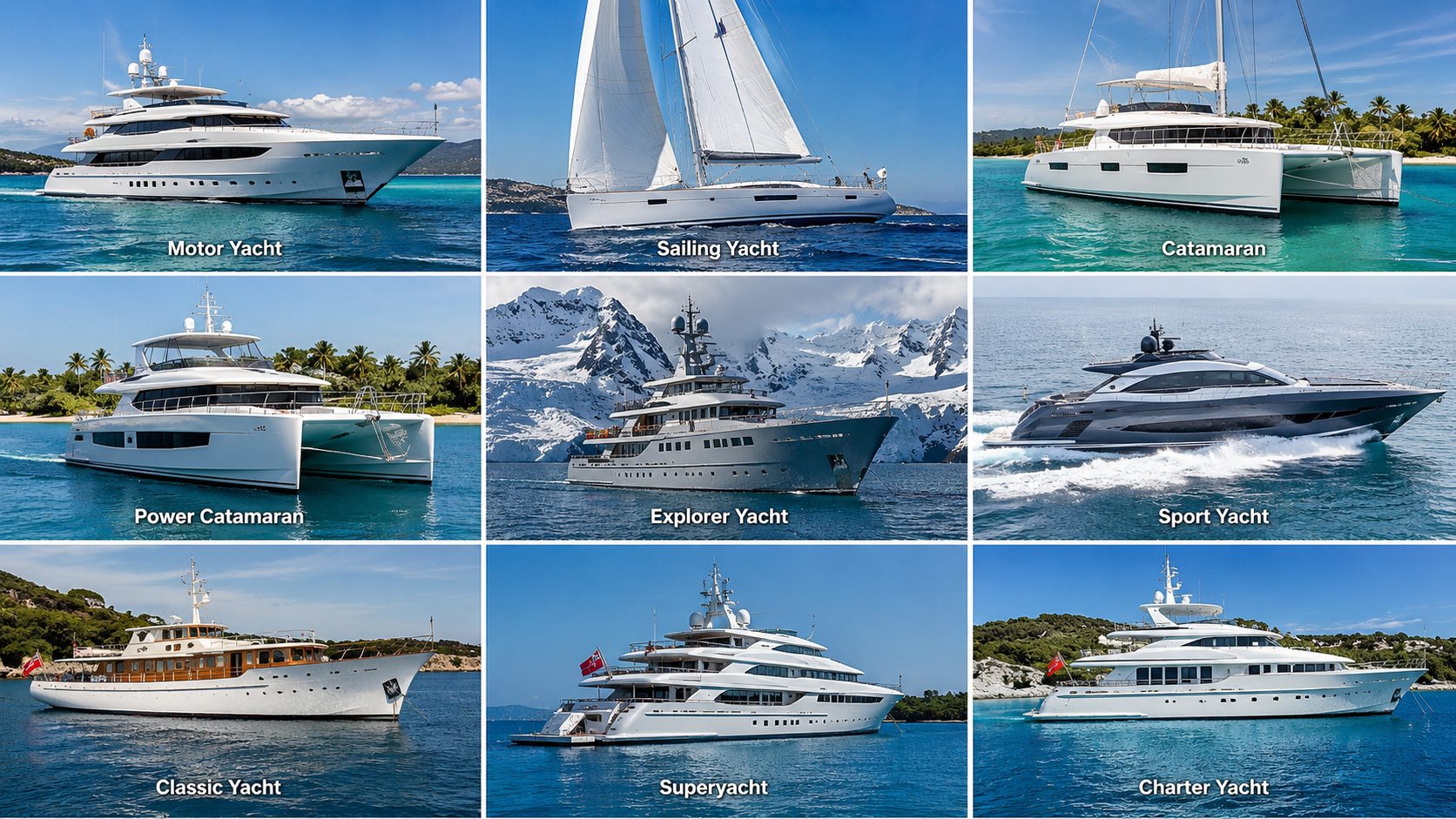
Motor yachts are widely considered the traditional symbol of maritime luxury and status. Driven entirely by powerful marine diesel engines, they are designed for owners who value space, speed, and elevated, climate-controlled comfort. Because they do not require masts, rigging, or sailing hardware, motor yachts maximize interior volume, allowing for expansive multi-deck layouts, larger staterooms, commercial-grade galleys, and extensive entertainment areas. In general, they allow you to travel point-to-point more rapidly than sailing vessels, making them highly suited for owners with limited time who wish to optimize their destination experiences.
The Sailing Yacht: Tradition, Romance, and Seamanship
The classic sailing monohull represents an authentic, engaging form of seafaring. These yachts typically appeal to traditionalists, maritime purists, and adventurers who view the journey itself as equally important to the destination. Sailing yachts cut through the water gracefully, relying primarily on wind power, which significantly reduces fuel consumption, emissions, and engine noise. While they require a deeper understanding of maritime skills and generally offer less interior volume than a motor yacht of the same length, many owners find the sensation of gliding silently across the open ocean to be deeply rewarding.
The Catamaran: Stability, Space, and Efficiency
Catamarans (multihulls) have seen a significant surge in popularity over the last two decades, successfully bridging the gap between motor and sail. Featuring two parallel hulls connected by a wide bridge deck, catamarans offer exceptional natural stability. They generally do not heel (lean) underway, making them an excellent choice for guests prone to seasickness. The wide beam creates an expansive main-deck living space, while the separation of the hulls affords excellent privacy for guest cabins. Furthermore, their shallow draft allows them to anchor in secluded bays and coral reefs that deeper monohulls often cannot reach.
Section Key Takeaways
• Motor Yachts typically deliver higher speeds, multi-deck volume, and rapid transit for those prioritizing luxury and time efficiency.
• Sailing Yachts offer an eco-conscious, deeply engaging experience for those who appreciate the art and tradition of sailing.
• Catamarans generally provide outstanding stability, wide social spaces, and shallow drafts, making them highly effective platforms for families and charter operations.
2. Specialized Yacht Categories
While the broad categories of motor, sail, and catamaran cover most of the market, two specific sub-categories have recently seen remarkable growth and deserve distinct consideration: Power Catamarans and Explorer Yachts.
Power Catamarans
Power catamarans combine the expansive living space and stability of a multihull with the ease of use of a motor yacht.
• How They Differ from Sailing Catamarans: They eliminate the mast, sails, and rigging entirely. This removal allows shipyards to design uninterrupted flybridges and forward lounging areas that would otherwise be obstructed by the mast base and boom. They also feature larger engines, offering higher cruising speeds than their sailing counterparts.
• Target Audience: They are highly suited for buyers who love the layout and stability of a catamaran but prefer the simplicity of push-button engine operation over managing sails and ropes.
• Advantages: Extensive main-deck volume, excellent fuel efficiency compared to a similar-length monohull motor yacht, very shallow draft, and incredibly intuitive joystick docking due to the widely set propellers.
• Disadvantages: Like all catamarans, their wide beam requires premium double-berths in marinas. They are also not designed to reach the high planing speeds of deep-V monohull motor yachts.
Explorer Yachts (Expedition Yachts)
Explorer yachts are heavily built vessels explicitly designed for long-range, autonomous cruising in remote areas.
• Design Philosophy: These vessels are built for endurance, often featuring robust steel or thick aluminum displacement hulls designed to handle heavy seas and, occasionally, light ice.
• Autonomy and Range: Explorer yachts carry significant fuel reserves, allowing for transoceanic ranges often exceeding 4,000 nautical miles. They also feature high-capacity watermakers, commercial-grade refrigeration for months of provisions, and significant redundancy in their mechanical systems.
• Target Audience: Owners who plan high-latitude cruising (such as Norway, Alaska, or Patagonia) or full world-cruising itineraries far away from typical marina infrastructure.
Section Key Takeaways
• Power Catamarans offer the space of a multihull without the complexities of sailing, making them ideal for coastal cruising and island hopping.
• Explorer Yachts provide high autonomy, robust construction, and long-range capabilities necessary for remote global expeditions.
• Both categories represent specialized solutions tailored for specific lifestyle requirements rather than general-purpose cruising.
3. Core Features & Pros vs Cons: A Transparent Breakdown
To simplify the initial decision-making process, we must look objectively at the primary advantages and inherent compromises of each vessel type. Every yacht is a compromise; understanding what you are giving up is just as important as knowing what you are gaining.
Motor Yacht Profile
Motor Yacht Pros
• Higher cruising speeds, especially in planing and semi-displacement hulls, generally allowing for rapid port-hopping.
• Substantial interior volume and headroom, offering apartment-like living spaces.
• Climate-controlled, multi-deck layouts with extensive flybridges and sun decks.
• Shallow bridge clearance, meaning fewer mast height restrictions when navigating under bridges or inland waterways.
• Highly maneuverable in tight, crowded marinas thanks to powerful bow and stern thrusters, or pod drive systems.
Motor Yacht Cons
• Typically the highest fuel consumption and carbon footprint of all yacht types.
• Significant engine maintenance costs due to the complexity of twin marine diesels.
• Deep-V hulls can be prone to rolling at anchor without the addition of gyroscopic or fin stabilizers.
• Often experiences a steeper initial depreciation curve compared to sailing vessels.
Sailing Yacht Profile
Sailing Yacht Pros
• Minimal fuel consumption when cruising under sail, resulting in notable operational savings.
• Quiet, peaceful, and more eco-friendly operation.
• Classic, elegant aesthetics that generally command respect in global marinas.
• Excellent heavy-weather capability; a properly ballasted deep-keel monohull is highly secure in severe offshore conditions.
• Often maintains steady, predictable resale value for models from premium shipyards.
Sailing Yacht Cons
• Slower cruising speeds, typically averaging 7 to 10 knots, requiring significant transit time between distant ports.
• Heeling (leaning) underway is unavoidable and can sometimes cause discomfort for inexperienced guests.
• Deep draft heavily restricts access to shallow bays, reefs, and certain coastal marinas.
• Requires specialized, labor-intensive maintenance for complex rigging, winches, and high-performance sails.
Catamaran Profile
Catamaran Pros
• Exceptional stability both underway and at anchor; the flat sailing profile prevents heeling.
• Expansive main-deck living space that flows seamlessly from the aft cockpit to the interior salon.
• Excellent privacy, as guest and owner accommodations are separated into the two distinct hulls.
• Shallow draft allows for anchoring close to beaches and navigating shallow cruising grounds like the Bahamas.
• High charter demand in the industry, generally offering strong Return on Investment (ROI) potential.
Catamaran Cons
• The wide beam makes finding marina berths difficult, and when found, they often carry a pricing premium.
• Annual haul-outs require specialized, extra-wide travel lifts, which are not available in every boatyard.
• Can suffer from bridge-deck slamming in choppy seas, which causes acoustic impacts in the salon.
• Typically offers less physical feedback and feel at the helm compared to the engaging steering of a sailing monohull.
Section Key Takeaways
• Motor yachts dominate in speed and total volume but require significant capital for fuel and engine maintenance.
• Sailing yachts offer serene, highly economical travel but require patience and physical engagement.
• Catamarans excel in stability and single-level living space but face logistical challenges regarding wide marina berthing and specialty haul-outs.
4. Leading Yacht Brands by Category
Navigating the brokerage market is significantly easier when you are familiar with the industry's most reputable shipyards. Below is an overview of leading brands across the different categories, known for their build quality, reliable systems, and strong resale value.
The inclusion of these brands is for informational purposes only and should not be interpreted as a ranking or endorsement. The ideal yacht always depends on the buyer's objectives, cruising plans and budget.
Notable Motor Yacht Brands
• Absolute: Known for highly innovative space utilization and luxurious, modern interiors in the 45-75 ft range.
• Fairline: A prestigious British shipyard recognized for elegant styling, sporty performance, and excellent sea-keeping.
• Horizon: Highly regarded for producing premium, semi-custom motor yachts and large volume vessels.
• Ocean Alexander: Renowned for building robust, incredibly spacious motor yachts that offer a blend of explorer capability and premium luxury.
Notable Sailing Yacht Brands
• Moody: Famous for their "deck saloon" concepts, offering single-level living that bridges the gap between motor yacht comfort and sailing performance.
• Solaris: An Italian shipyard celebrated for building stunning, high-performance luxury cruisers with sleek, minimalist lines.
• CNB: Builders of exceptional semi-custom luxury sailing yachts, typically in the 60 to 80-foot range, offering superb blue-water capabilities.
Notable Catamaran Brands
• Aquila: Currently one of the fastest-growing and most respected names specifically in the Power Catamaran sector, known for robust build quality.
• Silent Yachts: Pioneers in the fully electric, solar-powered catamaran market, offering near-infinite range for eco-conscious buyers.
• Lagoon & Fountaine Pajot: Two industry leaders producing the vast majority of production sailing catamarans, ideal for family cruising and chartering.
• Sunreef: A premier builder of fully custom, luxury super-catamarans, favored by UHNW clients.
Section Key Takeaways
• Familiarity with leading shipyards helps buyers identify vessels with proven build quality and reliable global support networks.
• Premium brands generally maintain a much smoother depreciation curve and offer stronger resale value.
• Brand selection should always align with the intended use—such as choosing an Ocean Alexander for volume or a Solaris for sailing performance.
5. Real Owner Profiles: Who Buys What?
Matching a yacht to your specific personality, lifestyle, and financial profile is critical. Over decades of international brokerage experience, Master Ocean has identified distinct psychological and practical profiles for the ideal owners of each vessel type.
The Motor Yacht Owner
The motor yacht owner tends to value time highly. They view their yacht as a premium luxury asset—a floating villa that can be relocated at their command. They prefer covering distances quickly to maximize their time enjoying the destination, rather than spending days in transit. With a robust operational budget, they are comfortable absorbing the costs of fuel consumption and full-time professional crew. The motor yacht serves as their platform for entertaining, hosting corporate clients, and relaxing in climate-controlled comfort.
The Sailing Yacht Owner
The sailing yacht owner is typically driven by maritime tradition and an active lifestyle. They view the yacht not just as a luxurious platform, but as a vessel that demands skill and respect. They travel purposefully, often prioritizing the physical challenge of harnessing the wind over arriving at a specific time. They are environmentally conscious and generally prefer the silence of wind power to the sound of diesel engines. Their budget prioritizes sail wardrobes and rigorous rigging maintenance.
The Catamaran Owner
The catamaran owner typically prioritizes family, safety, and social space. They want a multi-generational retreat where guests can coexist without feeling cramped. They are highly practical, preferring the stability of a multihull to ensure guest comfort. Instead of tying up in crowded marinas, they prefer to drop anchor in secluded bays, utilizing the yacht’s wide deck space for water sports and outdoor dining. They are also often financially pragmatic, utilizing the catamaran’s popularity to offset costs through charter management.
Section Key Takeaways
• Select a Motor Yacht if you desire premium luxury, speed, and a prestigious entertaining platform.
• Select a Sailing Yacht if you appreciate the physical art of sailing and maritime tradition.
• Select a Catamaran if you prioritize safe family cruising, broad social areas, and shallow-water exploration.
6. Real Ownership Scenarios
To move beyond theory, let us examine how different buyer profiles and specific life circumstances often align with particular yacht types in the real world.
Scenario 1: The Family with Young Children
• Strongest Choice: Catamaran
• The Reality: A family planning extended summer holidays in the Mediterranean or Caribbean will frequently find a 45–50 ft catamaran more practical than a similarly priced 55 ft motor yacht. The flat sailing profile means children are not thrown off balance underway. The separation of hulls allows parents to put children to sleep in one hull while continuing to entertain guests in the salon without noise transfer.
Scenario 2: The Time-Poor Weekend Owner
• Strongest Choice: Planing Motor Yacht
• The Reality: Consider an executive based in Europe who only has 48 hours of free time from Friday evening to Sunday afternoon. Owners who cruise between Monaco, Cannes, and Saint-Tropez frequently prefer fast motor yachts. A vessel capable of 25 knots allows them to reach Corsica or a remote anchorage, enjoy a full day of relaxation, and return swiftly before Monday morning.
Scenario 3: The Retired Couple Seeking Leisure
• Strongest Choice: Displacement Motor Yacht (Trawler) or Push-Button Sailing Yacht
• The Reality: An experienced retired couple looking to comfortably cruise the coast of Maine or the Greek Islands often opts for a robust trawler. It offers apartment-like living, high bulwarks for safety, and highly economical cruising. Alternatively, a modern sailing yacht with fully automated in-mast furling and electric winches allows older couples to enjoy sailing without intense physical labor.
Scenario 4: The Charter Investor
• Strongest Choice: Sailing or Power Catamaran (50–65 ft)
• The Reality: Investors looking to place a vessel into a managed charter fleet to generate ROI frequently choose catamarans. A 50-foot catamaran can comfortably house four to five equal-sized, en-suite VIP cabins. This layout is highly appealing to groups of couples sharing the charter cost.
Scenario 5: The Around-the-World Cruiser
• Strongest Choice: Heavy Displacement Monohull or Explorer Motor Yacht
• The Reality: Crossing the Pacific or navigating high latitudes requires high seaworthiness. An owner embarking on a global circumnavigation needs a vessel built for endurance. A heavy displacement aluminum sailing yacht can weather ocean storms securely. For those who prefer engines, an Explorer motor yacht provides autonomy far from civilization.
Scenario 6: The Liveaboard Owner
• Strongest Choice: Large Catamaran or Wide-Beam Trawler
• The Reality: Living aboard year-round requires significant payload capacity. Owners must accommodate winter clothing, tools, spare parts, scuba gear, and full-sized appliances. Catamarans and Trawlers offer the required storage lockers and weight-carrying capacity for full-time living.
Scenario 7: The Corporate Yacht Owner
• Strongest Choice: Tri-Deck Motor Yacht
• The Reality: Yachts purchased by corporations or UHNW individuals for hosting business events generally require distinct socializing zones, complete climate control, and efficient crew circulation. A large motor yacht provides commercial galleys for catering and formal dining rooms, ensuring a highly professional environment.
Section Key Takeaways
• Families and charter investors naturally gravitate toward the space and stability of catamarans.
• Weekenders and corporate hosts benefit from the speed and controlled environment of motor yachts.
• World cruisers and liveaboards require sturdy vessels designed for long-term comfort and safety.
7. Typical Buyer Mistakes: The Biggest Pitfalls
The journey to yacht ownership contains various financial and logistical complexities. First-time buyers, and even experienced owners upgrading rapidly, often fall into predictable patterns. Avoiding these mistakes can save significant capital and frustration.
• Buying Too Large, Too Fast: Size introduces complexity. Jumping from a 50-foot owner-operated boat to an 80-foot vessel is a significant leap. It mandates a full-time professional crew, increases running costs, restricts marina access, and changes the operational nature of the hobby.
• Ignoring Annual Operating Costs: The purchase price is merely the entry point. A commonly used industry guideline suggests annual ownership costs often range around 10% of the yacht's purchase price, depending on size, usage, crew, cruising area, and maintenance standards. Failing to budget accordingly usually leads to neglected vessels.
• Choosing the Wrong Marina Logistics: Buying a 45-foot catamaran without securing a wide-beam berth first can leave an owner with limited berthing options. Similarly, buying a deep-keel sailing yacht without verifying the draft limitations of a local home port is a notable logistical error.
• Underestimating Crew Requirements and Costs: A yacht performs only as well as the crew managing it. Restricting crew salaries often leads to high turnover and poor yacht maintenance.
• Buying Without a Rigorous Survey: Never bypass a comprehensive pre-purchase condition survey and sea trial conducted by an independent marine surveyor. Even brand-new yachts direct from the shipyard can exhibit defects that need addressing prior to handover.
• Buying Based Only on Appearance: A beautifully staged salon can distract a buyer from a poorly designed hull or an engine room that restricts basic mechanical access. Seaworthiness and engineering layouts should ideally precede interior design choices.
• Forgetting Resale Value: Highly customized or eccentric layouts often shrink the pool of future buyers. Maintaining traditional layouts from reputable shipyards generally ensures a smoother exit strategy.
• Overlooking Tax and VAT Implications: Navigating international maritime tax law, EU VAT status, and flag registry rules is complex. Incorrectly importing a yacht can lead to tax penalties or customs complications.
Section Key Takeaways
• Calculate total ownership costs accurately, factoring in local operational variables and crew requirements.
• Always require an independent marine survey prior to closing any transaction, even on new builds.
• Ensure the yacht's dimensions are practically suited to your chosen home port and intended cruising grounds.
8. Best Yacht by Budget
Your capital budget largely dictates the age, size, and specific type of yacht available. Here is an objective breakdown of what different financial tiers typically command in the current global brokerage market.
Under €100,000
In this tier, buyers are primarily looking at older, smaller (30–38 ft) production sailing yachts or used day-cruisers. Buyers here must be realistic; vessels in this range usually require DIY maintenance, mechanical aptitude, and dedicated refit capital to remain reliable.
€100k–250k
This budget provides access to well-maintained used production sailing yachts (35–45 ft) from recent decades, or older, heavily built motor cruisers. This is a popular entry point for owner-operators who want a reliable coastal cruiser with proven systems.
€250k–500k
The market expands significantly here. Buyers can access spacious early-generation catamarans, excellent modern 40–50 ft sailing monohulls, and well-kept 50 ft motor yachts from reputable European or American shipyards.
€500k–€1M
A highly active bracket for premium owner-operators. Options include new entry-level production catamarans (40–45 ft), high-end performance sailing yachts, and lightly used 60 ft motor yachts that require minimal immediate refit work.
€1M–€5M
This tier grants access to new-build catamarans (50–70 ft), customized motor yachts (60–80 ft), and premium blue-water expedition vessels. At the upper end of this tier, owners generally transition into the complexities of hiring and managing a full-time professional crew.
€5M+
This is the realm of fully custom builds, 90 ft+ tri-deck motor yachts, and large luxury catamarans featuring commercial-grade systems. Operations at this level run similarly to a commercial enterprise, requiring dedicated captains, engineers, and hospitality staff, along with corresponding operational budgets.
Section Key Takeaways
• Entry-level budgets are well suited for older sailing monohulls and capable day-cruisers, provided the owner budgets for refits.
• The €500k to €1M tier offers considerable variety and modern amenities for owners who wish to operate the vessel themselves.
• Budgets exceeding €1M frequently involve the necessary transition to professionally crewed operations.
9. Best Yacht by Experience Level
Operating a maritime vessel safely requires aligning the yacht's systems and physical dimensions with your personal experience level.
Beginner (0–2 Years Experience)
• Vessels: Sub-40 ft Sailing Monohulls or Sub-45 ft Power Catamarans.
• Rationale: These vessels are generally forgiving, relatively easy to dock, and possess manageable system complexities. Power catamarans offer wide-set propellers, making joystick docking intuitive for novices who may be intimidated by single-engine monohulls.
Intermediate (2–5 Years Experience)
• Vessels: 40–55 ft Owner-Operated Vessels.
• Rationale: Owners with solid navigational skills, an understanding of weather routing, and experience with basic engine troubleshooting can usually manage vessels of this size safely. They may opt to hire a freelance deckhand for offshore passages, night transits, or difficult docking situations.
Experienced Owner (5+ Years Experience)
• Vessels: 60–70 ft Vessels.
• Rationale: At this length, the physical forces involved in docking are substantial. These yachts feature complex systems, including watermakers, heavy hydraulics, and advanced electrical grids. While a highly experienced owner can helm them, they usually require at least one or two full-time crew members to handle daily maintenance and heavy line handling.
Professional Captain Required
• Vessels: 70 ft+ Vessels.
• Rationale: At this tier, maritime insurance companies generally dictate that the vessel must be operated by a captain holding commercially endorsed maritime licenses (such as an MCA Yachtmaster). The owner's operational responsibilities cease, and they enjoy the vessel entirely as a guest.
Section Key Takeaways
• Beginners should focus on vessels under 45 feet to safely develop boat handling skills without overwhelming system complexity.
• Intermediate owners can manage up to 55 feet but must be prepared for the increased maintenance oversight.
• Yachts over 70 feet strictly require professional, licensed crew for safe operation, general upkeep, and insurance compliance.
10. Best Yacht for Different Activities
Your primary intended activity should strongly influence your hull choice, ensuring the vessel adequately supports your lifestyle.
Fishing (Offshore/Sport)
• Vessel Type: Planing Motor Yacht (Sportfisher).
• Rationale: Generally required for the high speed necessary to reach deep-water fishing grounds quickly, featuring a specialized aft cockpit equipped with bait wells, and a customized flybridge or tuna tower for spotting fish.
Diving & Watersports
• Vessel Type: Catamaran.
• Rationale: The wide aft deck, low twin swim platforms, and significant storage capacity for dive compressors, heavy tanks, and underwater scooters make the catamaran a highly functional basecamp for underwater activities.
Remote Work / Digital Nomad
• Vessel Type: Catamaran.
• Rationale: The bright, panoramic salon serves as an excellent floating office. The broad hardtop roof provides substantial real estate for extensive solar panels and satellite internet antennas, ensuring off-grid power and connectivity.
Long-Distance Ocean Crossings
• Vessel Type: Heavy Displacement Monohull or Explorer Motor Yacht.
• Rationale: Built to withstand heavy, breaking seas, these vessels feature robust hull construction, substantial fuel and provision storage, and heavily protected pilothouses.
Luxury Corporate Events
• Vessel Type: Tri-Deck Motor Yacht.
• Rationale: Maximizes guest capacity, features commercial galleys required for high-end catering, and offers distinct socializing zones allowing crew to circulate invisibly while guests enjoy privacy.
Section Key Takeaways
• Catamarans excel for diving, remote work, and watersports due to their immense deck space and payload capacity.
• Planing motor yachts are highly effective for sportfishing and fast coastal transit.
• Heavy displacement hulls are strictly required for reliable, safe ocean crossings.
11. Cruising Grounds: Mediterranean vs Caribbean vs Worldwide
Where you plan to spend the majority of your time dictates the ideal vessel type. The marine environment varies significantly by region.
The Mediterranean (French Riviera, Italy, Croatia, Greece)
Motor Yachts and Sailing Monohulls typically perform exceptionally well in the Mediterranean. The Med is characterized by deep-water marinas, historic port towns, and relatively short distances between anchorages. A 65-foot semi-displacement motor yacht is an ideal platform for securing berths in highly competitive ports like Portofino or Ibiza. Furthermore, the Med often features short-period choppy waves where a heavy monohull generally provides a more comfortable ride than a light catamaran.
The Caribbean and Bahamas
Catamarans and Shallow Draft Motor Yachts are highly advantageous here. These regions are defined by shallow coral reefs and sandbars where deep-keel vessels cannot navigate safely. An owner exploring the Bahamas will find a catamaran drawing just 4 feet of water vastly superior to a sailing monohull drawing 8 feet, as the catamaran can anchor directly over sandy shoals in secluded anchorages.
High Latitudes (Norway, Alaska, Patagonia) & Worldwide
Explorer Motor Yachts and Heavy Displacement Aluminum Sailing Yachts are typically necessary. Ice, heavy swells, and remote locations demand complete self-sufficiency. Owners require enclosed, heated pilothouses, durable hulls capable of taking impacts, and robust systems redundancy to ensure survival far from commercial ports.
Section Key Takeaways
• The Mediterranean favors motor yachts and monohulls well-suited for deep marinas and short-period waves.
• The Caribbean and Bahamas rely heavily on the shallow draft of catamarans to access the best anchorages.
• High-latitude exploration strictly requires the rugged survivability of specialized expedition vessels.
12. The Hidden Costs of Yacht Ownership
While buyers generally anticipate fuel, crew salaries, and insurance premiums, the true financial impact of yachting involves hidden operational and maintenance expenses.
Air Conditioning Maintenance
Marine A/C units rely on raw saltwater pumped through the hull to cool the compressors. These raw water strainers ingest marine growth, jellyfish, and debris, requiring consistent cleaning. The lines must be periodically flushed with acid to remove calcium scale.
Generator Servicing
Yachts at anchor rely on diesel generators for electrical power. These engines often run continuously for days. They require oil changes, filter replacements, and top-end rebuilds frequently, adding significant maintenance hours.
Tender and Outboard Maintenance
The tender (dinghy) requires dedicated servicing, proper fuel management (such as sourcing ethanol-free gasoline), and winterization. A reliable tender is essential for shore access while anchored.
Water Toys and Deck Gear
Jet skis, Seabobs, and dive compressors require their own specialized maintenance schedules, battery management, and annual servicing to prevent failure in the saltwater environment.
Electronics Upgrades
Marine navigation suites age quickly. Screens delaminate in the sun, and software requires updates. Upgrading a helm station and integrating it with modern satellite communications represents a notable recurring expense.
Shore Power Costs and Converters
Large motor yachts require substantial shore power. Electricity bills in premium marinas can be considerable. Taking a European yacht (220V) to the US or Caribbean (110V) typically requires expensive frequency converters to protect the internal electrical grid.
Watermaker Servicing
Desalination systems require regular use. If left idle without proper chemical storage procedures ("pickling"), the internal membranes can fail and require costly replacement.
Annual Safety Equipment Servicing
Life rafts, EPIRBs, and fire suppression systems must be inspected and certified annually by licensed professionals to remain compliant with maritime law and insurance requirements.
Section Key Takeaways
• Budgeting must encompass preventative maintenance for auxiliary systems, not just the main propulsion engines.
• Systems such as air conditioning, watermakers, and generators require consistent technical attention and consumable parts.
• Safety equipment and marine electronics represent an ongoing cycle of upgrades and recertifications.
13. 5-Year Ownership Cost Example
To help you visualize the financial commitment, here is a comparative overview of expenses over a standard 5-year ownership cycle for a theoretical 60-foot luxury yacht.
The Motor Yacht (60 ft)
Over five years, the motor yacht generally incurs the highest operating costs. The primary expenses are fuel—due to high consumption at planing speeds—and main engine maintenance, requiring professional mechanics for scheduled major services. Depreciation is typically steeper as design trends evolve rapidly. Moderate expenses include standard marina fees and crew salaries. The convenience of speed and interior volume comes with a higher financial footprint.
The Sailing Yacht (60 ft)
The financial profile of the sailing yacht differs. Day-to-day running costs are often lower, as fuel consumption is significantly reduced under sail. However, around year four or five, owners generally face notable capital expenditures: standing rigging must be rigorously inspected and likely replaced, sails will stretch and require replacement, and teak decking may need re-caulking or deep sanding. The sailing yacht yields lower daily costs, provided the owner maintains a reserve fund for the 5-year refit cycle.
The Catamaran (60 ft)
The catamaran offers a balanced profile. Fuel costs remain relatively low due to highly efficient hull designs. However, elevated expenses arise from berthing logistics; the wide beam often requires booking double berths at a premium. Haul-outs also require specialty wide travel lifts, incurring higher boatyard fees. Engine maintenance is moderate, involving two smaller engines.
The catamaran often maintains strong resale value, effectively offsetting its berthing premiums.
Section Key Takeaways
• Motor Yachts require consistent capital for high fuel consumption, depreciation, and scheduled engine servicing.
• Sailing Yachts offer lower daily costs but necessitate strict reserve funds for periodic sails and rigging updates.
• Catamarans are fuel-efficient but carry continuous premiums for wide marina docking and specialized boatyard handling.
14. Yacht Size Guide: Finding Your Perfect Fit
Size dictates not just the purchase price, but the logistical reality, legal compliance, and human resources required for yacht ownership.
30–40 ft (The Weekender)
Ideal for owner-operators. No professional crew is required. This size is highly manageable for day trips and weekend getaways, and finding transient marina space is straightforward and affordable.
40–50 ft (The Family Cruiser)
A practical choice for active families. It offers multiple en-suite cabins and robust offshore capability. Experienced owners can operate vessels of this size independently, handling lines and systems themselves.
50–70 ft (The Luxury Inflection Point)
Crossing the 50-foot mark increases complexity. Professional crew involvement generally becomes highly recommended (1 to 2 members). These yachts offer long-term liveaboard comfort, domestic-scale appliances, and tender garages.
70–100 ft (The Mini-Superyacht)
This size typically requires a dedicated, full-time crew (3 to 5 members). These vessels are capable of serious luxury charter operations. Features often include extensive flybridges, gyroscopic stabilization, and multiple VIP staterooms.
100 ft+ (The Superyacht)
Moving into superyacht territory. Operations run similarly to a commercial ship, requiring licensed captains, specialized engineers, chefs, and interior stewardesses. Global range, complex maritime law compliance, and thorough customization define this tier.
Section Key Takeaways
• Vessels under 50 feet allow for private owner-operation and highly controlled running costs.
• The 50 to 70-foot range is the inflection point where professional crew involvement becomes necessary.
• Yachts over 70 feet shift ownership into a professionally managed, highly complex logistical operation.
15. Charter Income Potential: Maximizing Your Investment
Many owners look to offset their annual running costs by placing their yacht into a professional charter management program. Understanding market demand is essential.
Catamarans: Strong Cash Flow Generators
Catamarans currently hold a highly dominant position in the modern charter market. Because they offer equal-sized cabins, extensive deck space, and shallow drafts, they are heavily booked by groups sharing the cost. A smartly managed 50 to 60-foot catamaran in the Caribbean or Mediterranean can often cover a significant portion of its annual running costs, and in prime seasons, generate a modest yield.
Motor Yachts: High Revenue, High Overhead
Motor yachts generally command the highest weekly charter rates, particularly in glamorous Mediterranean locations. They attract clients who prioritize prestige, speed, and luxury. However, substantial fuel consumption, higher engine hours leading to faster depreciation, and larger crew requirements mean that while the gross revenue is high, the net profit margins must be carefully managed.
Sailing Yachts: A Niche but Loyal Market
Classic monohulls appeal to clients desiring a traditional, engaging sailing experience. They typically have a slightly lower booking volume than catamarans because they lack broad social areas, but they benefit from intensely loyal repeat clients who value the performance and aesthetics of a monohull.
Section Key Takeaways
• Catamarans offer high booking volume and represent the most efficient path to covering operating expenses.
• Motor Yachts command premium rates but involve substantial overhead costs that affect net profitability.
• Chartering strictly requires adherence to commercial maritime safety standards, which must be planned prior to purchase.
16. Private Ownership vs Company Ownership (SPV)
For High-Net-Worth (HNW) and Ultra-High-Net-Worth (UHNW) clients, the structural ownership of a yacht is often as critical as the physical vessel selection. Choosing between holding the asset in your private name or within a Special Purpose Vehicle (SPV) company involves several corporate considerations.
Private Ownership
Holding a yacht in an individual’s name is straightforward but lacks operational insulation. Private ownership ties personal assets directly to maritime liabilities. If a legal claim arises from an incident on board, your broader personal estate could potentially be exposed. Furthermore, private ownership offers minimal confidentiality, as registration details are often searchable on public registries.
Company Ownership (SPV)
Structuring the acquisition through a dedicated SPV—typically an offshore or low-tax jurisdiction corporation—is standard industry practice for many modern yacht owners. This asset ring-fencing shields your personal wealth from maritime liabilities, aiming to protect your estate from litigation or operational claims.
VAT and Tax Considerations
An SPV is often essential if you intend to operate the yacht commercially or place it into a charter program. In jurisdictions like the European Union, a company structure allows the yacht to be registered as a commercial entity, which can potentially grant exemptions from VAT on the initial purchase price, fuel, and parts, provided the vessel actively operates as a business. Private owners must generally pay full, non-refundable VAT.
Long-Term Strategy
Company structures can simplify the future sale of the asset. Rather than physically reregistering the yacht and shifting titles between individuals, the owner can sometimes simply sell the shares of the SPV company to the buyer. This transaction is often faster, structurally cleaner, and can reduce local transfer taxes and registration fees.
Section Key Takeaways
• Private ownership is simple but leaves the owner exposed to direct liability and offers no privacy.
• SPV structures effectively ring-fence maritime liabilities, ensuring broader personal asset protection.
• Holding a yacht within a corporate structure is typically mandatory for legitimate VAT optimization and commercial charter operations.
17. Choosing the Right Flag
The flag flying from your yacht’s stern dictates the legal framework, tax liabilities, crewing requirements, and degree of scrutiny your vessel will likely receive from customs authorities globally.
Private vs Commercial Registration
Before selecting a flag country, you must declare whether the vessel is Private or Commercial. Private yachts generally face less stringent safety equipment regulations and fewer restrictions on crew nationality, but cannot generate income. Commercial registries require rigorous safety compliance, adherence to international labor conventions, and mandatory surveys, but may unlock substantial tax benefits and charter capabilities.
The Red Ensign Group (Cayman Islands, Marshall Islands, UK)
The Cayman Islands and the Marshall Islands are highly favored flag registries for luxury yachts. As part of the British Red Ensign Group, they provide premium consular protection worldwide, utilize stable English maritime law, and are recognized globally by financial institutions. This often makes financing a yacht significantly easier. They also maintain a clean standing with international port state controls.
European Registries (Malta, France, Spain)
Malta has become a premier European flag registry due to its efficient corporate structures, competitive tonnage tax systems, and clear commercial charter frameworks within EU waters. Conversely, flags like France or Spain carry more rigorous local crewing requirements and higher social security contributions, but are often preferred by owners who operate strictly within their home waters and desire direct local consular support.
Section Key Takeaways
• The choice of flag directly determines your international tax exposure and the frequency of customs boardings.
• Red Ensign flags (Cayman Islands, Marshall Islands) offer high legal protection and are strongly favored by marine lenders.
• Malta represents a robust, highly efficient European flag for commercial charter operations inside the EU.
18. Yacht Insurance Basics
A comprehensive maritime insurance policy is essential to protect your significant capital investment and manage liability risk. Marine policies are specialized and distinct from standard property insurance.
Hull and Machinery (H&M) Insurance
This is the foundational component of your policy, covering physical damage to the yacht’s hull, superstructure, propulsion systems, and onboard equipment caused by collisions, grounding, fire, storms, or heavy seas. It is typically written on an "Agreed Value" basis rather than "Market Value" to protect against unpredictable depreciation disputes after a total loss.
Protection and Indemnity (P&I) Coverage
P&I insurance handles third-party liabilities. This covers legal costs and compensation claims for bodily injury to guests or crew, damage to marine infrastructure (like docks or coral reefs), pollution clean-up costs (such as fuel spills), and wreck removal mandated by maritime authorities.
Specialized Crew and Charter Addendums
If your yacht employs professional crew, you generally must carry dedicated crew medical and liability coverage to comply with international maritime labor laws. Furthermore, if the vessel enters a charter program, you require a specialized commercial charter extension to protect against injuries sustained by paying passengers or liability claims arising from commercial operations.
Section Key Takeaways
• Hull and Machinery insurance protects the physical asset based on a pre-agreed valuation framework.
• P&I coverage is strictly mandatory to insulate the owner from third-party liability and environmental claims.
• Transitioning a yacht from private use to commercial charter requires immediate policy adjustments to prevent coverage denial.
19. Yacht Financing Options
Structuring the acquisition correctly preserves liquidity and optimizes tax exposure. While many buyers assume cash is the only way to purchase a luxury yacht, the maritime finance sector offers several sophisticated alternatives.
Cash Purchase
A direct cash transaction is the simplest and fastest method, avoiding interest rates, appraisal requirements, and lending delays. However, it ties up a significant amount of capital in a depreciating asset rather than allowing those funds to remain liquid or generate yields in other portfolios.
Marine Mortgage
Similar to real estate, a marine mortgage uses the yacht itself as the collateral for the loan. Lenders typically require a 20% to 30% down payment and offer amortization schedules spanning 10 to 20 years. The yacht must usually meet strict survey and valuation requirements before the bank will approve the funds.
Leasing Programs
Popular in certain European jurisdictions, yacht leasing can provide notable tax efficiencies. Under a leasing scheme, a financial institution purchases the yacht and leases it back to the owner. Depending on the flag and the operational area, this can defer or structure VAT payments more efficiently over the life of the lease.
Balloon Payment Structures
To keep monthly capital expenditures lower, some lenders offer balloon payment loans. The owner pays smaller monthly installments based on a longer amortization schedule, but agrees to pay a large, lump-sum "balloon" payment at the end of a shorter term (e.g., 5 to 7 years). This often aligns well with owners who plan to sell or upgrade the yacht before the balloon payment is due.
Private Banking & Asset-Backed Lending
For UHNW individuals, a highly efficient route is often bypassing traditional marine mortgages and utilizing asset-backed lending through their private bank. By borrowing against existing investment portfolios, real estate, or corporate assets, owners can often secure lower interest rates and faster closing times without subjecting the yacht to standard mortgage underwriting.
Section Key Takeaways
• Cash purchases offer speed but reduce overall financial liquidity.
• Marine mortgages require strict surveys and typical down payments of 20% to 30%.
• Asset-backed lending through private banks often provides the most favorable rates and efficient processing for UHNW buyers.
20. Negotiating the Purchase Price
The asking price of a brokerage yacht is rarely the final sale price. Successfully negotiating the acquisition requires strategic market knowledge, emotional detachment, and precise timing.
How the Price is Determined
A yacht’s initial asking price is generally influenced by comparable market sales (comps), the prestige of the shipyard, engine hours, and the extent of recent refits. However, the true value is largely dictated by the vessel's documented condition and the seller's motivation to exit the asset.
What to Check Before Negotiating
A skilled broker will analyze how long the yacht has been on the market. Yachts sitting unsold for extended periods may indicate an optimistic seller or a vessel with known defects. Review the service history before submitting an offer; a lack of maintenance records provides leverage to lower the price, as you assume the risk of deferred maintenance.
When to Negotiate
Negotiation typically occurs in two distinct phases:
1. The Initial Offer: Based on visual inspections and market comps, you present a formal offer subject to survey and sea trial. Funds are placed in a secure escrow account.
2. The Post-Survey Adjustment: This is where highly effective negotiation happens. If the marine surveyor discovers hidden defects—such as elevated moisture in the hull, failing generator mounts, or outdated rigging—your broker uses the survey report to renegotiate the price downward or request the seller fix the issues prior to closing.
When to Walk Away
No matter how much time you have invested, you must be prepared to walk away from a deal. It is generally advisable to walk away if the survey reveals severe structural hull damage, significant engine internal wear discovered via oil analysis, or if the seller cannot produce clear, unencumbered title documents.
Section Key Takeaways
• The initial asking price is a starting point; market comparables and seller motivation dictate the true value.
• The most effective negotiations occur after the survey, utilizing identified defects as leverage for price adjustments.
• Be prepared to abandon the transaction if severe structural, mechanical, or legal issues are uncovered.
21. Why a Marine Survey Is Essential
Purchasing a yacht without a marine survey is equivalent to buying a commercial property without an inspection. It is a critical risk-management step designed to protect your capital and ensure safety at sea.
Hull and Structural Inspection
A surveyor will physically inspect the vessel's structural integrity both in and out of the water. They check for grounding damage, stress cracks in the fiberglass, and perform acoustic soundings (tapping) to ensure the hull laminate remains structurally sound.
Moisture Testing and Osmosis
Using specialized meters, the surveyor measures the moisture content deep within the fiberglass hull. High moisture readings can indicate water intrusion (osmosis), which causes blistering. Repairing severe osmosis requires stripping the gelcoat and re-glassing the hull—an expensive and time-consuming process.
Engine and Mechanical Inspection
While the general surveyor inspects the hull, a specialized marine mechanic should ideally assess the propulsion systems. This includes pulling oil and coolant samples for laboratory analysis to detect hidden internal engine wear, checking turbochargers, and inspecting the exhaust systems for corrosion.
The Sea Trial
The sea trial is the physical test of the yacht under load. The surveyor will monitor the engines at Wide Open Throttle (WOT) to verify they reach maximum RPM without overheating, check for excessive vibrations in the running gear, and test the autopilot, steering hydraulics, and navigation electronics in a real-world environment.
Valuation and Insurance Requirements
Beyond peace of mind, the survey serves a strict financial purpose. The surveyor will issue a formal "Fair Market Value" and "Replacement Value" in their final report. Marine lenders and insurance companies nearly universally require this official valuation before they will approve a mortgage or underwrite a policy.
Section Key Takeaways
• A marine survey identifies hidden structural and mechanical defects before you commit your capital.
• Moisture testing and engine oil analysis are critical procedures that should never be skipped.
• Lenders and insurance providers mandate a formal survey report prior to finalizing coverage or loans.
22. The Comprehensive Maintenance Calendar
A meticulously maintained yacht preserves capital, ensures high resale value, and guarantees safety at sea. Here is a baseline expectation for a professional maintenance program.
Monthly Maintenance
• Test run main engines and generators under load to ensure operating temperatures remain stable.
• Exercise all through-hull sea valves (seacocks) to prevent them from seizing.
• Clean air conditioning sea strainers and flush lines.
• Check all bilge pumps and automatic float switches.
• Clean and polish exterior stainless steel to prevent pitting.
Quarterly Maintenance
• Change oil and filters on main engines and generators (per manufacturer hour intervals).
• Inspect and replace sacrificial zinc anodes to prevent galvanic corrosion.
• Test all safety gear, including EPIRBs, life rafts, and fire suppression systems.
• Check battery banks, clean terminal connections, and test charging relays.
Annual Maintenance (The Haul-Out)
• Lift the vessel out of the water in a boatyard.
• Apply fresh antifouling paint to the hull.
• Remove, polish, and balance propellers and shafts; inspect cutlass bearings.
• Service bow thrusters and underwater lights.
• Conduct a full rigging inspection by a certified rigger (for sailing yachts and catamarans).
Every 5 Years
• Replace all standing rigging cables and turnbuckles.
• Conduct scheduled major engine servicing and inspections of heat exchangers.
• Update navigation electronics to ensure modern safety standards.
• Re-caulk or sand teak decking to maintain structural integrity.
Section Key Takeaways
• Yacht maintenance is an ongoing, year-round commitment, not a seasonal task.
• Adhering to a documented maintenance calendar prevents structural and mechanical failures at sea.
• Documented service history is a critical factor in retaining the yacht's long-term resale value.
23. Environmental Impact and the Future of Yachting
Sustainability is actively reshaping the global yachting industry. Buyers are increasingly conscious of their vessel's environmental footprint, and shipyards are implementing new technologies.
Hybrid and Electric Propulsion
To address fuel consumption and emissions, the industry is seeing a shift toward hybrid and electric propulsion. Modern hybrid yachts can cruise silently on battery power for short distances. Large lithium-ion battery banks allow a yacht to sit at anchor overnight, running air conditioning and hotel loads without the noise and exhaust of a diesel generator.
Solar Power Integration
Catamarans, with their broad hardtop roof surfaces, are well-suited for extensive solar arrays. Innovations in high-efficiency solar panels allow modern catamarans to generate sufficient power to sustain daily living off-grid, reducing reliance on fossil fuels.
Sustainable Materials
Shipyards are gradually shifting toward eco-friendly bio-resins, basalt fiber composites, and sustainable alternatives to traditional teak for decking. Recyclable hull composites are also in development to improve the lifecycle sustainability of vessels.
Noise Reduction and Marine Life
The silent running of a sailing yacht or a hybrid-electric motor yacht minimizes acoustic pollution in the water, which can disrupt marine life. By adopting electric propulsion and advanced vibration dampening, owners protect marine environments while enhancing onboard comfort.
Section Key Takeaways
• Sailing yachts remain highly eco-friendly due to wind propulsion.
• Catamarans offer excellent physical space for solar power integration.
• Motor yachts are adapting with advanced hybrid-electric systems to reduce emissions and noise.
24. New vs Used Yacht: Making the Right Acquisition
Deciding whether to commission a new build or purchase a pre-owned vessel involves weighing time, capital, and risk.
Advantages of Buying New
Buying new provides comprehensive shipyard warranties, pristine systems, and a clean history. Furthermore, buying new allows for deep customization—owners can select exact wood finishes, layouts, and navigation suites. However, there are considerations. Wait times for premium shipyards currently range from two to four years. Additionally, a new yacht typically experiences steep initial depreciation, often losing 15% to 20% of its value in the first two years of operation.
Advantages of Buying Used (Brokerage Market)
Buying a used yacht offers immediate availability. You can generally complete a transaction in weeks rather than years. Financially, buying a vessel that is three to five years old is often strategic; the first owner has absorbed the initial depreciation and addressed "new boat" warranty claims with the shipyard. The primary consideration when buying used is accurately assessing the vessel's maintenance history. This requires rigorous scrutiny by an independent marine surveyor and a deep analysis of the service logbooks. Owners should also allocate a refit budget to update aesthetics or electronics if necessary.
Master Ocean Yacht Buying Insight: A lightly used, 3-year-old yacht from a premium shipyard, accompanied by a flawless, documented service history, generally represents a highly strategic financial acquisition in the marine market.
Section Key Takeaways
• Buy new if you require bespoke customization, warranty protection, and can accommodate delivery timelines.
• Buy used if you desire immediate delivery, wish to avoid steep initial depreciation, and are prepared to manage minor updates.
• A used yacht's value is directly tied to its documented service history.
25. The Master Ocean Yacht Buying Checklist
Treat buying a yacht with the exact same legal and technical scrutiny as acquiring premium real estate. Incorporate these steps into your due diligence process.
• ✔ Independent Condition and Value Survey: Hired exclusively by the buyer to assess the structural and operational integrity of the vessel.
• ✔ Fluid Analysis (Oil & Coolant): Laboratory analysis of engine and generator oil helps reveal internal wear and coolant leaks before a failure occurs.
• ✔ Hull Moisture Test / Osmosis Check: Crucial for aging fiberglass hulls to detect potential water intrusion in the laminate.
• ✔ Rigorous Sea Trial: Test the boat under load to ensure engines reach their rated maximum RPM without overheating or vibration issues.
• ✔ Title Search and Lien Verification: Verify that there are no outstanding maritime liens or mortgages attached to the vessel.
• ✔ VAT and Tax Status: Confirm if the Value Added Tax (VAT) is paid, unpaid, or zero-rated, and secure the original tax documents.
• ✔ Continuous Chain of Title: Verify the Builder's Certificate and ensure an unbroken chain of Bills of Sale.
Section Key Takeaways
• Technical surveying and fluid analysis are essential risk management tools.
• Legal and financial due diligence (Title, VAT, Liens) is as important as the physical condition of the boat.
• Incomplete paperwork can complicate the sale or operational freedom of the yacht.
26. Glossary of Essential Yachting Terms
Understand the specific language used by yacht brokers, captains, and marine surveyors.
• AIS (Automatic Identification System): An automated tracking system displaying vessel speed, heading, and identity for collision avoidance.
• Beam: The widest point of the yacht's hull.
• Bow Thruster: A propeller mounted at the bow used to push the front of the yacht sideways during docking.
• Chartplotter: An electronic navigation system that overlays GPS data onto marine charts.
• Displacement Hull: A hull designed to push through the water smoothly. Very fuel-efficient and stable, but relatively slow.
• Draft: The minimum vertical depth of water a yacht needs to float.
• EPIRB: Emergency Position Indicating Radio Beacon. A distress beacon that transmits your GPS location to rescue satellites.
• Flybridge: An upper deck providing 360-degree views and an external helm station.
• Gyro Stabilizer: A heavy fly-wheel spin system inside the hull that uses angular momentum to counteract a yacht's side-to-side roll.
• Hull: The main structural body of the vessel.
• Keel: The structural fin at the bottom of a sailing yacht that provides ballast and lateral stability.
• LOA (Length Overall): The maximum length of the vessel from bow to stern.
• Planing Hull: A flat-bottomed hull designed to lift out of the water at high speeds, skimming the surface.
• Rigging: The system of wire cables (standing rigging) and ropes (running rigging) that support the mast and control the sails.
• Seacock: A marine valve fitted to the hull that controls the intake or discharge of seawater.
• Semi-Displacement: A hybrid hull design offering more speed than a full displacement hull, but more efficiency than a planing hull.
• Stabilizers (Fin): External wings under the waterline that pivot dynamically to reduce rolling motion.
• Tender: A smaller auxiliary boat used to transport guests to shore or for water sports.
• Transom: The flat or curved vertical surface forming the stern of the yacht.
• Watermaker: A reverse-osmosis desalination plant that converts seawater into drinking water.
27. Master Ocean Expert Recommendations
Based on decades of international yacht brokerage experience, here are our practical recommendations for specific buyer needs:
• Best Yacht for First-Time Buyers: 40–50 ft Sailing or Power Catamaran. It offers a stable, manageable platform and generally maintains strong resale value.
• Best Yacht for Families: Power Catamaran. Provides ample, safe deck space while simplifying operational complexity.
• Best Yacht for Charter Investment: Sailing Catamaran (50–60 ft). An effective platform for generating charter ROI globally.
• Best Yacht for Long-Distance Cruising: Explorer Motor Yacht or Aluminum Sailing Monohull. Prioritizes safety, fuel range, and heavy-weather capability.
• Best Yacht for Mediterranean Holidays: Planing or Semi-Displacement Motor Yacht (60–80 ft). Suited for port-hopping and accessing high-demand European marinas.
Section Key Takeaways
• There is no universally "best" yacht, only the yacht best suited for your specific use-case.
• First-time buyers generally benefit from the stability of catamarans.
• Long-distance ambitions require the robust build of an explorer or heavy monohull.
28. Decision Framework: Final Comparison
Use this final decision framework to help clarify your path forward:
Choose a Motor Yacht if...
• You wish to travel between destinations quickly and efficiently.
• You prioritize interior volume, climate-controlled environments, and premium amenities.
• You intend to host formal corporate events or extensive social gatherings onboard.
• You have an operational budget prepared for higher fuel consumption and engine maintenance.
Choose a Sailing Yacht if...
• The journey, navigation, and connection with the marine environment are your primary motivations.
• You want to minimize your carbon footprint and reduce fuel expenses.
• You appreciate maritime traditions and the satisfaction of wind propulsion.
• You are comfortable with a deliberate pace of travel and the physical aspects of sailing.
Choose a Catamaran if...
• You plan to cruise with a family or groups who value privacy and separated living quarters.
• You want to anchor in shallow bays and reefs, particularly in the Caribbean or Bahamas.
• Stability and preventing seasickness are top priorities for your guests.
• You are looking for a vessel with proven commercial charter revenue potential.
29. Frequently Asked Questions (FAQ)
To further assist your research, we have compiled the most common questions our brokers receive from prospective buyers worldwide.
General Comparisons
1. Which yacht type is the safest? All modern yachts from reputable builders are highly safe when operated correctly. Heavy displacement monohulls and explorer motor yachts are widely considered the safest in severe offshore conditions.
2. Which yacht type is the fastest? In general, planing motor yachts represent the fastest recreational vessels, easily exceeding 25–30 knots.
3. Which yacht type is the most stable? Catamarans typically offer the highest initial stability due to their wide beam, preventing rolling. Motor yachts utilize active stabilizers to achieve similar comfort.
4. Is a catamaran safer than a monohull? Catamarans are highly buoyant and difficult to sink. However, in extreme storms, a ballasted monohull will self-right if capsized, whereas a catamaran will not.
5. Which yacht has the most interior space? A motor yacht generally offers the most total volume across multiple decks, while a catamaran offers the most single-level, main deck space.
Costs & Finances
6. How much does it cost to maintain a yacht annually? A commonly used industry guideline suggests annual ownership costs often range around 10% of the yacht's purchase price, depending on size, usage, crew, cruising area, and maintenance standards.
7. Which yacht depreciates the fastest? Production motor yachts typically depreciate faster than premium sailing yachts or catamarans due to changing design trends and engine wear.
8. Which yacht has the best resale value? Highly sought-after production catamarans currently hold their value exceptionally well due to strong global demand.
9. Are older yachts cheaper to own? Generally, no. While the purchase price is lower, refit costs, system replacements, and higher insurance premiums typically offset initial savings.
10. How much does yacht insurance cost? Typically 1.5% to 2.5% of the vessel's declared hull value annually, dependent on cruising grounds and crew experience.
11. Is a yacht a good long-term investment? Financially, yachts are depreciating assets. The investment is in lifestyle, experiences, and family time, though chartering can help offset the depreciation.
Living Aboard & Comfort
12. Do I need a crew to operate a yacht? Vessels under 55 feet can generally be owner-operated by experienced individuals. Yachts over 65–70 feet require professional crew.
13. Which yacht is best for avoiding seasickness? A catamaran, due to its flat sailing profile and lack of rolling.
14. Can I work remotely from a yacht? Yes. Low-earth orbit satellite systems provide reliable high-speed internet globally.
15. Is there air conditioning on sailing yachts? Yes, modern luxury sailing yachts have climate control systems, powered by a generator or lithium battery banks.
16. Can I bring pets onboard? Yes. Catamarans offer safer, wider decks for pets, while the stairs on sailing yachts can sometimes be challenging.
Cruising & Operations
17. How far can a motor yacht travel on one tank? Fast planing yachts may have a 300–400 nautical mile range. Explorer yachts can boast ranges exceeding 4,000 nautical miles.
18. Do sailing yachts have engines? Yes, all modern sailing yachts feature auxiliary diesel engines for maneuvering in port and cruising when wind is absent.
19. Why is a shallow draft important? A shallow draft allows you to cross sandbars, anchor closer to the beach, and access protected hurricane holes.
20. How hard is it to find marina space for a catamaran? It can be challenging. A catamaran's beam often requires booking a "double berth" or mooring on a T-dock, incurring a premium.
21. Can I cross the Atlantic in a catamaran? Yes, ocean-classed (CE Category A) catamarans routinely cross oceans with proper weather routing.
Chartering & The Buying Process
22. Can I make a profit chartering my yacht? A well-managed charter program can significantly offset your annual running costs, though consistent net profit is rare.
23. Do I have to pay VAT if I charter? Yes, commercial charter operations are subject to Value Added Tax rules depending on the country of operation.
24. How many weeks per year will my yacht charter? A successful Mediterranean/Caribbean yacht might book 12 to 20 weeks a year.
25. Can I use my yacht while it’s in a charter program? Yes, owners can reserve weeks for personal use.
26. What is MCA coding? It is a stringent set of commercial safety and construction standards required for a vessel to operate legally as a charter yacht.
27. Why do I need a yacht broker? A buyer's broker protects your financial interests, coordinates surveys, and manages the legal transfer of title.
28. What is a sea trial? A physical test of the yacht prior to purchase to evaluate engines, electronics, and overall performance.
29. Should I buy new or used? New offers customization and warranties; used offers immediate delivery and limits initial depreciation.
30. How long does the yacht buying process usually take? For a used vessel, the process from initial offer to final closing typically takes 4 to 8 weeks, depending on survey scheduling and financing.
30. Final Advice Before Buying a Yacht
Before you begin browsing listings or contacting shipyards, establish a clear foundation for your search.
• Define your budget: Calculate both your initial acquisition capital and your annual operating budget realistically.
• Define your cruising area: Select a hull type and draft that matches the geography of your intended destinations.
• Think about annual costs: Factor in marina premiums, haul-outs, and professional crew salaries.
• Always complete a survey: Never purchase a vessel without a thorough independent inspection and fluid analysis.
• Never rush the purchase: Take the time to view multiple vessels and sea trial different hull designs.
• Work with an independent broker: Ensure you have professional representation to guide you through negotiations, contracts, and maritime law.
31. Why Choose Master Ocean
Every acquisition is different. Our role is not simply to sell a yacht, but to represent the client's interests throughout the entire acquisition process—from the first consultation to long-term ownership support.
Acquiring a luxury yacht is a complex financial, technical, and legal transaction spanning multiple international jurisdictions. Navigating the global brokerage market alone exposes buyers to unnecessary risks, hidden mechanical defects, and compromised resale value.
Master Ocean provides elite, end-to-end maritime advisory services for HNW and UHNW clients worldwide. Our services include:
• Worldwide Yacht Brokerage: Access to premium vessels across the globe, from European shipyards to American builders.
• Buyer Representation: We act strictly as your advocate, protecting your capital and negotiating professionally on your behalf.
• Seller Representation: Strategic marketing to our global network of qualified buyers to ensure a structured exit strategy for your asset.
• Off-Market Yachts: Exclusive access to confidential listings that are not advertised publicly.
• Confidential NDA Transactions: Ensuring discretion and privacy for our clients throughout the acquisition lifecycle.
• Yacht Sourcing: Leveraging our network to find the exact vessel that meets your specifications.
• Negotiation: Expert structuring of purchase agreements, deposits, and final terms.
• Marine Survey Coordination: Hiring independent marine surveyors, engine analysts, and riggers.
• Registration Support: Strategic advice on selecting the most advantageous Flag State for operational efficiency.
• VAT Assistance: Navigation of complex EU VAT laws and commercial structuring.
• Financing Guidance: Connecting clients with marine lenders to structure acquisition financing.
• Insurance Assistance: Securing comprehensive hull, machinery, and liability coverage.
• Yacht Management: Complete oversight of your vessel's operational budget and logistical compliance.
• Technical Management: Managing major yard periods and ensuring adherence to the maintenance calendar.
• Refit Advisory: Project management for major interior or mechanical refits to enhance the vessel's value.
• Charter Management: Marketing your yacht to global charter brokers and managing booking calendars.
• Worldwide Delivery: Coordinating professional delivery crews or heavy-lift transport ships.
• Long-Term Ownership Support: We remain your dedicated maritime advisors for the entire duration of your ownership journey.
32. Conclusion
Choosing between a motor yacht, a sailing yacht, and a catamaran is a highly personal and strategic decision. Because every buyer brings a unique set of priorities—whether that involves speed, eco-friendly cruising, or family-oriented living spaces—there is no single universal answer to which yacht is "best." The right choice requires meticulously balancing your operational goals with the practical realities of the ocean.
It is essential to select a yacht that accurately reflects your actual lifestyle rather than a theoretical ideal. Assessing hidden maintenance costs, understanding hull dynamics, mapping out specific cruising grounds, and realistically forecasting crew requirements will help ensure that your vessel becomes a source of enjoyment rather than a logistical burden.
Acquiring a luxury yacht remains a significant financial transaction. Partnering with an independent broker saves capital, reduces technical risks, and streamlines the complexities of maritime law and international taxation. Whether you are purchasing your first yacht, upgrading to a larger vessel, investing in a charter yacht, or searching for a confidential off-market opportunity, Master Ocean provides independent brokerage, strategic advice, and complete acquisition support worldwide.
The best yacht is not necessarily the largest, fastest or most expensive. It is the yacht that best matches your lifestyle, cruising ambitions, operational budget and long-term ownership goals.
Contact Master Ocean today for a highly confidential consultation. Let us professionally guide your acquisition, and please remember to request our comprehensive Yacht Buying Checklist during your initial meeting.