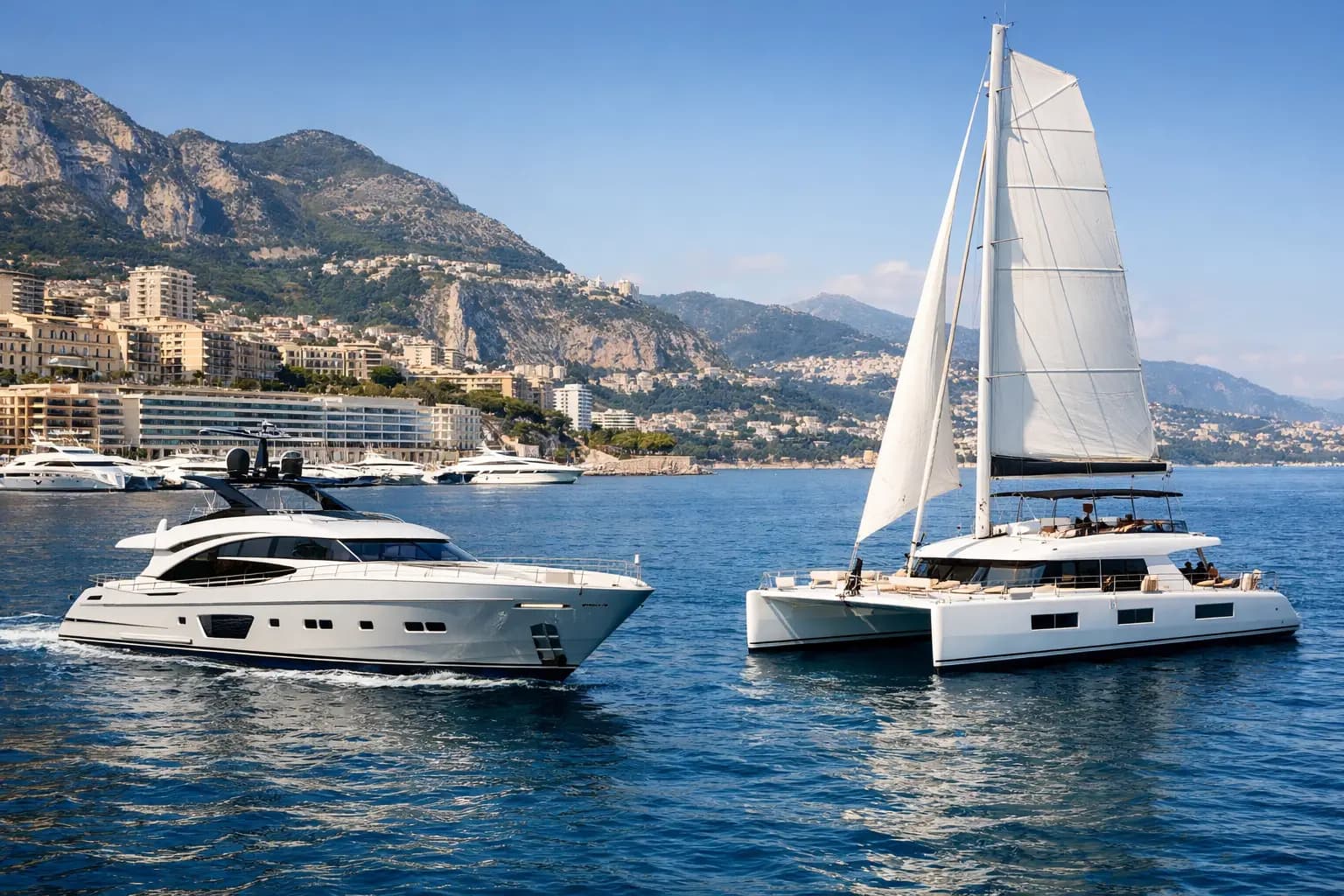
A client planning a week in Ibiza usually asks about cabins, crew, and beach clubs. A client buying for long seasons in the Mediterranean asks a different question first: motor yacht vs catamaran. It is the right question, because the choice shapes not only how you cruise, but how you entertain, operate, and feel on board.
For some owners and charter guests, a motor yacht delivers the polished profile, speed, and prestige they want. For others, a catamaran offers a more relaxed onboard experience with exceptional volume and stability. Neither is universally better. The right answer depends on how you intend to use the yacht, where you plan to cruise, and what kind of experience matters most to you and your guests.
Motor yacht vs catamaran: the real difference
The simplest distinction is hull design. A motor yacht typically runs on a single-hull platform with engines designed for higher cruising speeds, refined handling, and a classic luxury yacht layout. A catamaran uses two hulls connected by a broad deck structure, creating a wider footprint and a very different sense of space.
That design difference affects nearly everything. It changes how the yacht moves through the water, how much exterior and interior volume you get for the length, how shallow the draft can be, and even how guests circulate on board. On paper, two yachts of similar length may appear comparable. In practice, they can feel like entirely different categories of vessel.
Space and onboard living
If your priority is usable living space, the catamaran usually has the advantage. Its beam creates expansive saloons, wide aft decks, and generous foredeck areas. For families, multi-generational groups, or charter guests who spend most of the day socializing on board, that width is immediately noticeable.
A motor yacht often feels more vertically layered and more private. The layout may include a defined main deck salon, lower guest accommodations, and in many cases a flybridge or upper deck that creates a more traditional luxury flow. This can feel more elegant and structured, especially for formal entertaining or owner use where privacy between guest and crew zones matters.
The trade-off is that catamarans often deliver more floor area for the size, while motor yachts tend to deliver a more classic yachting atmosphere. If you want the feeling of a floating villa, a catamaran is compelling. If you want the feel of a refined private yacht with stronger visual presence, a motor yacht often wins.
Cabin comfort and guest experience
Catamarans can offer impressive cabin separation because accommodations are often split across both hulls. That can create more privacy for couples, children, or charter groups. Motion at anchor is also typically gentler, which many guests appreciate, particularly overnight.
Motor yachts vary more dramatically by model and build philosophy. A well-designed motor yacht can provide superb owner suites, stronger crew separation, and a more elevated finish level, especially in premium and custom segments. For buyers or charter clients who value detail, materials, and the traditional language of luxury yachting, that distinction matters.
Performance, speed, and handling
This is where many decisions become clear. A motor yacht is usually the better choice if speed and range under power are central priorities. It can cover distance more efficiently in terms of time, making it ideal for itineraries with multiple ports, tight schedules, or owners who want to move decisively between destinations.
A catamaran is rarely about aggressive pace. Even power catamarans prioritize comfort and efficiency over the kind of fast, assertive cruising associated with many motor yachts. The ride can be flatter in many sea conditions, but the sensation is different. Some guests love the stability. Others prefer the more familiar motion and commanding feel of a monohull.
Handling in marinas is also worth considering. A catamaran's beam gives it stability, but that width can make berth selection more restrictive in high-demand ports. In places such as Monaco, Saint-Tropez, or Ibiza during peak season, marina logistics are not a minor detail. A motor yacht may have more berth flexibility, depending on length and local availability.
Fuel use and operating logic
For owners thinking beyond aesthetics, operating profile matters. In many cases, a catamaran can be more fuel-efficient at moderate cruising speeds because of its hull form and lower resistance. That makes it attractive for longer stays on the water, island cruising, and owners who value efficient passagemaking without constant high-speed operation.
A motor yacht generally consumes more fuel, especially at faster planing speeds. That is not necessarily a negative. Many owners accept the higher operating cost because they want speed, stronger resale demand in certain segments, or a more premium superstructure and guest experience.
The better question is not which yacht uses less fuel. It is whether the operating model matches your actual use. If your schedule involves short, stylish transfers between established marinas and beach clubs, the motor yacht's strengths may justify the higher burn. If you prefer slower, longer, more relaxed cruising with substantial time at anchor, the catamaran starts to make strong financial and lifestyle sense.
Stability, draft, and access to anchorages
Catamarans are widely appreciated for stability at rest. For guests prone to discomfort, or for owners who host family members and clients on board, that can be one of the most practical advantages. Entertaining at anchor often feels easier because the deck remains flatter and movement is reduced.
Draft is another major factor. Many catamarans can access shallower waters than comparable motor yachts, opening up attractive anchorages and coastal areas where deeper-draft vessels must stay farther out. In parts of the Caribbean and the Balearics, that can materially change the experience.
Motor yachts, however, often perform better when owners want the confidence of a heavier vessel in a broad range of sea states, along with the refined underway feel that premium monohulls deliver. Stability is not only about being flat at anchor. It is also about how the yacht behaves at speed, in turns, and during longer passages.
Style, status, and market perception
Yachting decisions are rarely purely technical. A motor yacht still carries a powerful image in the luxury market. The silhouette, the arrival experience, and the association with classic yacht culture remain strong. For some owners, especially those using the yacht for corporate hospitality, high-profile entertaining, or premium charter positioning, that image has real value.
Catamarans have evolved considerably in the luxury segment and no longer sit outside serious consideration. High-end power and sailing catamarans now offer sophisticated finishes, strong charter appeal, and an onboard lifestyle many clients prefer. Still, market perception can vary by region, event setting, and buyer expectations.
If visual impact in a marina is central to your decision, a motor yacht often makes the stronger statement. If your priority is how life feels once everyone is barefoot on deck with the tender launched and lunch being served at anchor, a catamaran can be the more rewarding platform.
Motor yacht vs catamaran for charter
For charter, the choice depends heavily on the guest profile. A motor yacht suits clients who want glamorous movement between destinations, water toys, polished crew service, and a classic luxury itinerary. It works especially well for couples, executive groups, and guests who value pace, privacy, and a higher-end arrival in each port.
A catamaran often excels for family charters, longer island-hopping routes, and groups who want comfort, easy flow, and generous outdoor living. It can feel less formal and more sociable, while still delivering premium service when managed correctly.
This is where a curated approach matters. The best yacht is not the one with the longest specification sheet. It is the one aligned with the charter rhythm, guest expectations, and destination conditions.
Which one makes more sense for ownership?
For private ownership, the decision usually comes down to four factors: intended cruising grounds, guest profile, time sensitivity, and ownership style. Owners who want a statement vessel with higher cruising speed and traditional luxury appeal often lean toward a motor yacht. Owners who prioritize space efficiency, comfort at anchor, and practical enjoyment across longer stays often prefer a catamaran.
There is also a commercial angle. If charter income is part of the ownership strategy, certain catamarans perform very well because of their layout efficiency and broad guest appeal. Certain motor yachts, meanwhile, can command strong charter interest where design, brand, and destination fit are right. The vessel should always be evaluated within its market segment rather than by type alone.
At Master Ocean, this is typically where the conversation becomes more valuable than the category itself. The wrong motor yacht can be less satisfying than the right catamaran, and the opposite is equally true.
The best choice is the one that fits your pace, your guests, and your idea of time well spent at sea. When a yacht matches the way you actually live and travel, the decision stops feeling technical and starts feeling obvious.