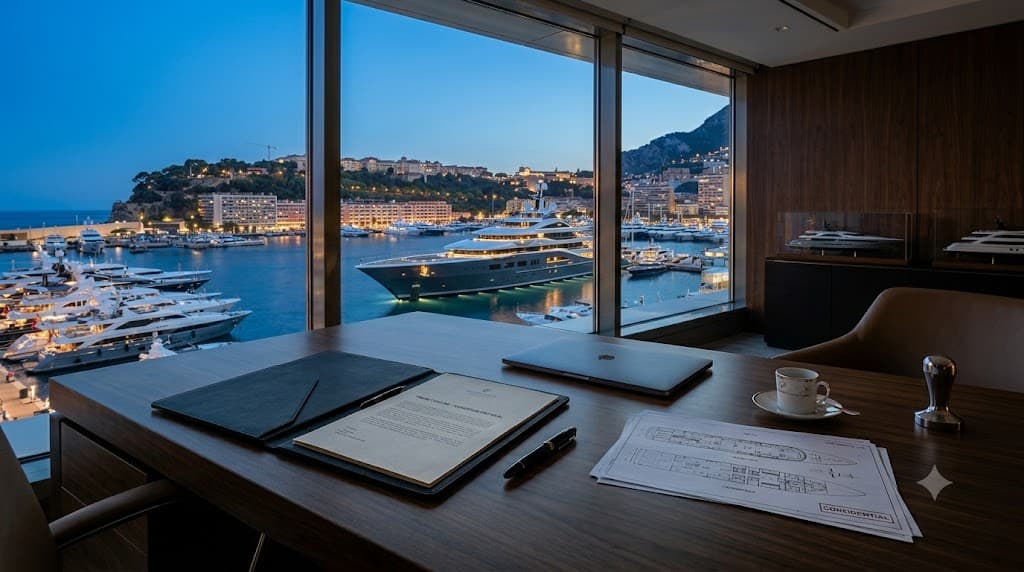
EXCLUSIVE OFF-MARKET YACHT DEALS
The Invisible Fleet: Sourcing Superyachts Beyond Public Visibility
The most desirable yachts in the world are often never advertised. Some of the largest and most significant superyacht transactions happen quietly, completely insulated from public listings, global press releases, or open brokerage exposure. In the highest echelons of luxury yachting, access often matters far more than visibility.
For Ultra-High-Net-Worth Individuals (UHNWI), single-family offices, and seasoned maritime investors, the conventional paths to yacht acquisition are increasingly viewed as inefficient. A public listing frequently carries a subtle burden of market fatigue, excessive foot traffic during international boat shows, and unnecessary media scrutiny. The true pinnacle of the luxury yacht market operates on an entirely different axis—one defined by sovereign privacy, absolute non-disclosure, and highly restricted networks that mirror the discretion of private banking and elite family office asset management.
When an exceptional custom motor yacht or a pedigree sailing yacht changes ownership off-market, the transaction leaves no digital footprint. It is an intricate dance of trusted relationships. For those inside this private sphere, the open market represents only a fraction of what is truly available. The most compelling opportunities remain hidden, accessible only to those who possess the keys to the industry’s inner circle.
Defining the Off-Market Spectrum: From Public Listings to True Private Deals
To navigate this elite domain, one must understand that off-market is not a monolithic term. Within professional luxury yacht brokerage, there is a strict hierarchy of confidentiality that governs how a high-value asset is positioned and sensitive data is handled.
Public Listings represent the visible layer of the industry. The yacht is openly promoted on global multi-listing platforms, featured in luxury lifestyle editorials, and displayed at major yacht shows in Monaco, Cannes, or Fort Lauderdale. Complete technical specifications, interior photography, and general arrangement plans are accessible to any market observer without prior qualification.
Semi-Private Listings occur when an owner wishes to test market appetite without initiating a full public campaign. The yacht is not indexed on open websites, but its availability is discreetly circulated among a select group of senior international yacht brokers. Information is shared on a need-to-know basis, allowing the owner to maintain operational privacy while quietly entertaining serious inquiries.
True Off-Market Opportunities occupy the highest tier of confidentiality. The vessel does not exist in any database, public or private. Its availability is known only to the principal owner, their personal yacht broker, and perhaps the captain or head of the asset's technical management team. Every byte of data—from the shipyard's name to the layout of the owner's deck—is heavily guarded. No information is released until a prospective buyer is thoroughly vetted, verified, and bound by a comprehensive, legally enforceable Non-Disclosure Agreement (NDA).
Owner-Direct Channels are generated directly through principal-to-principal relationships or institutional networks. These transactions are frequently handled between family offices, private wealth managers, or corporate entities holding maritime assets. By utilizing direct owner connections, buyers can bypass traditional market noise entirely, ensuring that the initial dialogue remains clear, collaborative, and completely private.
The Psychology of the UHNW Buyer: Why Discretion Prevails
The decision to acquire a superyacht through off-market channels is rarely driven by mere convenience; it is a calculated lifestyle and financial strategy employed by the world’s most sophisticated buyers. For an UHNW individual, privacy is a finite and incredibly valuable commodity. The public acquisition of a 50-meter plus luxury yacht inevitably invites external speculation from business competitors, financial journalists, and regulatory bodies.
Furthermore, elite buyers actively seek to avoid bidding wars. When a highly coveted custom build from a premier northern European shipyard hits the open market, it can spark emotional, hyper-competitive behavior among buyers, driving the transaction price well past rational valuation boundaries. Off-market procurement insulates the buyer from this artificial inflation, allowing for a structured, analytical negotiation based strictly on asset health, historical survey data, and authentic market intelligence.
Access to hidden inventory also provides an undeniable psychological and strategic advantage. Securing an elite explorer yacht or a pristine catamaran slot before it is exposed to global wealth networks ensures a position of privilege. It allows the buyer to acquire a rare asset quietly, integrate it into their private fleet, and deploy it to destinations like the Mediterranean, the Caribbean, or the South Pacific without ever entering the public discourse.
Why Billionaires Rarely Buy Yachts Through Public Listings
The world's most affluent individuals operate under a completely different paradigm of risk and acquisition logic. For a billionaire, purchasing a superyacht is not merely a transaction; it is the procurement of a sovereign floating estate. When a vessel enters the public domain, it is immediately compromised by what asset managers refer to as digital pollution. Every photograph of the master suite, every detail of the security system, and the layout of the private helipad become permanent public records. For those requiring institutional-grade security and absolute anonymity, stepping onto a yacht that has been visually cataloged by millions online is an unacceptable vulnerability.
Furthermore, public yacht listings are fundamentally structured to capture retail market attention, often carrying inflated premiums that account for extensive promotional campaigns and cascading broker commissions. Billionaires and single-family offices do not source high-value maritime assets through generic listing aggregates for the same reason they do not buy blue-chip artwork at public flea markets. They require curated intelligence. They understand that a public listing often signals that the asset has already been rejected by the private networks or carries operational constraints that prevent a quiet, swift closure.
Ultimately, the elite tier of wealth values bespoke exclusivity above all else. A yacht listed publicly lacks the narrative of a rare, non-public opportunity. By acquiring an asset through private, off-market networks, a billionaire ensures that their fleet remains completely undocumented by the press, unanalyzed by competitors, and completely isolated from market speculation. In this stratosphere of wealth, true luxury is defined by owning what money can buy, but only exclusive access can find.
The Owner’s Perspective: Why Strategic Sellers Choose Confidentiality
For a superyacht owner, protecting the asset’s reputation and market integrity is paramount. An open sale can occasionally be misinterpreted by the broader market as a sign of financial restructuring or corporate distress, regardless of how stable the owner's portfolio actually is. By electing a confidential off-market strategy, the owner safeguards their public reputation and ensures their business affairs remain entirely private.
Corporate Restructuring means that superyachts are frequently held within complex corporate structures, trusts, or offshore entities. When an owner undergoes a broader corporate realignment, asset liquidation, or generational wealth transfer, the yacht must often be repositioned. A quiet, off-market transaction allows the family office to optimize the maritime portfolio smoothly, without disrupting corporate valuations or alerting the media.
Lifestyle Transitions such as matrimonial dissolution or geopolitical tax relocation require the swift and silent redistribution of high-value assets. In these sensitive scenarios, exposing a mega-yacht to public listing platforms is legally and personally counterproductive. A private sale keeps the transaction within the confines of trusted legal frameworks and escrow accounts, far from public record.
Seamless Fleet Upgrades are chosen by many owners who are serial charterers or passionate yachtsmen consistently upgrading to larger hulls or new build slots. Selling their current vessel via a confidential network allows them to continue enjoying their summers in Monaco or winter seasons in Dubai without the intrusion of constant buyer viewings. The yacht remains fully operational and available for personal use or high-value charters until the exact moment the closing documents are executed.
Inside the NDA-Protected Superyacht Network
The private luxury yacht market operates as an elite ecosystem built on decades of mutual trust, verified track records, and strict code-of-conduct compliance. In this environment, a broker’s true value is measured not by their marketing budget, but by the depth of their private Rolodex and their standing among the world's top shipyards, yacht management firms, and maritime law practices.
Information within this network is treated with the same precision as intelligence in private banking. Senior brokers interact directly with heads of family offices, elite yacht captains, and shipyard directors to identify subtle shifts in ownership intent before those intents crystallize into formal listings. A single breach of confidentiality can permanently alienate a brokerage firm from these exclusive channels, meaning that discretion is naturally enforced by the collective self-interest of the market's key players.
Example of a Real Off-Market Deal Flow
To appreciate the sophistication of a private transaction, one must look at how a typical €20M to €80M+ superyacht acquisition actually progresses through confidential channels. These deals are highly engineered maneuvers designed to mitigate risk while preserving absolute anonymity for both the buyer and the seller.
The process initiates when an UHNW client or their family office issues a highly specific, non-public acquisition mandate. The broker activates trusted industry connections to source matching vessels that are not on the market but whose owners would entertain an institutional offer. Once a potential match is identified, the initial cross-verification begins without revealing the identity of either principal.
The transaction moves rapidly from a theoretical match to a structured legal framework. Because the asset is private, the documentation must be flawless from the outset. Specialized maritime lawyers construct bespoke agreements that govern how technical data, crew records, and inventory lists are transferred. Every interaction—from the captain's interview to the review of the yacht’s maintenance logs—is tightly monitored to prevent any external market leakage.
Sourcing Architecture: What Happens From First Contact to Closing
A professional off-market transaction follows a highly disciplined timeline executed with absolute discretion and professional precision from the initial brief to the final handover.
The process begins with the Buyer Brief and Strategic Sourcing phase. The buyer or their designated family office outlines the definitive acquisition profile. This brief extends far beyond length overall and cabin configuration; it specifies hull material, propulsion systems, cruising range, ice-class ratings, helicopter capability, and commercial charter potential. The broker then quietly queries direct owner relationships, shipyard order books, and private yacht management databases to locate the ideal candidate.
The transaction then advances to the NDA Execution and Proof of Funds phase. Before a single page of technical specification or interior layout is disclosed, both parties sign a comprehensive, multi-jurisdictional Non-Disclosure Agreement. Concurrently, the buyer undergoes an initial verification process, providing a confidential Proof of Funds or a letter of capability from an approved financial institution, alongside preliminary Know Your Customer and Anti-Money Laundering documentation.
This leads directly into the Confidential Introduction and Letter of Intent phase. Once mutually verified, the hidden asset is presented to the buyer in a controlled environment. If the buyer decides to proceed, a formal Letter of Intent or a conditional offer is drafted. This document outlines the economic terms, target closing dates, and the specific conditions precedent that must be met before funds are released from escrow.
Next comes the Technical Survey, Sea Trial, and Legal Due Diligence phase. Even in the most private transactions, rigorous due diligence is non-negotiable. A team of independent marine surveyors, bound by personal NDAs, conducts a comprehensive mechanical, structural, and electronic inspection of the motor yacht or sailing yacht. Simultaneously, a sea trial is organized quietly to test performance under operational conditions. On the legal side, title searches, hull registration verifications, and a meticulous audit of the vessel's VAT status are conducted to ensure the asset is free of liens or maritime encumbrances.
The final stage is the Escrow Setup, Closing, and Secure Delivery phase. The financial architecture of the deal is anchored by a secure escrow account managed by a premier maritime law firm or a tier-one international bank. Upon satisfaction of all technical and legal conditions, the remaining funds are transferred, ownership titles are executed, flag registration is updated under respected jurisdictions such as the Cayman Islands, Malta, or the Marshall Islands, and the yacht is discreetly delivered to its new owner along with a seamless crew transition.
Sourcing Intelligence: Where Private Yacht Opportunities Actually Originate
The inventory for off-market luxury yachts does not materialize out of thin air; it is systematically cultivated through deep integration into the maritime supply chain.
Premier Shipyards serve as invaluable sources of intelligence. Shipbuilders in the Netherlands, Germany, and Italy hold private information regarding owners who may wish to trade in an existing hull, or clients who need to quietly exit a new build project midway through construction due to changing personal or financial horizons.
Yacht Management Companies possess real-time knowledge of a vessel's true operational status and an owner’s evolving willingness to sell. These entities manage the day-to-day operations, safety compliance, and crew payroll for massive global fleets.
The Elite Captain Network acts as the frontline guardians of these assets. Because superyacht captains manage the owner's private schedule and the yacht’s technical performance, they are often the first to know when a principal is contemplating a fleet transition.
Family Office Portfolios frequently trade high-value assets internally. A family office looking to reallocate capital toward real estate or liquid markets will often offer their motor yacht or premium catamaran to friendly peer networks before involving the open market.
Comparative Matrix: Public Listings vs. Off-Market Yacht Transactions
When evaluating the parameters of high-value acquisitions, a clear structural divergence emerges between the open market and the confidential sector across all primary strategic factors.
Regarding the Level of Confidentiality, public listings offer none, as these assets are widely indexed across global platforms and search engines. In stark contrast, off-market transactions maintain an absolute level of secrecy, strictly guarded by multi-party NDAs and rigorous KYC protocols from the inception of the deal.
In terms of Pricing Dynamics, open listings are often artificially inflated to accommodate protracted public negotiations and multiple broker cuts. The off-market sector operates on pricing that is firmly grounded in objective asset valuation, facilitated through private, rational dialogue between qualified principals.
Looking at Market Integrity, a publicly listed vessel is susceptible to market fatigue if the asset remains unsold for an extended duration, diminishing its perceived value. Conversely, an off-market transaction completely retains its pristine exclusivity, ensuring the asset remains completely untarnished by public exposure.
With respect to Buyer Vetting, the open market is heavily impacted by casual inquiries and unqualified viewers, leading to unnecessary foot traffic and security risks.
The private sector mitigates this entirely, limiting access strictly to pre-qualified buyers who have provided verified Proof of Funds.
Finally, the Transaction Environment of a public sale remains vulnerable to media speculation and competitive bidding wars that drive prices beyond rational boundaries. Off-market transactions provide a protected, professional environment specifically tailored for corporate entities or private wealth management structures.
Mitigating the Inherent Risks of Off-Market Acquisitions
While the advantages of private yacht transactions are significant, navigating this space requires acute legal and technical vigilance. The primary risk of an off-market deal is the lack of public cross-referencing. Because the yacht is not exposed to the broader market, establishing an accurate baseline valuation demands exceptional market intelligence. Buyers must rely on recent, verifiable transaction data of comparable vessels to ensure they are entering the deal at an equitable price point.
Furthermore, hidden assets can occasionally carry hidden liabilities. If a yacht has been operating privately without strict institutional management, it may possess undocumented technical deficiencies or unresolved crew claims. Navigating international tax frameworks—specifically European VAT compliance, temporary admission regulations, and state-side use taxes—requires expert counsel. A successful off-market acquisition is never built on haste; it is built on a foundation of uncompromising technical surveys and relentless legal due diligence.
Critical Errors Buyers Must Avoid in Private Transactions
The most common misstep made by wealthy buyers entering the off-market sector is engaging too many intermediaries. In an attempt to uncover every hidden opportunity, a buyer might distribute their acquisition brief to multiple independent brokers. In the tightly knit world of global superyacht brokerage, this causes immediate systemic friction. The same private brief is quickly broadcast across identical closed networks, creating a false impression of hyper-demand. This artificial noise drives up the asset's implicit price and completely compromises the buyer's anonymity.
Another critical error is allowing the desire for secrecy to bypass standard technical safeguards. Some buyers, seduced by the exclusivity of an off-market deal or eager to close a distressed situation quickly, accept incomplete maintenance histories or truncated sea trials. No matter how prestigious the yacht's lineage or how elite its current owner, every system—from the stabilization units to the main engine cylinder liners—must be subjected to rigorous, independent destructive and non-destructive testing.
The Investor’s Angle: Unlocking Value in Distressed and Off-Market Assets
Professional investors and corporate entities view the off-market superyacht sector through a strictly financial lens. Professional investors typically evaluate off-market yacht opportunities through a combination of acquisition discount, projected market value, charter revenue potential, technical condition, depreciation exposure and long-term ownership efficiency.
When structured correctly, distressed acquisitions, speculative build slots and private owner transitions can create substantial value while reducing acquisition competition and preserving confidentiality. For experienced investors, the true advantage of the off-market sector is not only pricing efficiency — it is access to opportunities that may never become publicly available.
Sourcing New Build Slots and Custom Superyacht Projects
Securing a build slot at a tier-one northern European yard is one of the most complex challenges in luxury yachting. The world’s elite shipyards are often booked solid for years in advance, and they are highly selective about who they allow into their construction queues. A public buyer looking to commission a custom 60-meter or 80-meter motor yacht is frequently faced with an unacceptable delivery timeline.
The off-market network provides the only viable solution to this bottleneck. Through confidential channels, a broker can identify existing contracts where the original contracting party is willing to quietly assign their rights to a new hull. This transfer of contract equity, executed away from the public eye, allows the incoming buyer to step directly into an active build cycle, shaving years off their time-to-delivery while preserving the full shipyard warranty and the ability to tailor the final engineering and interior details.
Managing Yacht Assets for Family Offices and Corporate Fleets
For single and multi-family offices, a superyacht is a complex corporate entity requiring sophisticated oversight. It involves crew payroll management, international maritime labor compliance (MLC 2006), hull and machinery insurance, structural classification renewals, and continuous flag-state audits. When a family office interacts with the off-market sector, they require an advisory partner who understands the asset's full operational lifecycle.
The acquisition is merely the first phase. Long-term wealth preservation dictates that the yacht be placed under a professional yacht management structure that continuously monitors operational costs, charter revenues, and depreciation curves. By treating the yacht with the same analytical rigor as a private aviation asset or a commercial real estate portfolio, family offices ensure that when the time eventually comes to transition out of the vessel, its off-market residual value remains optimally preserved.
Sourcing Private Yacht Opportunities Globally
Through confidential relationships developed across shipyards, owners, family offices, and private broker networks, Master Ocean assists qualified buyers in sourcing exclusive opportunities often unavailable on the public market. The firm focuses on delivering tailored solutions for private buyers, yacht owners, and institutional investors seeking absolute discretion in their maritime transactions.
Master Ocean provides comprehensive guidance across the entire transactional arc, including:
• Bespoke off-market yacht sourcing and asset identification
• Confidential negotiation and transaction structuring
• Strict NDA-protected document coordination
• Comprehensive legal due diligence, VAT, and flag registration advisory
• Technical survey oversight and yacht management integration
Operating with a global perspective that connects key hubs across Monaco, France, Italy, Spain, the UAE, and the USA, Master Ocean ensures that its clients retain a distinct competitive edge, navigating the private superyacht market with absolute security, clarity, and precision.
Frequently Asked Questions
How is client confidentiality maintained before the physical inspection of an off-market yacht? Confidentiality is secured via a multi-tiered legal process. Prior to the release of any identifying data, a binding Non-Disclosure Agreement is executed between the principal parties. Physical inspections are scheduled during non-operational periods or private windows, ensuring no external shipyard personnel or third-party observers are aware of the buyer's presence.
Can a family office execute an off-market yacht transaction using cryptocurrency or alternative financing structures? Yes. High-value transactions are increasingly structured using diverse corporate financing models, including secured asset-backed loans, international bank guarantees, and verified digital asset transfers. Any alternative payment mechanism must undergo rigorous institutional compliance, third-party escrow verification, and comprehensive KYC/AML clearing before the execution of the final Bill of Sale.
What specific documentation is required to pass the initial off-market verification process? Prospective buyers are required to submit an updated corporate or individual profile, a formal Know Your Customer disclosure, and an official Proof of Funds. The POF typically takes the form of a confidential letter from a recognized prime bank or a certified financial audit confirming immediate liquidity equal to or greater than the target acquisition value.
How is the true market value of a hidden yacht determined without public historical data? Valuation is established through an extensive analysis of closed-door transaction registries, private shipyard build costs, and current replacement values. Professional maritime advisors cross-reference this internal data with the yacht's specific mechanical wear, depreciation lifecycle, and historical charter yields to calculate an accurate, non-inflated intrinsic value.
Are off-market yachts subject to the same international maritime regulations as publicly listed vessels? Absolutely. A private transaction changes the ownership structure but has no impact on regulatory mandates. The vessel must fully comply with all relevant flag-state requirements, international safety management codes, class certifications, and local fiscal regulations regarding VAT and temporary importation.
Why would an owner reject a public listing if it potentially exposes the yacht to more buyers? For most UHNW owners, the marginal benefit of a wider audience is vastly outweighed by the immediate costs of public exposure. Open listings attract unqualified inquiries, compromise personal privacy, disrupt personal charter schedules, and can create a perception of financial vulnerability that savvy buyers might exploit during negotiations.
How does a buyer verify that an off-market yacht is free of legal liens or undisclosed encumbrances? This is achieved during the legal due diligence phase. Specialized maritime attorneys perform exhaustive searches within the yacht’s underlying registry of charter to confirm that no outstanding maritime liens, crew wage disputes, shipyard debts, or financial mortgages are recorded against the hull.
What is the average timeline required to close a private superyacht transaction? Because the preliminary vetting and legal frameworks are established before the asset is widely introduced, an off-market deal can move with remarkable speed. A standard transaction typically concludes within 30 to 60 days, depending primarily on the complexity of the technical survey and the speed of the cross-border escrow clearing.
Can an off-market yacht be placed directly into an international charter fleet immediately after closing? Yes. If the vessel is already built to commercial compliance standards, transitioning it into an active charter fleet can be managed seamlessly. The post-acquisition yacht management structure can immediately assume operational control, updating the commercial registration and preserving continuity of bookings without public market disruption.
What role do shipyards play in enforcing off-market transaction integrity? Shipyards act as vital neutral gatekeepers. Because they wish to maintain pristine long-term relationships with both the departing owner and the incoming principal, they facilitate the secure transfer of build documentation, engineering designs, and warranty certificates under strict corporate discretion, ensuring the asset's structural history remains intact and confidential.
Conclusion
In luxury yachting, the most exceptional opportunities are rarely public. They move quietly — through trusted relationships, private intelligence, verified networks and absolute discretion. For yacht buyers, investors and owners alike, access to the right brokerage network often determines whether an opportunity is discovered or disappears before the market ever becomes aware of it.
Master Ocean works with qualified buyers, yacht owners, investors and family offices seeking confidential yacht transactions, off-market yacht opportunities and luxury yacht acquisitions worldwide.