Charterers: Budget 1.45 to 1.7x Your Quote for Yacht Charters
Yacht charter prices in 2026 run from roughly $2,000 a week for a small bareboat sailboat to $300,000 or more for a crewed superyacht, and neither number tells the whole story. The number that matters more: budget between 1.45 and 1.7 times whatever base fee you’re quoted. That gap covers the Advance Provisioning Allowance, taxes, and crew gratuity, the three line items that turn an advertised rate into your real invoice.
TL;DR:
The total cost of a yacht charter in 2026 includes a multiplier of 1.45 to 1.7 times the base fee to cover taxes, provisioning allowance, and gratuity.
Smaller groups on bareboat or skippered yachts benefit from lower per-person costs, whereas larger groups can secure more value on crewed yachts due to scaling costs.
Additional expenses like VAT, fuel, dockage, and gratuities significantly increase the final invoice, often doubling the advertised rate.
Timing and region heavily influence prices, with shoulder seasons and Mediterranean itineraries often offering savings of 25% to 35%.
Working with a yacht brokerage helps obtain a precise all-in quote, accounting for taxes, fees, and route-specific costs before booking.
How Much Does a Yacht Charter Cost by Type and Size?
Where you land on the price spectrum depends almost entirely on two choices: how much crew you want, and how big a boat you need. Bareboat charters, where you or a hired skipper run the vessel yourselves, sit at the bottom. Fully crewed superyachts sit at the top, sometimes by a factor of 100.
Weekly base rates in 2026 break down roughly like this:
Bareboat monohull sailboat (35 to 45 feet): $2,000 to $6,000
Bareboat catamaran (40 to 45 feet): $4,500 to $9,000
Skippered catamaran (45 to 50 feet): $7,000 to $14,000
Crewed motor yacht, entry tier (60 to 80 feet): $25,000 to $60,000
Crewed motor yacht, mid tier (90 to 120 feet): $70,000 to $180,000
Superyacht (130 feet and up): $200,000 to $300,000+
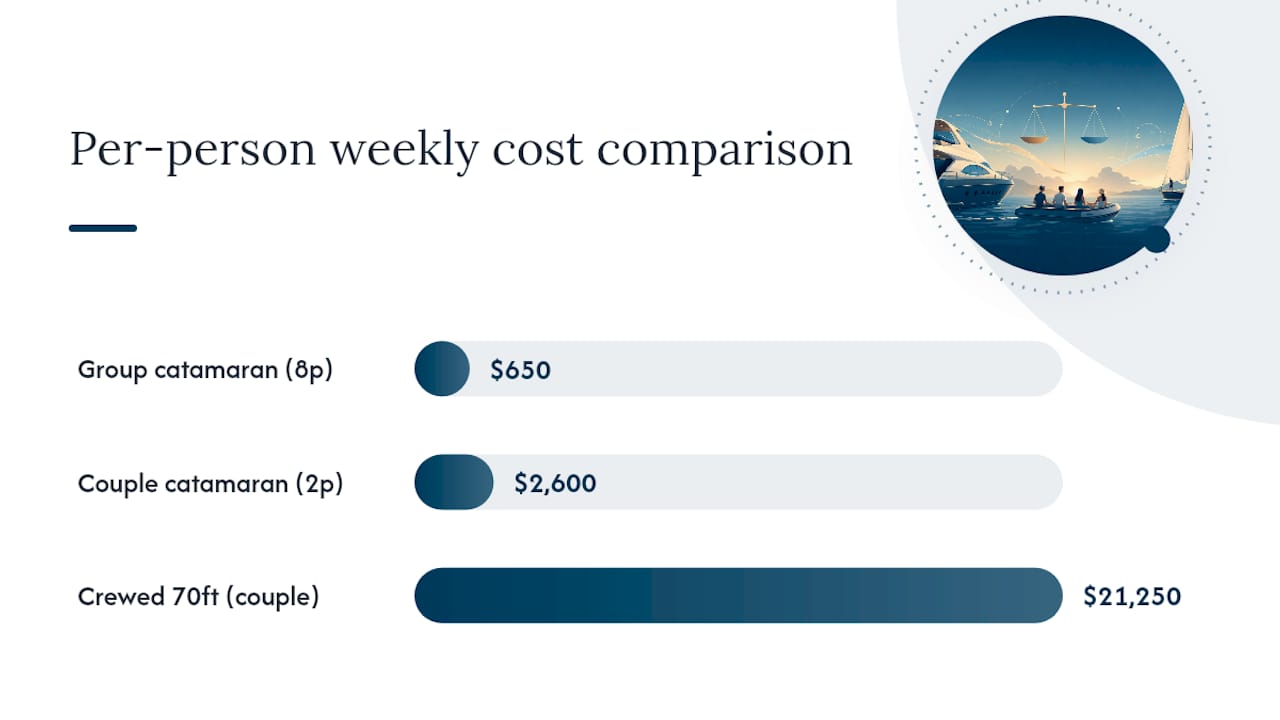
A skippered catamaran split among eight guests can run as little as $500 to $800 per person for the week, base fee only, before APA and extras. That’s a genuine benchmark against a hotel room in a comparable destination, which is part of why charter demand keeps climbing among groups who never considered it affordable.
The math changes fast with smaller groups. A couple chartering that same catamaran pays the full base fee themselves, so per-person cost roughly quadruples. Crewed yachts compress this gap less because service and crew costs scale with the boat, not the guest count, which is why couples chartering a crewed 70 footer often find the per-person math less favorable than a big group on a bareboat catamaran.
What’s Included in the Base Fee, and What Costs Extra?
The base charter fee covers the yacht itself and, on crewed charters, the crew’s wages and the vessel’s ordinary running condition. It does not cover what you eat, drink, burn in fuel, or tip the captain. That’s where APA and the other line items come in, and misreading this distinction is the single biggest source of budget shock.
Here’s how the extra costs typically break out:
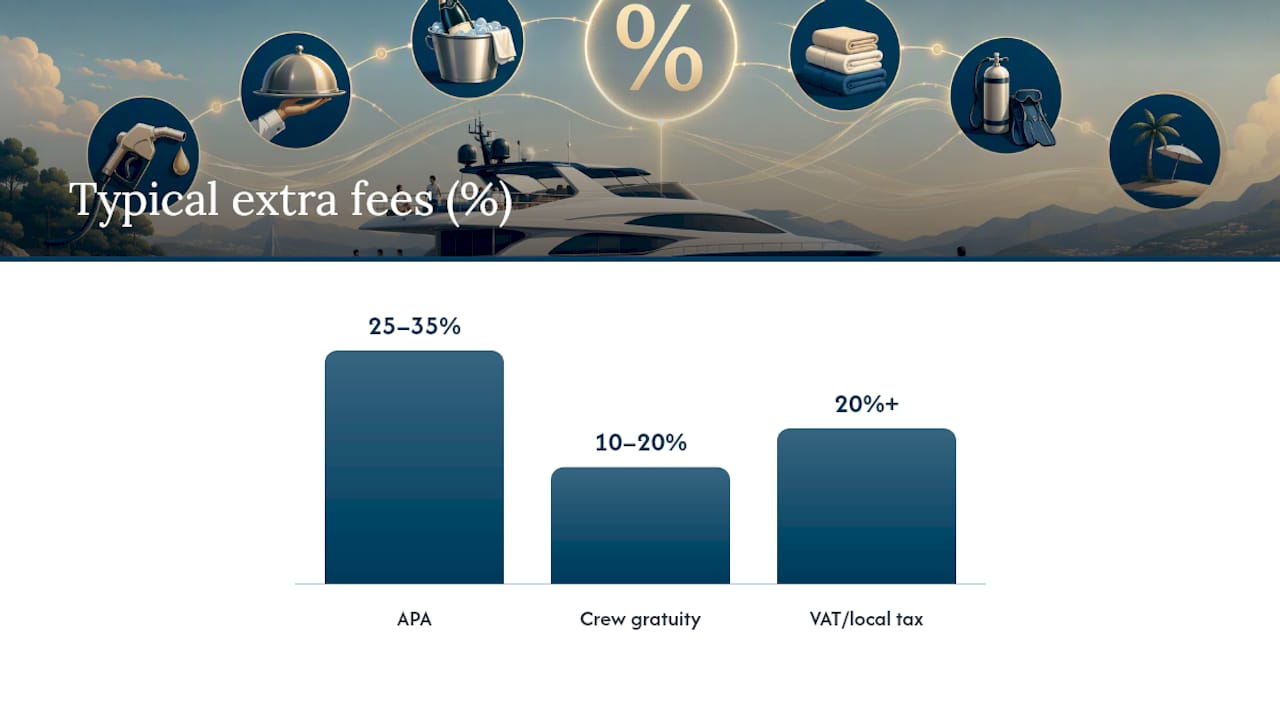
APA (Advance Provisioning Allowance): Usually 25% to 35% of the base fee, paid before the trip into an account the crew draws down for fuel, food, drinks, and dockage. Whatever’s unspent gets refunded at the end; whatever runs short, you cover on the spot.
VAT and local taxes: Vary by country and by where the charter embarks, sometimes reaching 20% or more in certain jurisdictions.
Crew gratuity: Customarily 10% to 20% of the base fee, paid at the end of the charter directly to the crew.
Bareboat running costs: Fuel, marina fees, and provisioning are billed separately, usually settled with a security deposit or fuel card at pickup and return.
Pro Tip: Ask for an itemized APA reconciliation clause in writing before you sign. A vague “APA will be settled at the end of the trip” line is how good-faith guests end up arguing over a bar tab on the last night.
Do Yacht Charter Prices Vary by Region?
They vary substantially, and the driver usually isn’t the boat, it’s the tax code and the local infrastructure. Mediterranean charters run 15% to 25% more expensive than equivalent Caribbean trips for a comparable yacht, largely because of VAT exposure and marina density in ports like Cannes, Portofino, and Dubrovnik.
A few levers move the number inside each region:
The embarkation port determines VAT exposure, since itineraries that stay in international waters or clear from a non-EU port can shift the tax treatment entirely.
Anchoring overnight instead of booking marina berths cuts both dockage fees and fuel burn on generator-heavy nights.
VAT treatment in the Mediterranean is genuinely itinerary-dependent, so a written statement from your broker before signing can save a swing of 10% to 20% on the total trip cost.
If you’re weighing Mediterranean options against a Caribbean itinerary, the base rate is only half the comparison. Run both regions through the same all-in multiplier before deciding.
What Else Drives the Final Price Up or Down?
Two boats of similar size and class can carry wildly different price tags, and it’s rarely random. A handful of factors do most of the work.
Season. Peak weeks (typically July and August in the Mediterranean, or the winter months in the Caribbean) can cost 25% to 35% more than shoulder-season sailing the same route.
Yacht age and equipment. A newly refit vessel with modern stabilization, updated air conditioning, and a full water-toy inventory commands a premium over an older sister ship, even at identical length.
Itinerary intensity. A charter that moves anchorage every day burns far more fuel than one that parks in a bay for three nights, and that difference lands directly on your APA bill.
Crew size and guest count. More crew means higher wages baked into the base fee, and a full guest list on a yacht rated for fewer people tends to push service standards, and therefore quotes, upward.
None of these show up clearly on a listing page. They show up on the invoice, which is why two “identical” 70 foot motor yachts can differ by tens of thousands of dollars for the same week.
How Do You Calculate the Real Cost of a Charter?
Run any quoted base fee through this sequence before you commit to a number.
Start with the advertised weekly base fee. This is the number brokers lead with, and it’s the smallest number you’ll actually pay.
Add APA at 25% to 35%. This covers fuel, food, drinks, and dockage, and unspent funds get refunded.
Add VAT or local taxes where they apply. Confirm the rate with your broker in writing, since it depends on embarkation country and route.
Add crew gratuity at 10% to 20% of base, plus any marina or fuel costs not covered by APA on a bareboat charter.
A worked example: a 45 foot crewed catamaran quoted at $12,000 for the week. Total: roughly $18,600, or about 1.55 times the headline rate, squarely inside the industry rule of thumb of 1.45 to 1.7x. Split across eight guests, that’s under $2,325 per person for a week on the water.
How Can You Get the Best Yacht Charter Deal?
Timing does more for your budget than negotiating ever will. Shoulder-season and last-minute bookings can run 25% to 35% below peak-season rates in many regions, though you trade some flexibility on dates and boat selection.
Before you sign anything, get clear answers on these points:
How VAT applies to your specific itinerary, in writing, not verbally
Whether APA is capped or open-ended, and how reconciliation is documented
The fuel policy: full-to-full, or billed against actual consumption
Cancellation terms and what portion of your deposit is refundable
A few watch-outs are worth flagging before you wire a deposit. Vague APA language (“provisioning will be arranged as needed”) without a percentage or cap is a red flag. So is a contract that skips itemized reconciliation at the end of the trip, or a security deposit handled informally rather than through an escrow-style arrangement. It’s almost always fuel, APA, or gratuity quietly left off the headline number.*
Booking Mediterranean charters as prices soften this summer is one example of how timing windows open up real savings without sacrificing the itinerary you actually want.
What Can Master Ocean Do for Your Charter Budget?
Getting an accurate all-in number before you commit is exactly the kind of work a brokerage handles daily. Yacht brokerages support charter planning across:
Bespoke quote comparisons across bareboat, skippered, and fully crewed options
APA estimation and reconciliation guidance before you sign
Itinerary planning that accounts for VAT exposure and fuel-heavy routes
Delivery and logistics coordination for cross-region charters
If you’re weighing bareboat against a crewed charter, a broker conversation upfront typically catches the cost surprises before they reach your final invoice.
What Should Charterers Actually Prioritize in 2026?
The conventional advice on yacht charter pricing spends too much time on the headline weekly rate and not enough on the multiplier. A $30,000 boat with a vague APA clause can cost more, in real dollars, than a $35,000 boat with a tight, itemized one. That’s the gap most first-time charterers fall into: they compare base fees across brokers like they’re comparing hotel rates, when the real variable is how disciplined the operator is about APA reconciliation and tax disclosure.
Group size matters more than boat size for per-person value. And the biggest lever most people ignore is timing. Shifting a Mediterranean charter from August to early June can cut the total bill by a third without touching the itinerary. Rate the base fee last, not first.
— Master
Ready to Get an Accurate Charter Quote?
A yacht brokerage works as the alternative to comparing bare listing prices on your own: instead of guessing at APA, VAT, and gratuity separately, you get one broker-built estimate that reflects the full cost before you commit to a date.
A consultation with Master Ocean typically covers a detailed APA estimate scoped to your itinerary, a written VAT treatment statement for your embarkation country, and an itinerary review that flags fuel-heavy legs before they hit your bill. Browse current listings on yachts for charter, or connect directly with yacht brokerage consulting to request a bespoke, all-in quote for your dates and destination.
Sources
How much does a yacht charter cost? A complete Global price breakdown - Up and Sail
The 2026 Luxury Yacht Charter Cost Index | Uncompromised Travel