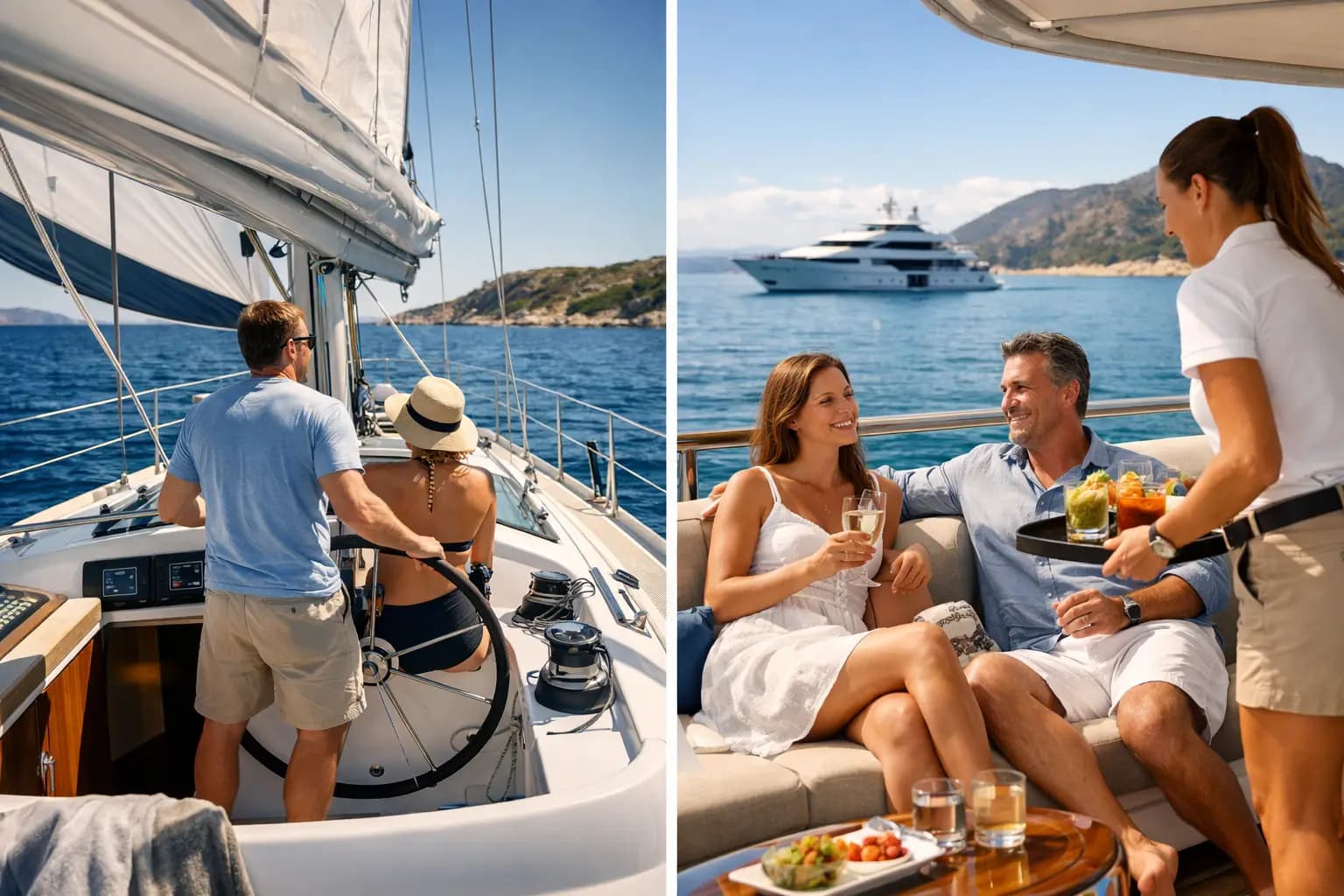
The difference between a memorable yacht vacation and the wrong charter often comes down to one decision: bareboat vs crewed charter. On paper, both put you on the water. In practice, they deliver completely different experiences, different responsibilities, and a very different relationship with the yacht itself.
For some clients, the appeal is complete independence - setting your own pace, taking the helm, and managing each day on your terms. For others, the standard is higher: a professionally staffed yacht, tailored service, expert local guidance, and the freedom to enjoy the destination without thinking about operations. Neither option is universally better. The right choice depends on how you travel, how experienced you are, and what you expect from time on board.
Bareboat vs crewed charter: the core difference
A bareboat charter gives you the yacht without crew. You or someone in your party acts as skipper and takes responsibility for navigation, docking, route planning, safety, and daily onboard management. Depending on the yacht type and destination, charter companies will usually require proof of relevant licensing and practical experience.
A crewed charter includes professional staff, often at minimum a captain and, on larger or more refined programs, additional crew such as a chef, stewardess, deckhand, or full hospitality team. The yacht is operated for you. The experience becomes less about running the vessel and more about enjoying a private service environment on the water.
That distinction affects everything else - privacy, effort, itinerary style, onboard comfort, destination access, and overall expectations.
Who bareboat charter suits best
Bareboat charter is best suited to experienced, confident boaters who genuinely want to operate the yacht themselves. This is not simply about being able to steer. It means understanding weather patterns, local regulations, anchorage selection, mooring procedures, fuel management, and contingency planning.
For the right client, that level of control is the entire point. You decide when to leave the marina, where to stop for lunch, how long to remain in a bay, and whether the day should be active or quiet. There is a personal satisfaction in commanding the itinerary directly, especially in sailing destinations where the act of handling the yacht is part of the pleasure.
Bareboat also tends to attract travelers who prefer a more private internal dynamic. Without crew on board, the yacht feels more self-contained. For families or close groups with strong boating competence, that can create a relaxed and personal atmosphere.
Still, independence comes with workload. Even on a leisurely itinerary, someone is always responsible for the vessel. Weather changes, provisioning, lines, systems checks, and harbor logistics do not disappear because the trip is meant to feel like a vacation.
When a crewed charter makes more sense
A crewed charter is often the stronger choice for clients who value time, comfort, and curated service over hands-on yacht operation. It is especially well suited to luxury travelers, multigenerational families, corporate hosts, and groups visiting unfamiliar cruising grounds.
With a professional captain and crew, the operational side disappears into the background. Mooring, navigation, local permissions, table service, housekeeping, meal planning, water toy setup, and day-to-day yacht management are all handled for you. That changes the rhythm of the trip immediately. You wake up, step on deck, and focus on the destination rather than the mechanics.
This matters even more in high-demand regions such as the French Riviera, the Balearics, Greece, Croatia, Dubai, or the Caribbean, where local knowledge can significantly improve the experience. A seasoned captain knows where to anchor comfortably, when to avoid crowded berths, how to time arrivals, and which coves, beach clubs, or ports genuinely fit your style.
For many clients, crewed charter is not only about luxury. It is about removing friction. The yacht becomes a private floating villa with a professional team behind it.
Cost is not the whole story
Clients often approach bareboat vs crewed charter with price as the first filter. That is understandable, but it can be misleading if viewed too narrowly.
A bareboat charter usually has a lower base charter rate because you are not paying for onboard crew service. That said, the lower headline cost does not mean the experience is simpler or automatically better value for every traveler. You may still need to account for fuel, provisioning, berthing, cleaning, security deposits, and the practical value of your own time and responsibility.
A crewed charter carries a higher overall investment, particularly on larger yachts or premium itineraries. However, it also includes a different category of product. You are paying for vessel operation, service delivery, hospitality, destination expertise, and a far more effortless standard of travel. For many clients, that is not an added luxury. It is the central reason to charter at all.
Value, in this context, depends on what you are trying to buy: command or convenience, autonomy or service.
Experience on board feels completely different
Two yachts of similar size can feel like entirely different vacations depending on whether they are bareboat or crewed.
On a bareboat charter, the atmosphere is more participatory. The day often starts with practical decisions - weather review, route choices, breakfast logistics, and marina or anchorage planning. If you enjoy the boating side, this feels engaging and rewarding. If you do not, it can quietly dominate the trip.
On a crewed charter, the guest experience is deliberately protected from those demands. Meals appear at the right time. Towels are refreshed. The yacht is reset between activities. Transfers, lunch reservations, and water sports can be coordinated without guests handling the details themselves. The result is not just more comfort, but more mental space.
That difference becomes especially clear on longer charters. A few days of self-management can be enjoyable. A week or more of managing a yacht while trying to host family or entertain guests is another matter entirely.
Licensing, confidence, and real capability
One of the most common mistakes in bareboat planning is assuming that prior boating experience automatically translates into bareboat readiness in every destination. It does not.
Charter operators and local authorities may require formal certifications, VHF credentials, logbook evidence, or a demonstrated level of command appropriate to the yacht size and cruising area. Even where regulations are straightforward, practical skill matters more than confidence alone.
A client who is highly capable on a familiar coastline may feel very different when handling stern-to mooring in a crowded Mediterranean port or navigating a busy island route with changing conditions. This is where honest self-assessment matters. Charter should feel rewarding, not stressful.
If there is any hesitation about qualifications or operational comfort, crewed charter is usually the better decision. It preserves the quality of the trip and reduces avoidable risk.
The destination can decide for you
Not every cruising ground favors the same charter style.
Bareboat can work beautifully in destinations with straightforward navigation, established charter infrastructure, and clients who are comfortable managing the vessel independently. Certain sailing regions are built around that model.
Crewed charter becomes more attractive where berthing is competitive, local insight has real value, itinerary complexity is higher, or the social standard of the trip matters as much as the scenery. If your plan includes refined dining ashore, event access, island-hopping with minimal effort, or hosting guests who expect a polished onboard environment, crew is often the more natural fit.
Destination choice also affects how much support you may want before and during the charter. A professionally managed crewed program can simplify permits, provisioning preferences, guest requests, and itinerary planning from the outset.
How to choose between bareboat and crewed charter
The clearest way to decide is to ask what role you want the yacht to play in the trip. If the yacht itself is your activity - if you want to sail, navigate, make technical decisions, and shape the experience firsthand - bareboat may be the right fit.
If the yacht is your setting for leisure, entertaining, family time, or destination-led travel, crewed charter usually aligns better. It gives you access to the same coastlines and anchorages, but through a more refined and professionally supported lens.
The size of your group also matters. Couples or highly experienced small parties may enjoy the simplicity of bareboat. Larger groups, mixed-experience guests, or clients celebrating an occasion typically benefit from the structure and service of a crewed yacht.
For those comparing options at the premium end of the market, the decision rarely comes down to capability alone. It comes down to standards. How much service do you expect? How much responsibility do you want to retain? And what kind of experience do you want your guests to remember?
At Master Ocean, these conversations are most valuable when handled early, before yacht selection begins. The charter style should lead the search, not follow it.
The right yacht matters, but the right charter format matters first. Choose the version of yachting that matches how you actually want to live on board, and the entire journey tends to fall into place.