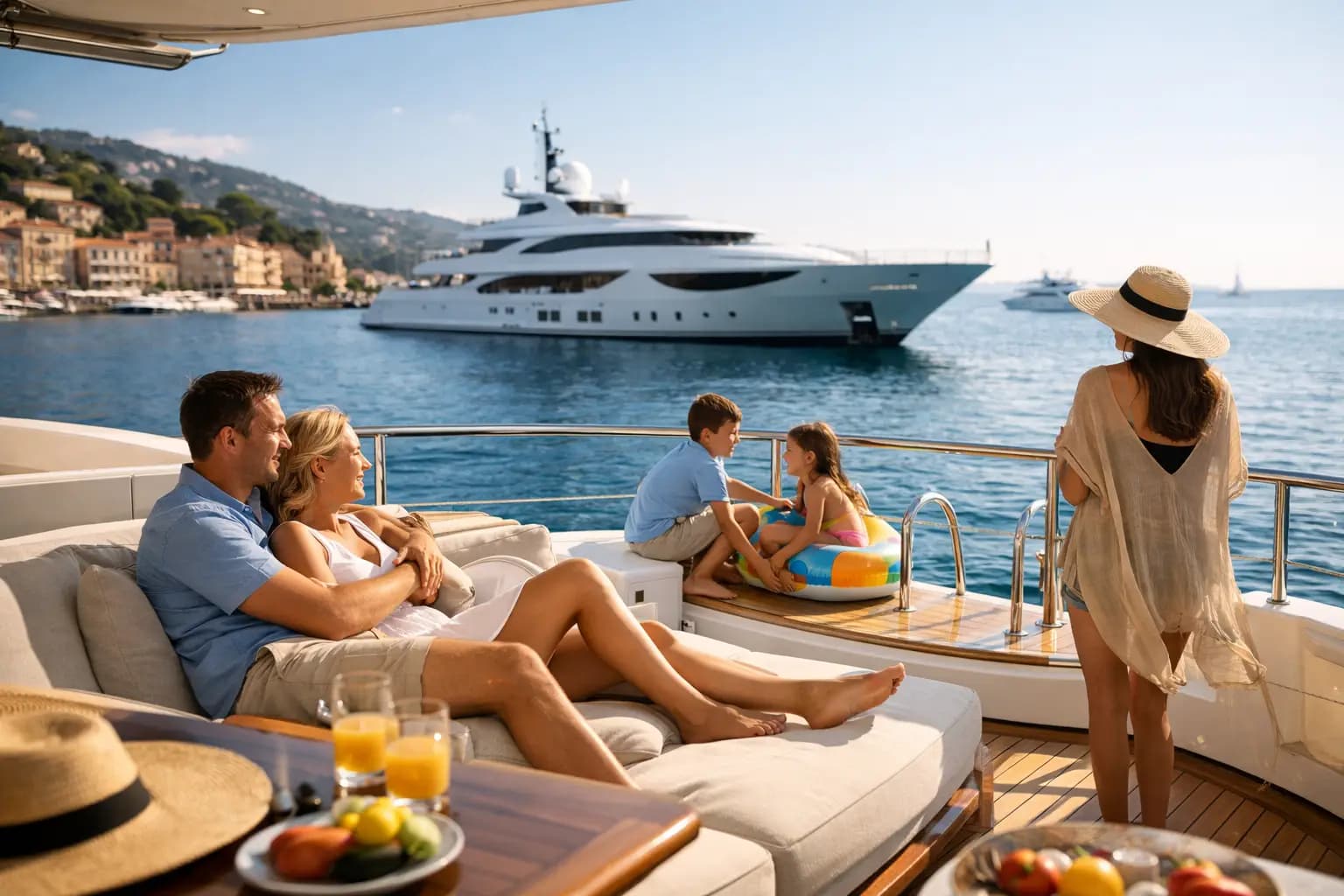
A family yacht is tested in the first hour, not the first season. You see it when children need shade, teenagers want space, grandparents want easy movement, and parents want the day to feel effortless rather than managed. That is why the best yachts for families are rarely defined by length alone. The right yacht is the one that balances safety, comfort, privacy, and practical flow without losing the sense of occasion that makes time on the water worth planning around.
For family use, the conversation should move beyond headline features and focus on how people actually live on board. A spectacular profile or aggressive performance number may impress at the dock, but family buyers and charter clients usually benefit more from thoughtful layouts, stable cruising behavior, generous deck circulation, and cabins that work for mixed age groups. The real decision is not simply what looks impressive. It is what will still feel comfortable on day three of a coastal cruise or during a two-week summer itinerary.
What makes the best yachts for families?
The strongest family yachts tend to share a few traits. They offer predictable stability, easy boarding, safe side decks, protected outdoor seating, and enough separation between social areas and sleeping areas to keep different routines from colliding. On a family yacht, design details matter. Wide steps, handholds in the right places, shaded aft decks, practical swim platforms, and flexible cabin arrangements often matter more than top speed.
Crew configuration also changes the equation. Some families prefer an owner-operated yacht with straightforward systems and manageable proportions. Others want a fully crewed experience where service, itinerary planning, watersports setup, and onboard dining are handled professionally. Neither approach is inherently better. It depends on whether the priority is hands-on ownership or a more curated lifestyle experience.
1. Power catamarans
If the brief is stability, usable volume, and family-friendly circulation, power catamarans deserve serious attention. Their beam creates a more planted feel at anchor and underway, which many families appreciate, especially when traveling with children or guests who are less comfortable at sea. The salon and cockpit often connect in a natural way, creating one large social space that feels easy rather than formal.
Another advantage is cabin distribution. Because the accommodations are spread across two hulls, power catamarans can offer privacy without forcing everyone into a compact central plan. Parents can have separation from children's cabins, and guests can enjoy more personal space. The trade-off is that marina access and berth costs can be more complex due to width, and some buyers still prefer the visual profile and prestige associated with a traditional monohull motor yacht.
2. Sailing catamarans
For families who value long-range cruising, outdoor living, and a quieter pace on the water, sailing catamarans remain one of the smartest formats available. They provide excellent deck space, shallow draft for select anchorages, and highly social upper and aft lounging areas. Many families also appreciate the more relaxed rhythm of sail-assisted travel, particularly in destinations such as the Mediterranean or Caribbean.
That said, sailing catamarans are not automatically ideal for everyone. Boom position, rigging, and sail handling introduce additional considerations, especially for younger children. The onboard experience is still highly comfortable, but it is more nautical in character than a motor yacht. For the right family, that is part of the appeal. For others, especially those prioritizing fast transfers and simplified operation, a power platform may be the better fit.
3. Flybridge motor yachts
Flybridge motor yachts are often the most versatile answer for family buyers who want a classic luxury yachting experience with clear separation of spaces. A well-designed flybridge creates a second living area that can function as an informal lounge, dining space, or observation deck. This matters when different age groups want different atmospheres at the same time.
Inside, these yachts often deliver a strong balance between elegance and practicality. The main deck salon offers climate-controlled comfort, while lower deck cabins can accommodate children, guests, and staff or crew depending on the size category. The best examples keep side decks secure and allow direct, simple movement between helm, cockpit, bow seating, and swim platform.
The trade-off is that not every flybridge yacht is equally family-minded. Some are built more for entertaining than extended family cruising, with design emphasis on style over storage, circulation, or child-safe deck planning. In this segment, layout discipline matters more than brand prestige alone.
4. Raised pilothouse yachts
Families planning longer voyages or multi-generational cruising often gravitate toward raised pilothouse yachts. These vessels tend to offer more defined living zones, substantial interior volume, and a calmer onboard rhythm suited to extended time aboard. The elevated helm area also creates strong visibility and keeps navigation separate from guest relaxation spaces.
This style appeals to owners who want substance. Storage is often better, crew service can be more discreet, and accommodations are usually more comfortable for longer itineraries. These yachts may not feel as sporty as open models, but for a family that values dependable comfort over showpiece design, they can be a very strong choice.
5. Explorer yachts
An explorer yacht is not only for remote expeditions. Increasingly, families choose this category because it supports serious time on board. Explorer yachts tend to offer robust build quality, long-range capability, larger tankage, practical toy storage, and layouts designed for real-world use. They suit owners who want to move between regions, spend extended periods aboard, or combine luxury cruising with operational confidence.
For families, the appeal is clear. There is usually more room for tenders, watersports equipment, and support systems that make longer stays easier. The atmosphere is often less glossy than a pure Mediterranean-style cruiser, but more purposeful. If your version of family yachting includes varied climates, ambitious itineraries, or support for larger guest groups, this category deserves attention.
6. Tri-deck superyachts
At the top end of the market, tri-deck superyachts offer the most complete answer for families who entertain extensively or travel with household staff, security, nannies, or multiple generations. The scale allows for true separation between owner spaces, guest accommodations, crew circulation, and service areas. That separation can transform the onboard experience from crowded to composed.
These yachts also create room for features that genuinely improve family life rather than simply decorate it. Beach clubs, elevators, cinema rooms, wellness areas, convertible cabins, and multiple dining options all become possible. The trade-off is obvious - acquisition, crew, maintenance, and operational requirements rise significantly. For some families, that is justified by the privacy and capability. For others, it is unnecessary excess.
7. Open and coupe motor yachts
Open and coupe motor yachts can work for families, but only under the right circumstances. They are often ideal for stylish day use, short coastal stays, and owners who prioritize speed, easy entertaining, and a strong connection to the water. In markets such as Miami, Ibiza, or the French Riviera, they can be excellent for social cruising with older children or adult guests.
Where they become less ideal is in weather protection, interior volume, and overnight flexibility. Families with very young children, grandparents, or plans for longer cruising windows usually outgrow this format quickly. These yachts are best viewed as lifestyle platforms first and family cruisers second.
8. Custom family-focused yachts
Some of the best yachts for families are not defined by category but by specification. A semi-custom or custom yacht can be tailored around how one family actually uses the vessel. That might mean convertible children's cabins, dedicated nanny accommodations, a more secure beach club arrangement, enhanced refrigeration for extended voyages, or quieter crew routing for privacy.
This route offers the greatest alignment with personal lifestyle, but it also demands patience, technical oversight, and the right advisory support. Custom projects reward clarity. If a family knows exactly how they travel, host, and spend time on board, customization can solve problems standard production layouts never quite address.
How to choose between the best yachts for families
The most reliable starting point is not model length. It is usage. A family planning summer charters with full crew has different needs than an owner planning to operate the yacht privately with occasional staff support. A household centered on weekend escapes will evaluate space differently than one planning month-long itineraries through the Balearics or the Caribbean.
Age mix matters too. Young children usually benefit from secure deck design, shaded lounges, and simple cabin access. Teenagers often care more about privacy, water access, connectivity, and informal hangout space. Older guests generally notice step geometry, railing height, movement underway, and bathroom accessibility before anything else.
Then there is service support, which is often underestimated. The right yacht is only part of the equation. Charter strategy, management quality, technical oversight, crew standards, and itinerary planning all affect whether family time on board feels elevated or complicated. This is where a full-service partner such as Master Ocean can add real value, particularly for clients balancing ownership decisions with charter potential and operational expectations.
A well-chosen family yacht should do something rare. It should feel luxurious without being fragile, impressive without being exhausting, and versatile without becoming generic. The best choice is the one that lets each generation enjoy the water in its own way while still bringing everyone back to the same table at the end of the day.