$100,000 Hawaii Rule and Lender Demands: Yacht Insurance Owners Need
Yacht insurance isn’t mandated by law in most U.S. states, but that doesn’t make it optional. Lenders, marinas, and port authorities routinely require it as a condition of financing or berthing, and a handful of jurisdictions, Hawaii among them, impose it by statute. At minimum, expect to carry liability coverage, hull protection where the vessel has a loan or slip contract, and proof of insurance, either a physical insurance card or a policy declarations page, whenever you’re asked for it.
TL;DR:
Most yacht owners are required by lenders or marinas to carry liability and hull coverage, even if not mandated by law in their state.
Hull and Machinery policies cover physical damage to the vessel, while Protection and Indemnity policies handle third-party claims and pollution costs.
Owners favor agreed value policies for higher-value or older yachts to ensure full payout regardless of depreciation; ACV policies pay less after a total loss.
Private-use policies typically exclude commercial charter activities, making disclosure of any paid use essential before chartering the vessel.
Proper documentation, including current surveys and fresh proof of insurance, is crucial for insurance approval and avoiding lapse-related claim denials.
Yacht Insurance Requirements: Core Policy Types Explained
Two policies do most of the work in any serious yacht insurance program, and confusing them is one of the fastest ways to end up underinsured.
Hull & Machinery (H&M) covers physical damage to the vessel itself: the hull, engines, generators, tenders, and onboard systems. It typically extends to sue-and-labor costs (expenses to prevent further damage after an incident) and salvage charges when a boat runs aground or takes on water. This is the policy that pays to fix or replace the boat.
Protection & Indemnity (P&I), sometimes just called liability coverage, handles third-party claims: injury to a guest, damage to another vessel, pollution cleanup, and wreck removal after a casualty. Larger yachts and commercial operations often access enhanced P&I protection through specialist P&I clubs, which tend to offer deeper support for pollution and wreck removal than standard retail policies.
A third piece, crew personal accident and medical coverage, matters most on crewed vessels. Where the Maritime Labour Convention applies, owners carry welfare and medical obligations toward crew that a standalone P&I policy may not fully satisfy.
One decision shapes every claim you’ll ever file: agreed value versus actual cash value (ACV).
Agreed value locks in a payout amount at the policy’s start, so a total loss pays that fixed figure regardless of depreciation.
ACV factors in depreciation, meaning an older yacht’s payout after a total loss can fall well short of what it would cost to replace.
Owners of higher-value or older yachts generally lean toward agreed value for exactly this reason.
Standard Coverage Versus Optional Endorsements
Every yacht policy bundles a baseline of protection, then lets you add endorsements for specific risks. Knowing which is which keeps you from assuming you’re covered for something you’re not.
Standard inclusions typically cover:
Third-party liability up to the policy’s base limit
Hull and machinery damage from named perils
A running down clause (liability for collision with another vessel)
Basic salvage and wreck removal contribution
Common optional endorsements include:
Pollution liability above standard P&I limits
War and strikes coverage for transits through higher-risk waters
Electronics, tender, and personal effects coverage
Loss of charter income if the vessel can’t be chartered after a covered loss
Kidnap and ransom coverage for yachts cruising specific regions
Specialist markets, including major marine insurers like Chubb, offer tailored products for high-value yachts with features like no-deduction total-loss settlement and extended replacement-cost options. If your yacht carries fine art, custom electronics, or unusually high-value contents, ask specifically about scheduled coverage for those items, since standard hull limits often cap out well below replacement cost.
Charter use changes everything about what endorsement you need. A policy written for private use typically excludes commercial activity outright, so any paid charter work requires a separate endorsement or a dedicated commercial policy.
Pro Tip: Before signing a charter management agreement, ask your broker to confirm in writing that your current policy extends to chartering. A verbal assurance from a dockside acquaintance is not proof of coverage.
Where Insurance Is Legally Required: Hawaii and State Examples
Statutory insurance mandates for recreational vessels are rare across the United States, but they’re not nonexistent, and lenders fill most of the remaining gap on their own.
Hawaii is the clearest example. Under HRS Section 200-13.5, vessels 26 feet or longer must carry at least $100,000 in coverage for removal and salvage of a grounded vessel, enforced through the DLNR Division of Boating and Ocean Recreation. Acceptable proof must show the carrier name, policy number, hull identification number, and effective dates, either on a declarations page or an insurance card.
Outside Hawaii, most states don’t mandate boat insurance by statute, but that rarely matters in practice. Lenders financing a yacht purchase almost always require:
Comprehensive and collision coverage for the life of the loan
The lender named as loss payee on the policy
Continuous coverage with advance notice before any cancellation or lapse
Marinas add their own layer. It’s common for a berthing contract to specify a minimum liability limit—often substantial—plus a requirement that the marina be named as additional insured on your declarations page before you’re handed a slip key.
Carry a declarations page that spells out policy limits, named insureds, and effective dates. Present it whenever a marina, port authority, or lender asks, rather than waiting to be asked twice.
What Drives Your Premium and Underwriting Terms
Underwriters price a yacht policy on four broad categories, and owners who understand them can influence their own terms more than they think.
Vessel characteristics carry the most weight: length, age, construction material, replacement value, and installed electronics all factor into the quote. Operational factors come next, including cruising area, planned voyages, and whether the boat sits in wet storage year round or gets hauled for winter. Transits through higher-risk waters, hurricane corridors during storm season being the obvious case, commonly trigger added premium or specific endorsements. NOAA’s National Hurricane Center advisories are a standard reference point insurers and owners both watch when planning seasonal transits.
Human factors matter almost as much as the boat itself: owner and crew experience, relevant certifications, and claims history all shape the quote you receive. Documentation rounds it out. Survey reports, maintenance logs, and onboard safety and security equipment give underwriters a reason to offer better terms rather than default pricing.
Owners who commission a professional survey and keep a structured maintenance log at renewal time typically see better underwriting terms and faster claims handling than owners who show up with nothing but a title.
Charter or commercial use changes the entire calculation, and undisclosed charter activity is one of the most common reasons insurers deny a claim outright.
How to Buy Yacht Insurance: A Practical Checklist
Buying or renewing a policy is straightforward once you know the sequence. Work through it in order rather than jumping straight to a premium quote.
Commission a marine survey. A current condition and valuation survey gives underwriters the data they need and often unlocks better terms than a quote based on self-reported specs alone.
Read the declarations page line by line. Confirm wreck removal and pollution wording, additional insured clauses, and loss payee language before you sign anything.
Choose agreed value or ACV. Base this on the yacht’s age and how much depreciation risk you’re willing to absorb in total loss.
Set liability limits to match your cruising and berthing reality. A marina requiring $500,000 in liability makes a $100,000 policy worthless for berthing purposes, regardless of what it costs.
Disclose any charter or commercial use up front. Request the correct endorsement rather than hoping it never comes up.
Keep proof of insurance accessible. A declarations page or insurance card should live onboard and in whatever file you hand to a lender or marina on request.
Pro Tip: Renew your survey before your policy renewal date, not after. Underwriters price current risk, and a five-year-old survey report tells them nothing about the boat sitting in the water today.
Common Exclusions Owners Miss Until It’s Too Late
Wear and tear, gradual deterioration, fouling, and corrosion sit outside coverage on nearly every yacht policy, since insurers treat these as maintenance issues rather than insurable losses. Unapproved repairs done outside a licensed yard can void a claim tied to that repair even years later.
Commercial and charter use is the exclusion that catches the most owners off guard. A policy written for private pleasure use typically excludes any paid use of the vessel outright, and undisclosed charter activity is a frequent cause of denied claims and voided coverage.
Hull and P&I responsibilities also overlap in ways that surprise first-time owners, particularly around who actually pays for pollution cleanup or wreck removal after a grounding. Specialist marine underwriters and P&I clubs tend to draw these lines more clearly than generalist insurers, which is worth checking before you bind a policy on price alone.
How Master Ocean Supports Insurer-Ready Ownership
Meeting yacht insurance requirements starts with documentation, and that’s where yacht surveying and audit services matter most. Master Ocean coordinates survey reports, maintenance records, and technical inspections that give underwriters exactly what they need to quote accurately. Combined with yacht management support and registration coordination, owners arrive at renewal with a documentation file, not a scramble.
What Happens When You File a Yacht Insurance Claim
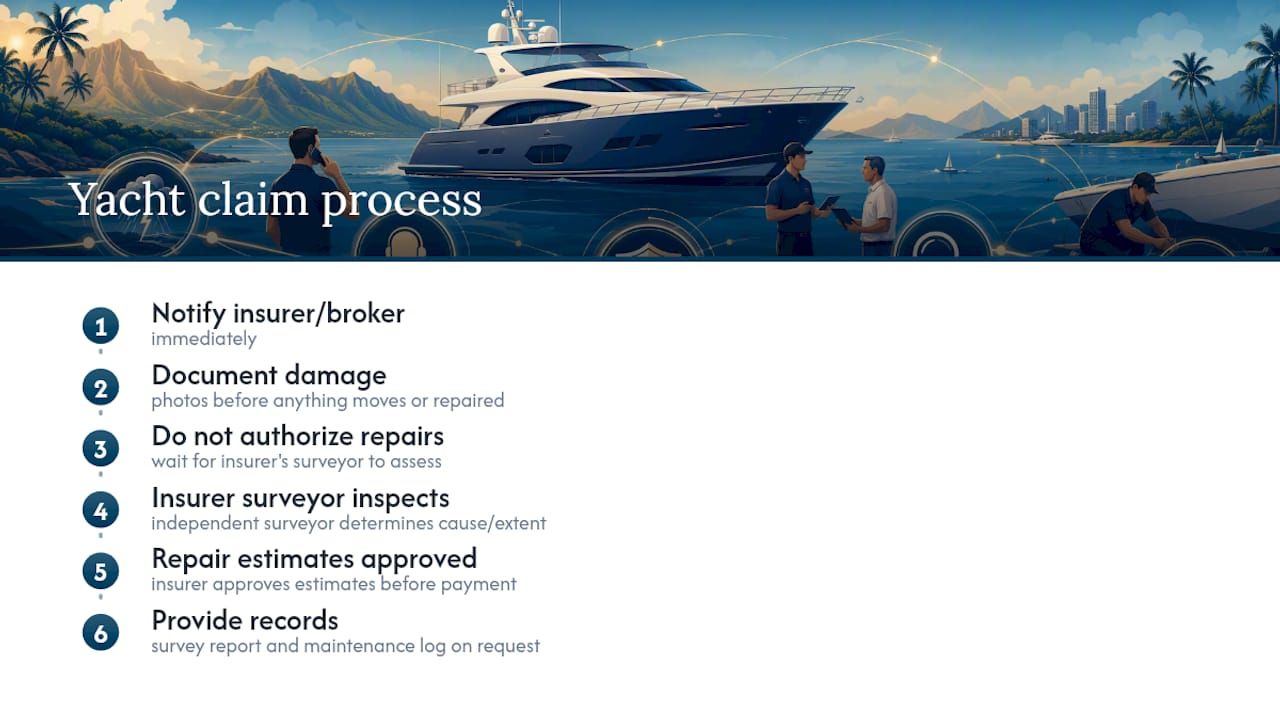
Most yacht claims follow a predictable path: notify your broker or insurer immediately, document the damage with photos before anything moves or gets repaired, and avoid authorizing repair work until the insurer’s surveyor has assessed the loss. For a grounding or collision, the insurer typically dispatches an independent surveyor to determine cause and extent before approving repair estimates.
Common claim scenarios split into a few recurring categories. Grounding and hull damage claims are the most frequent for private owners, often triggered by unfamiliar waters or navigational error. Storm and weather damage claims spike seasonally, particularly for vessels left in wet storage during hurricane season without adequate haul-out planning. Third-party liability claims, a collision with another vessel or an injury to a guest aboard, run through the P&I side of the policy rather than hull coverage. Theft and vandalism claims, while less common, usually require a police report as a prerequisite to payment.
Total loss claims are where agreed value versus ACV terms matter most directly: an agreed value policy pays the pre-set figure, while an ACV policy applies depreciation before settling. Salvage and wreck removal costs, covered separately from hull damage in most policies, can escalate quickly on a grounded vessel and are a major reason underwriters price that coverage distinctly. Keep your survey report and maintenance log accessible throughout any claim, since insurers frequently request them to confirm the vessel’s condition prior to loss.
Consequences of Sailing Without Adequate Coverage
Operating without required insurance carries consequences well beyond the obvious financial exposure. In Hawaii, failing to carry the statutory $100,000 minimum for vessels 26 feet or longer, or failing to produce acceptable proof when asked by DLNR, exposes an owner to state enforcement action tied directly to that statute.
Elsewhere, the consequences run through contracts rather than courts. A lender who discovers a lapse in required coverage can call the loan or force-place an expensive replacement policy on the owner’s behalf, usually at a far higher premium than the owner could have secured directly. A marina that finds a berthing contract’s insurance clause unmet can terminate the slip agreement outright, leaving the owner scrambling for alternative moorage on short notice.
The costliest scenario is usually the quiet one: a claim gets denied after the fact because coverage lapsed, a charter endorsement was never added, or a required document was never filed. At that point, the owner isn’t facing a fine. They’re facing the full, reimbursed cost of hull damage, third-party injury, or wreck removal out of pocket. Wreck removal alone can run into six figures depending on location and vessel size, which is precisely the exposure a lapsed or inadequate policy leaves completely uncovered.
Private Use Versus Commercial Charter: Different Rules Entirely
A private pleasure policy and a commercial charter policy are not the same product with different price tags. They’re structured around fundamentally different risk profiles, and treating them interchangeably is how coverage gets denied.
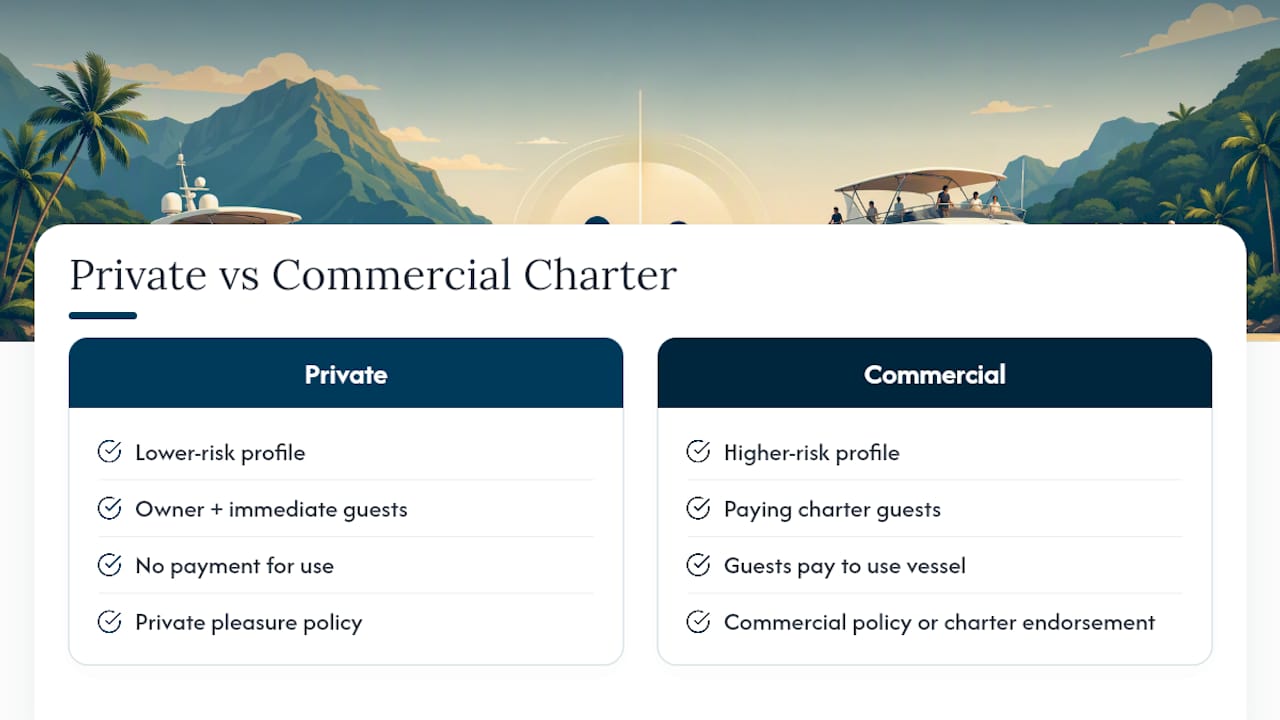
Private use policies assume the owner and immediate guests are the only people aboard, with no money changing hands for use of the vessel. Liability limits, survey requirements, and premium calculations all reflect that lower-risk assumption.
Commercial charter operations, MYBA-style crewed charters, bareboat charter fleets, and skippered charter businesses alike, require an entirely different underwriting approach. Charter guests are legally treated as paying customers, which raises the liability bar insurers apply and typically requires a dedicated commercial policy or an explicit charter endorsement declaring the number of charter weeks and the scope of commercial activity. Charter endorsements commonly carry a higher premium than private-use coverage, reflecting the increased exposure to paying third parties aboard.
The distinction matters most at the point of disclosure. An owner who charters occasionally without declaring it to their insurer isn’t saving money, they’re operating without coverage the moment a charter guest is aboard. Whether a specific arrangement counts as bareboat, skippered, or fully crewed charter, and which regulatory and tax obligations attach to each, depends on the jurisdiction and the specific charter agreement, so confirming classification with a qualified maritime professional before finalizing any charter contract is worth the delay.
Master Ocean Team Perspective: Where Owners Actually Go Wrong
Most gaps we see aren’t dishonesty, they’re oversight: a charter weekend never mentioned to the insurer, a survey that’s years out of date, a maintenance file that doesn’t exist. Two habits fix most of it: keep proof of insurance onboard at all times, and confirm marina or lender wording in writing before you sign anything.
Let Master Ocean Handle the Compliance Groundwork
Getting insurer-ready isn’t a one-time task, and most owners don’t want to chase surveyors, registration offices, and maintenance paperwork on top of actually running their yacht. That’s the gap Master Ocean fills: coordinated support across the pieces underwriters and marinas actually ask for.
Our team coordinates:
Professional surveying and audit reports underwriters accept without back-and-forth
Registration support across jurisdictions, including flag and documentation guidance
Ongoing yacht management that keeps maintenance logs and crew records current
Delivery and technical coordination when a vessel changes hands or changes waters
If you’re buying, renewing coverage, or preparing a yacht for charter, start with a conversation about yacht management services or browse yachts for sale to see how Master Ocean supports owners through the full ownership lifecycle. All insurance, tax, and legal specifics should still be confirmed directly with your insurer, lender, or a qualified maritime attorney before you finalize any policy.
Sources
FAQ
What Kind of Insurance Do You Need for a Yacht?
Most owners need Hull & Machinery for physical damage and Protection & Indemnity for third-party liability, pollution, and wreck removal, plus crew medical coverage on crewed vessels. Charter operations need an additional commercial endorsement or dedicated policy.
What Is the 10% Rule for Yachts?
There’s no universally recognized “10% rule” governing yacht insurance requirements, and definitions vary depending on the source. If you’ve encountered this term in a specific policy or brokerage context, confirm its meaning directly with that insurer rather than assuming a standard definition applies.
Is Yacht Insurance Mandatory?
It depends on where you are and how you’re financing the vessel. Hawaii mandates a $100,000 minimum for vessels 26 feet or longer by statute, but most other states don’t require it by law, though lenders and marinas almost always require it as a condition of financing or berthing.
What Documentation Proves I Have Valid Yacht Insurance?
A policy declarations page or insurance card showing the carrier name, policy number, hull identification number, and effective dates satisfies most marina, lender, and statutory requirements.
Does My Policy Automatically Cover Chartering My Yacht?
No. Private-use policies typically exclude any commercial or charter activity, so chartering requires a specific endorsement or a separate commercial policy, and failing to disclose charter use risks having a claim denied entirely.
This article is provided for general informational purposes only and does not constitute legal, tax, financial, investment, technical or safety advice. Yacht availability, prices, specifications, regulations and tax treatment may change and must be independently verified before any decision or transaction. Master Ocean coordinates with qualified third-party professionals where required.