Yacht Financing & Leasing: How to Finance a New or Pre-Owned Yacht
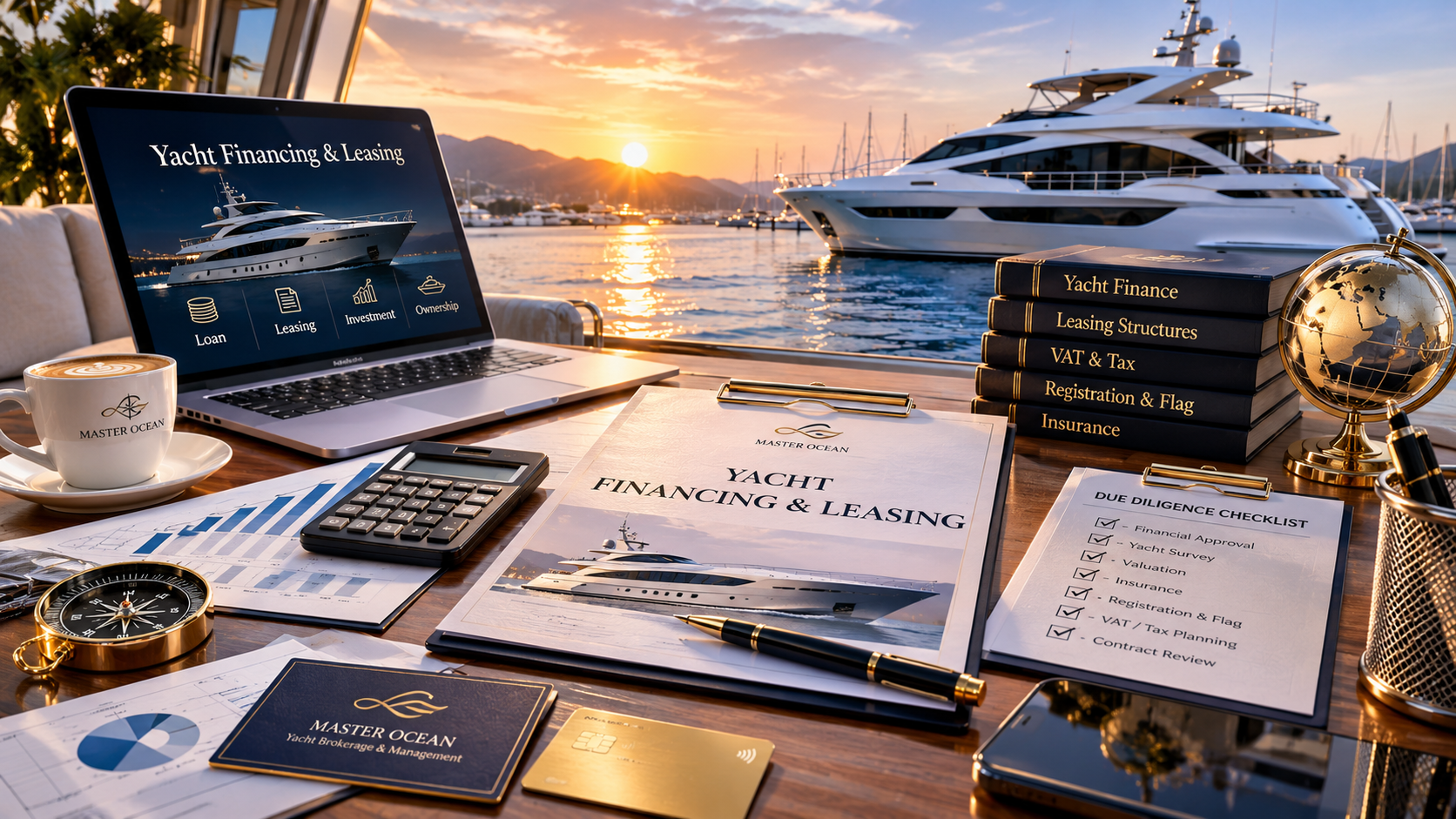
Yacht Financing & Leasing: How to Finance a New or Pre-Owned Yacht
Yacht financing allows a buyer to pay for part of a yacht's purchase price through a loan secured against the vessel, repaid over an agreed term. Yacht leasing works differently: a finance company buys the yacht and the client pays regular instalments for its use, with the ownership outcome depending on the structure. In both cases the product is issued by an independent lender or lessor, and the terms depend on the buyer, the yacht, its intended use and the jurisdiction involved.
This guide explains how the main options compare, what lenders typically assess, and which questions are worth settling before you commit to a purchase. It is educational, not an offer of finance, and it does not quote current rates, because rates and terms are set by each provider and change with the market.
Why Buyers Choose Yacht Financing
Many buyers prefer not to commit the full purchase price from liquid capital. Common reasons include:
- Keeping capital available for a business, property or investment portfolio
- Spreading the cost of acquisition over several years
- Buying a larger or newer yacht than cash alone would allow
- Structuring ownership through a company or lease for tax or administrative reasons, subject to professional advice
Finance is not automatically the better choice: it adds interest, fees and security requirements, and for some buyers paying cash is the sounder decision.
Yacht Loans vs Yacht Leasing
The two structures serve different needs, and the differences matter most in ownership and tax treatment.
Yacht loans. The buyer purchases the yacht and is its legal owner from the outset. The lender takes security, usually a registered mortgage over the vessel, and the buyer repays principal and interest over the term.
Yacht leasing. The lessor owns the yacht during the lease. The client pays instalments for its use and, depending on the contract, may have an option to buy at the end, return the yacht or renew. Leasing can suit buyers whose circumstances, or whose yacht's intended use, favour that arrangement. Eligibility, ownership arrangements, tax treatment and contract conditions vary between jurisdictions and need independent professional assessment.
The legal meaning of terms such as lease-purchase differs by country, so ask the provider to explain the structure in writing.
Financing New and Pre-Owned Yachts
New yachts. Lenders generally view new builds from established yards as lower risk, because the vessel is documented, warrantied and has a clear value. Staged payments during construction add complexity: the buyer must understand how instalments to the shipyard are protected and whether the lender will fund against milestones.
Pre-owned yachts. Finance is commonly available for pre-owned yachts, but the age, condition, size, flag and maintenance history of the vessel influence what a lender will consider. An independent survey is usually central. Older yachts may attract shorter terms or a larger deposit, and some may fall outside a lender's criteria altogether.
If you are still choosing a vessel, you can explore new and pre-owned yachts available through Master Ocean and then match shortlisted yachts against the financing criteria that matter to you. An independent yacht survey and technical audit is worth arranging early, since lenders and insurers frequently rely on it.
How Yacht Financing Works
The process differs by lender, but a purchase financed through an independent marine finance provider usually follows this sequence:
- Define the purchase. Budget, yacht type, size, age, location, flag and intended use (private, charter or mixed).
- Approach providers. The buyer or an introducer presents the proposed purchase and the buyer's profile to one or more lenders.
- Receive indicative terms. The lender outlines the structure it could consider, subject to due diligence. Indicative terms are not a commitment to lend.
- Agree the yacht purchase. A memorandum of agreement is signed with the seller, typically with a deposit held by an escrow agent or broker, and conditions that include survey and finance.
- Complete due diligence. The lender reviews the buyer, the yacht, its survey, valuation, insurance and registration.
- Complete the transaction. Funds are released, ownership passes and the lender's security is registered.
Finance can affect your negotiating position and timetable, so discuss it before making an offer. Buyers who want an introduction to independent providers can find out more about Yacht Finance & Leasing Services at Master Ocean.
Down Payments, Interest Rates and Repayment Terms
Down payment. Yacht financing and leasing arrangements may require an initial down payment typically ranging from 30% to 45% of the yacht's purchase price, depending on the buyer's financial profile, the yacht's characteristics, intended use, jurisdiction and the independent finance provider's requirements. The exact deposit, financing terms and approval conditions are determined individually by the lender.
Interest rates. Rates may be fixed or floating, and they depend on the lender's cost of funds, the currency, the buyer's profile and the risk the lender attaches to the yacht. Any quoted rate will be specific to that lender and date. Compare the total cost of finance, including arrangement fees, valuation and survey costs, early-repayment charges and insurance requirements, not the headline rate alone.
Repayment terms. The term is influenced by the age and type of yacht and the lender's policy. Some structures amortise fully; others include a final larger payment. Check what happens if you sell before the term ends.
Private Yacht Financing vs Commercial Yacht Financing
Lenders distinguish between a yacht used privately and one used commercially, for example in charter.
Private use. The lender focuses on the buyer's financial strength, source of funds and the yacht's value as security.
Commercial use. Where the yacht will operate in charter, the lender will also look at the intended operating model, the yacht's compliance with commercial codes, the management arrangements and the realism of the business plan. Charter income can vary widely with season, location, bookings and costs, and lenders typically do not treat projected income as certain. Many providers expect conservative assumptions and may ask for additional security.
International Yacht Financing
Yacht transactions are often cross-border: a buyer in one country, a yacht in another, a flag in a third and a lender in a fourth. This raises practical questions:
- Which lenders will consider the buyer's nationality and country of residence?
- Where is the yacht located, and where will it be registered?
- In which currency will the loan be denominated, and does this match the buyer's income or assets?
Foreign buyers can often be considered by marine finance providers, but lenders apply their own geographic and regulatory limits, and anti-money-laundering and source-of-funds checks are standard. Preparing documentation in advance usually saves considerable time.
Yacht Financing in Monaco, France, Spain, Italy, the UK, the UAE and the USA
Financing markets differ in structure and regulation. The notes below are general orientation, not tax or legal advice, and they do not describe any specific lender's appetite.
- Monaco. A major yachting centre with many international buyers and ownership structures. Its VAT position is closely connected to French arrangements, so local advice is essential.
- France. An established marine finance and leasing market. VAT status and the conditions for using a yacht in French waters are central points to verify.
- Spain. Registration-related taxes may apply to certain recreational vessels, with different treatment for some commercial uses, so review planned registration and use with a Spanish adviser before purchase.
- Italy. A long tradition of yacht building and marine leasing, with specific rules on leasing structures and VAT to check against current legislation.
- United Kingdom. A significant marine finance and registration jurisdiction. Since Brexit, a yacht's VAT status in relation to the UK and the EU should be confirmed carefully.
- United Arab Emirates. A growing yachting market. Regulation, local lender appetite and VAT treatment should be confirmed locally.
- United States. A large marine lending market where documentation, state taxation and registration vary by state and vessel type, so take advice from a local marine attorney and tax adviser.
Documents Required for Yacht Financing
Each lender sets its own list, but buyers commonly prepare:
- Valid identification and proof of address
- Evidence of source of funds and wealth, and financial statements or tax returns
- For company buyers, corporate documents, ownership structure and beneficial owner details
- The yacht's specification, photographs and listing details
- The memorandum of agreement or draft purchase contract
- A pre-purchase survey and, where required, an independent valuation
- Proof of title, registration documents and VAT status evidence for the yacht
- Insurance quotation or evidence of cover
- For commercial use, the intended charter or operating plan and management agreement
Gathering these early reduces delays.
Yacht Insurance, Flag Registration and VAT Considerations
These three subjects directly shape both the purchase and the financing.
Insurance. Lenders typically require comprehensive insurance for the yacht and often require their interest to be noted on the policy. Premiums depend on the yacht, cruising area, crew and use.
Flag registration. The flag determines the legal framework, the registration of any mortgage and many practical obligations. Choice of flag should be considered with legal advisers before completion, not after.
VAT. A yacht's VAT status, whether it has been paid or whether the yacht benefits from a particular regime, can materially affect value and legality of use in certain waters. Leasing and ownership structures can affect VAT treatment, and rules differ by country.
Taxation, registration and ownership structures require jurisdiction-specific professional advice. Master Ocean is not a tax adviser or law firm; it can work alongside independent legal, tax, insurance and registration professionals chosen for your situation.
Financing a Yacht for Charter Operations
Many owners wish to offset running costs through charter. A financed charter yacht requires more planning than a private one:
- The yacht must meet the commercial requirements of its flag and operating area.
- Ownership, management and charter contracts need to be coherent, and lenders will review them.
- Insurance, crew costs, maintenance, berthing, marketing and broker commissions all reduce net income.
Professional yacht management, including technical management, crew administration and charter support, is usually a key part of a lender's comfort with a commercial operating plan.
Yacht Ownership and Investment Considerations
Financing and investment are different subjects and should not be confused.
Yacht financing is how you pay for a yacht you intend to own and use, whether privately or commercially. Yacht investment is the commitment of capital to a yacht or yacht project with a commercial objective, such as a new-build programme, a project seeking a partner or a vessel intended for commercial operation. Investment involves risk, including the possibility of loss, and returns are never guaranteed. Master Ocean does not promise investment returns.
Before considering any yacht as an investment, review:
- Total cost of ownership, including crew, insurance, maintenance, berthing, refit and management
- Depreciation and the liquidity of the yacht on resale
- Quality of the shipyard, designer or project promoter, and the contractual protections for staged payments
- Exit options and who controls key decisions
Readers who wish to explore this area can look at Master Ocean's yacht investment opportunities, including new-build and project listings, and discuss the structure with their own financial and legal advisers.
Common Mistakes When Financing a Yacht
- Making an offer before checking financing criteria. A signed contract that depends on finance a lender will not give is a serious problem.
- Focusing on the interest rate alone. Fees, security requirements and early-repayment terms can change the true cost.
- Underestimating running costs. Insurance, maintenance, crew, berthing and refit must be budgeted alongside the instalments.
- Skipping the survey. Lenders and insurers may rely on it, and so should the buyer.
- Ignoring VAT and registration. Late discovery of an issue can affect value, finance and legal use.
- Assuming charter income will cover the loan. Treat projected income as uncertain.
How Master Ocean Supports International Yacht Buyers
Master Ocean is an international yacht brokerage and yacht services company. For buyers considering finance, we can help in practical, non-regulated ways: identifying suitable yachts, supporting negotiation and transaction coordination, preparing yacht-related documentation, arranging technical inspection and, with the client's consent, introducing independent finance providers and other professionals. After purchase, we can support ongoing yacht management. Our yacht brokerage and consulting team can also help you define requirements before you speak to lenders.
Frequently Asked Questions
Can you finance a pre-owned yacht?
Often yes, subject to the lender's criteria. Age, condition, size, flag, survey and value all influence availability and terms.
What deposit is typically required for yacht financing?
Yacht financing and leasing arrangements may require an initial down payment typically ranging from 30% to 45% of the yacht's purchase price, depending on the buyer's financial profile, the yacht's characteristics, intended use, jurisdiction and the independent finance provider's requirements. The exact deposit, financing terms and approval conditions are determined individually by the lender.
What is the difference between yacht financing and yacht leasing?
With a loan, the buyer owns the yacht and the lender holds security. With a lease, the lessor owns the yacht while the client pays for its use, with the end-of-term position set by the contract. Legal and tax treatment differ by jurisdiction.
Can foreign buyers obtain yacht financing?
In many cases foreign buyers can be considered, although each lender applies its own geographic and regulatory limits and carries out identity, source-of-funds and compliance checks.
Can a commercial charter yacht be financed?
It can be, but lenders examine the operating model, management arrangements, commercial compliance and the realism of projected income, which is never guaranteed.
What documents are required for yacht financing?
Typically identification, evidence of funds, company documents where relevant, the purchase agreement, a survey, registration and VAT evidence, and insurance details. Each lender confirms its own list.
How does VAT affect yacht leasing?
VAT treatment depends on the yacht's VAT status, the jurisdiction, the lease structure and the way the yacht is used. This is a specialist area, and you should obtain advice from a qualified tax professional in the relevant jurisdiction before committing.
Does Master Ocean provide yacht loans directly?
No. Master Ocean does not lend and does not provide leasing products. Financing is offered by independent providers, whose terms and approvals are theirs alone.
Final Conclusion
Financing a yacht is a structured decision, not a single product. The right route depends on the yacht, its intended use, where it will be registered and how the purchase fits your wider finances. Decide the structure early, verify VAT and registration, plan for the full cost of ownership and treat any figure not issued by a lender in writing as indicative.
If you are ready to explore your options:
- Learn about yacht finance and leasing solutions and the introductions Master Ocean can arrange to independent providers.
- Browse yachts for sale and shortlist new and pre-owned yachts for your purchase.
- If you are considering commercial yacht ownership, explore Master Ocean's yacht investment services.
MASTER OCEAN LTD is not a bank or lender and does not itself provide loans, leasing products or regulated financial advice. All financing offers, terms and approvals are the responsibility of independent providers. Services involving regulated credit intermediation will only be undertaken where legally permitted and appropriately authorised or exempt.
MASTER OCEAN LTD
International Yacht Brokerage & Management
Email: info@master-ocean.com
Website: https://master-ocean.com