Yacht Charter Costs Explained: APA, Payments and Crew Tips
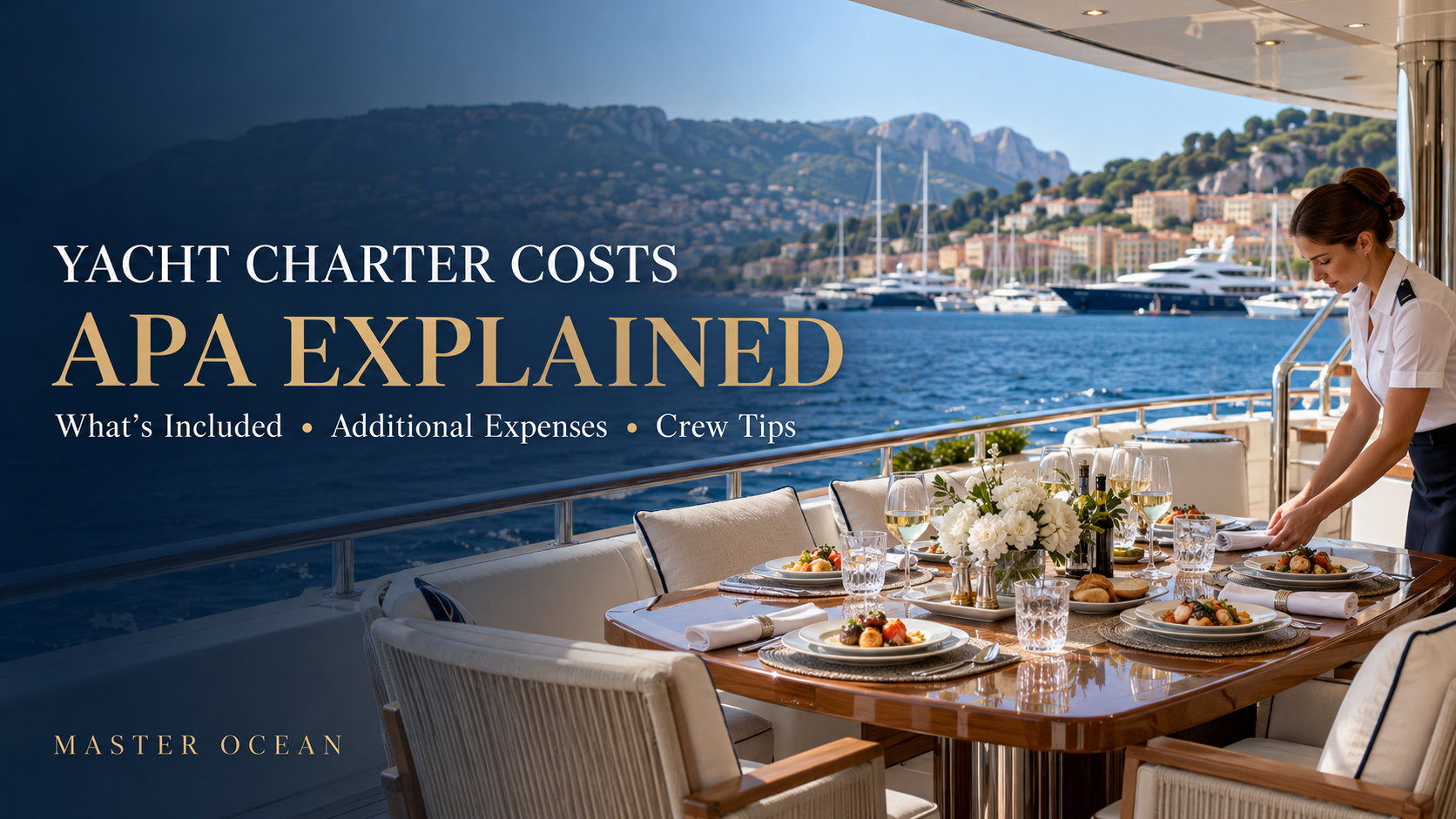
Yacht Charter Costs: What Is Included, What APA Means and Which Additional Expenses to Consider
Planning a crewed yacht holiday is an exciting process. However, first-time charter clients often misunderstand how the overall cost is calculated. When viewing a published weekly charter rate, it is easy to assume that it covers absolutely every expense during the trip, from fuel and marina berthing to fine dining and drinks.
In practice, the financial structure of a charter works differently. The yacht charter fee does not always reflect the full holiday budget. To enjoy your time on board as comfortably as possible, without unexpected financial surprises, it is important to understand in advance exactly what you are paying for, how additional expenses arise and how the advance expense allowance known as APA works.
Preparing a sound budget begins with understanding the difference between the base charter fee and the associated operating expenses.
1. Why the Charter Fee Does Not Always Equal the Full Holiday Budget
The main misconception among first-time charterers is that the charter fee is the final, all-inclusive price. In international crewed yacht charter, the “charter fee plus expenses” model is widely used. The specific terms are determined by the offer and the charter agreement.
The distinction is as follows:
The base charter fee covers the use of the yacht and the services of its crew.
Individual expenses are costs that depend directly on your personal preferences, itinerary, activities and dining requirements.
The services included always depend on the terms of the specific offer and agreement. Some arrangements already include certain expenses in the price, so it would be incorrect to suggest that additional expenses apply to every charter.
2. What Is Usually Included in the Base Charter Fee
Under the terms of a MYBA charter agreement, the base charter fee generally includes:
Provision of the yacht in proper working order and with the necessary equipment.
The professional crew’s wages and upkeep, including food and uniforms.
Insurance for the yacht and the owner’s third-party liability.
An important detail: having a highly skilled chef on board ensures professional meal preparation, but it does not mean that food and drinks are included in the price. The chef’s salary is included in the charter fee, while ingredients purchased for your menu are charged separately.
You should also avoid assuming that all water sports equipment, communications services, shore transfers or other specialised equipment are included in the base price without checking the specific agreement and the yacht’s particulars.
3. What APA Is and How It Works
APA, or Advance Provisioning Allowance, is an advance payment to cover the expenses specified in the agreement during your charter. It is a financial arrangement designed to ensure that your holiday runs smoothly.
Why Is APA Needed?
The allowance is paid before the trip begins. This enables the crew to arrange the yacht’s provisioning and payment of the agreed expenses ahead of your arrival, order the required food and drinks, and prepare the yacht according to the guests’ preferences agreed in advance.
Clients do not need to pay personally for every refuelling, market purchase or berth. The captain keeps the accounts and pays these ongoing expenses from the APA funds.
What APA Is Not:
It is not a damage deposit: the allowance is not intended to cover damage to the yacht’s property. A separate security deposit may be required for this purpose.
It is not a crew gratuity: the allowance is used exclusively for direct expenses associated with your trip.
It is not a fixed, non-refundable surcharge: APA is neither a commission nor an additional service fee. Any unused balance is refundable.
It is not a guaranteed spending cap: the allowance is an initial estimate, not a strict limit.
The APA Amount
APA frequently amounts to 30–40% of the base charter fee. However, this percentage is neither a universal rule nor a maximum limit. The exact amount is determined by the offer and agreement, the yacht’s characteristics, the itinerary and the guests’ preferences.
4. Which Expenses Can Be Covered by APA
The allowance covers the main operating expenses incurred during the trip:
Fuel used to operate the yacht and chargeable to the client under the charter terms.
Fuel for generators powering air conditioning, lighting and domestic appliances while the yacht is stationary.
Fuel for tenders and motorised water sports equipment.
Food for guests.
Alcoholic and non-alcoholic beverages.
Marina berthing and port fees.
Shore power and water.
Agency fees and local port expenses specified in the agreement.
Other guest expenses agreed in advance.
Please note that certain special orders, individual shore services, excursions or transfers may be paid for separately by agreement with the client, rather than automatically being covered by APA.
5. Who Manages APA and How the Funds Are Monitored
The captain is responsible for APA expenditure and accounting, including purchases made by other crew members.
The client may request information about expenditure and the current balance at any time. At the end of the charter, before guests disembark, the captain presents a detailed expense statement with supporting receipts and invoices in accordance with the agreement. The final reconciliation and refund of the balance are handled in accordance with the agreement.
The final settlement process is as follows:
If actual expenses are lower than the advance paid, the unused balance is refundable following the final settlement. The refund procedure and timing are determined by the agreement.
If the remaining balance is insufficient to cover anticipated expenses, the captain requests an APA top-up in advance, rather than waiting until the funds have been exhausted.
6. What Affects the Level of Expenses
The rate at which the allowance is used depends on several key factors:
Cruising speed and passage duration: travelling at higher speeds consumes more fuel than leisurely cruising or remaining at anchor in a bay.
Choice of marinas: berthing in popular marinas during high season costs more than anchoring.
Dining preferences: orders for rare delicacies and exclusive drinks directly affect provisioning costs.
Equipment use: continuous operation of generators and air conditioning systems involves additional fuel consumption.
Individual programme: the number of guests, the frequency of tender use and the shore services engaged all contribute to the final budget.
A realistic itinerary and a guest preference sheet completed in advance help make expense planning more accurate.
7. How Charter Payments Are Made
A commonly used payment schedule is as follows:
First instalment: 50% of the base charter fee upon signing the agreement.
Second instalment: the remaining 50% of the charter fee, together with APA, applicable taxes and agreed additional charges, before the charter begins.
The exact amounts, deadlines and payment details are specified in the individual agreement. For bookings made shortly before the charter begins, payment in full may be required in a single instalment.
The charter fee is transferred to the account specified in the agreement. A clear distinction should be made between the initial charter payment, APA and any security deposit. If a security deposit is required, it is returned under the terms of the agreement, less any justified deductions that may arise.
8. Taxes and Other Additional Charges
Applicable tax legislation must be taken into account when calculating the full budget:
VAT and other applicable taxes may be included in the published price or charged separately. This must be clarified in the specific offer. The applicable taxes and the way they are calculated depend on the legislation and the terms of the individual charter.
Charges for delivering or returning the yacht to another port may apply if the guests’ embarkation or disembarkation location differs from the yacht’s home port.
9. Crew Gratuities
Gratuities are a voluntary expression of guests’ appreciation for excellent service and the crew’s attentive care.
As a guideline, you may follow MYBA’s recommendation of 5–15% of the agreed charter fee, excluding APA and taxes, for excellent service. This is a recommendation, not a mandatory payment or a universal standard for every region.
Gratuities are usually given to the captain for distribution among all crew members. APA funds cannot automatically be used for gratuities: this is possible only at the client’s express instruction.
10. A Clear Budget Example
The following illustrative calculation shows how the expenses are structured:
Base charter fee: €50 000.
APA at 30%: €15 000.
Initial amount budgeted before applicable taxes and additional charges: €65 000.
Let us consider two possible scenarios:
Scenario 1: Actual expenses for fuel, berthing and food amount to €12 000. This leaves €3 000 of the APA paid, which is refundable to the client.
Scenario 2: Actual expenses amount to €17 000 due to longer passages. In this case, an additional €2 000 is required. A top-up may be needed while the trip is still underway.
Separately, if the client chooses to show appreciation to the crew, a voluntary gratuity may be given, for example 10% of the base charter fee — €5 000.
This example is illustrative. Taxes and potential charges have not been calculated, and the €65 000 figure does not guarantee the final cost of the holiday.
11. What to Clarify Before Booking
Before signing the agreement, we recommend asking your broker the following questions:
What is included in the base charter fee?
Are taxes included in the published price?
What APA amount is specified in the offer?
Which itinerary is the initial expense estimate based on?
Which services and orders are charged separately?
Are there any yacht delivery or redelivery charges?
Is a security deposit required?
How, and in what format, is the expense statement provided?
How are APA top-ups and refunds of the remaining balance handled?
12. Your Journey with Master Ocean
Understanding the base charter fee, APA, applicable taxes and additional services helps you assess the holiday budget before booking. Careful attention to detail allows you to plan your time on board without unnecessary concerns.
The specialists at international yacht company Master Ocean will help you select a suitable yacht, prepare an initial estimate based on your itinerary, berthing arrangements and personal preferences, and explain all the terms of the agreement in detail. Contact us to arrange your voyage.
Frequently Asked Questions
What Is APA in Simple Terms?
APA is an advance payment to cover expenses specified in the charter agreement, such as fuel, food, drinks and port berthing.
Is APA Included in the Published Charter Price?
Under the “charter fee plus expenses” model, APA is usually listed separately from the base charter fee. What the published price includes must be checked in the specific offer.
Is the Unused Balance Refunded?
Yes. If actual expenses are lower than the advance paid, the unused balance is returned to the client in accordance with the procedure set out in the agreement.
What Happens If APA Runs Out?
If the remaining balance is insufficient to cover anticipated expenses, the captain requests a top-up in advance.
Can a Charter Be Booked Without APA?
Yes. Some offers include expenses or use a different payment arrangement. If the selected agreement requires APA, the allowance must be paid on the agreed terms.
Are Crew Gratuities Mandatory?
No. Gratuities are voluntary. The amount and the decision to leave a gratuity remain entirely at the client’s discretion.