Why Masterpieces of Yachtbuilding Are Created in Studios of Engineering Thought, Not in Factories
A Yacht Begins with a Question, Not a Drawing
The first question an owner usually asks is which shipyard to choose. A properly structured project begins with a different question: what is the yacht being built for, and which constraints must be identified in advance?
Cruising area, operational profile, crew composition, guest accommodation and usage patterns, intended ownership period, tax and flag jurisdiction, acceptable noise and vibration levels, and autonomy requirements must all be considered.
These answers form the Owner's Brief, the document that defines what a successful yacht means to a particular owner.
A custom project differs from a production model not in the amount of wood or marble used in its interior. The fundamental difference is that its initial requirements are determined by the owner rather than by a shipyard's production programme.
A production yacht offers a proven platform, transparent pricing, and a predictable delivery schedule. For many clients, this is the most appropriate choice.
A custom project becomes justified when the owner's requirements cannot be accommodated within an existing platform: an unconventional operational concept, specific autonomy or classification requirements, complex systems architecture, a unique layout, or the integration of equipment unavailable in standard production configurations.
The answer to which option offers better value depends on the objective.
Production yachts save time and reduce engineering risks. Custom projects provide a closer match to specific requirements but demand discipline from the outset, because the cost of correcting mistakes in the initial specifications increases with every subsequent stage.
Owners wishing to evaluate their options before committing to a particular direction may begin with new-build yacht consulting through Master Ocean, allowing production solutions and custom projects to be compared using specific technical and commercial criteria.
Naval Architecture: The Invisible Foundation
Yacht Design and Naval Architecture are frequently confused, although they represent different disciplines.
The yacht designer is responsible for appearance, spatial organisation, and the experience of living on board.
The naval architect is responsible for ensuring that the yacht floats, maintains its course, remains stable, withstands sea conditions, and preserves the required level of safety in the event of damage.
The strongest projects emerge when these two teams work together from the earliest sketches rather than exchanging completed designs at later stages.
The engineering framework of a modern yacht project relies on several essential tools.
CAD and three-dimensional modelling establish the geometry of the hull and superstructure and the arrangement of equipment. They also identify spatial conflicts between piping, cable routes, and ventilation systems before production begins.
CFD, Computational Fluid Dynamics, helps assess hydrodynamic resistance, propulsion performance, flow characteristics, and the influence of hull geometry on energy consumption.
FEA, Finite Element Analysis, evaluates structural strength and stiffness, loads on foundations supporting heavy equipment, and the behaviour of structural connections under wave-induced and local loads.
Stability, buoyancy, and damage-condition calculations establish the boundaries of safe operation and form part of the technical documentation reviewed by classification societies and flag administrations.
Weight control and load distribution ensure that displacement and the position of the centre of gravity remain within calculated limits. Weight management directly affects speed, draught, and the stability margins of the completed yacht.
The result of this work is not a visual rendering but a complete package of technical documentation: general arrangement plans, hull lines plans, structural drawings, system diagrams, electrical schematics, equipment specifications, and engineering calculation reports.
This documentation forms the common technical language through which the owner, shipyard, suppliers, and supervisory organisations discuss the same yacht.
The more precise this language becomes, the smaller the gap between expectations and results, and the fewer decisions are postponed until construction, when modifications are most expensive.
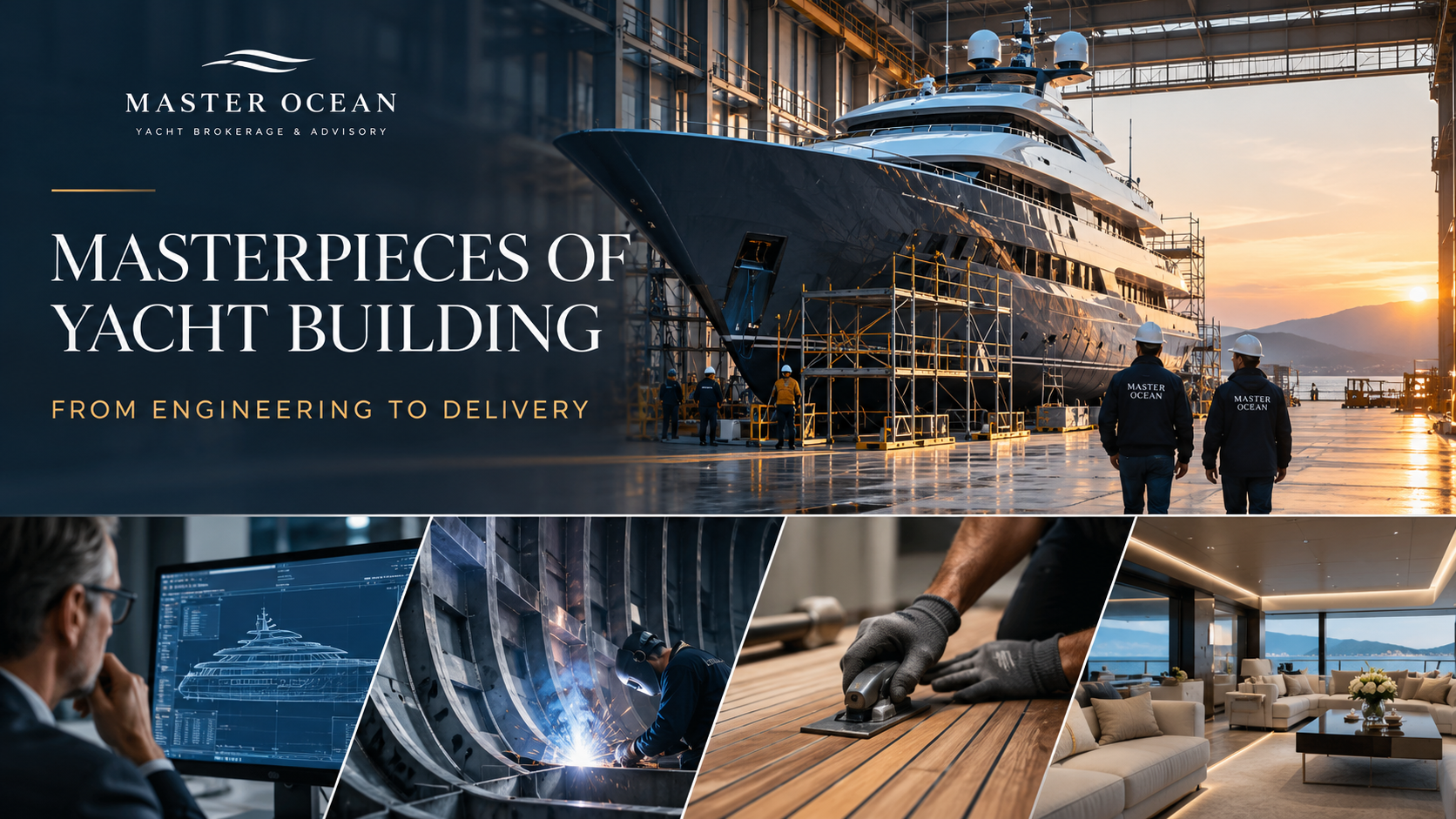
From Concept to Delivery: Eleven Stages, Each Establishing a Critical Decision
In this context, an engineering studio is not necessarily a physical building. It represents a working methodology.
Major shipyards are also capable of building exceptional one-off yachts, and many do so successfully.
The distinction lies in where the key decisions are made and who retains control over them.
The following sequence illustrates a professionally structured process, regardless of which organisation performs the work.
1. Owner's Brief — Owner Requirements
Defines the project's objectives, limitations, budget range, and priorities.
Every subsequent decision is assessed against this document. An unclear brief creates the conditions for disagreements at every following stage.
2. Concept Design
Determines whether the owner's requirements are compatible with one another.
This is where it becomes clear that certain expectations may require compromises involving weight, internal volume, autonomy, or cost.
3. Preliminary Design
Transforms the concept into initial engineering assessments, including displacement, power requirements, stability margins, and internal volumes.
Errors discovered at this stage are generally less expensive to correct than those identified later.
4. Naval Architecture
Establishes the vessel's hydrodynamic characteristics, stability, structural integrity, and safety.
At this stage, the project moves beyond visual interpretation and becomes an engineered vessel.
5. Basic Design
Defines the architecture of onboard systems and the principal technical solutions.
It provides the foundation for commercial enquiries to shipyards and technical coordination with classification societies.
6. Detailed Engineering
Develops systems into individual components, routing arrangements, foundations, and interfaces.
The completeness of this work directly influences the number of technical problems that may arise during production.
7. Production Drawings
Translate the engineering design into instructions suitable for cutting, bending, moulding, fabrication, and assembly.
Incomplete production documentation can immediately result in workshop downtime and costly rework.
8. Shipyard Selection
Matches the project's requirements against the actual capabilities, workload, financial stability, and quality management practices of potential shipyards.
9. Construction Supervision
Verifies at designated inspection points that the yacht is being constructed in accordance with the approved design, specified materials, and agreed standards.
10. Commissioning and Sea Trials
Validate under operational conditions what was previously calculated and specified.
This includes onboard systems, speed, noise, manoeuvrability, and safety performance.
11. Delivery and After-Sales Support
Completes the project through the handover of as-built documentation, crew training, warranty procedures, and a structured maintenance programme.
The underlying principle is straightforward.
Each stage removes a degree of uncertainty and establishes a decision.
When stages are omitted or compressed, uncertainty does not disappear. It moves into the next stage, where resolving it becomes more expensive.
A practical principle of yachtbuilding is that the later a problem is discovered, the more costly it becomes to correct.
Some of the most expensive problems are identified during construction or even during sea trials.
Who Owns the Drawings? A Question Asked Too Late
A client who has paid for a yacht design often assumes ownership of the entire package, including drawings, three-dimensional models, and engineering calculations.
In practice, these represent three separate legal questions.
The answer to each depends on the contract and applicable law rather than on assumptions.
Ownership of documentation concerns physical and electronic copies. Receiving and possessing files does not automatically grant the right to use them for construction.
Copyright in the design generally remains with the creator, whether a design studio or an individual designer, unless the contract expressly provides for its transfer. The scope and conditions of such transfers can vary considerably between jurisdictions.
Licensing rights for use and construction determine whether the client may build a yacht from the design, at which shipyard, how many times, whether modifications are permitted, and who must approve them. This is often the most important of the three rights.
A particular risk arises when changing shipyards.
If the client has not obtained the right to transfer the design documentation to another builder, while the original engineering models remain with the designer, a dispute with the shipyard or financial difficulties at the yard may effectively freeze the project.
A replacement shipyard may require a new licence or substantial redesign, potentially resulting in months of delays and significant additional expenditure.
A similar problem arises when documentation is delivered in proprietary formats that cannot be edited or without the calculation files supporting structural strength and stability assessments.
Before signing a design agreement, several practical questions should be addressed.
Under what conditions is the construction licence granted? Can the shipyard be replaced? Who is authorised to modify the design after the original designer's involvement ends? How will source files and engineering calculations be stored? What happens if one of the contracting parties becomes insolvent?
This is not legal advice. Specific contractual provisions should be reviewed by lawyers experienced in maritime law and intellectual property law in the relevant jurisdiction.
However, these questions must be raised at the beginning of the project, not after a dispute has arisen.
Shipyards, Specialist Craftsmen, and International Cooperation
A custom yacht is rarely designed and constructed entirely within one country or by a single company.
The design may be developed by one studio, the steel or composite hull manufactured at one facility, outfitting completed at another, interiors produced by a specialist workshop, and automation systems supplied by a dedicated systems integrator.
This is not a weakness of the industry. It is a normal operating model in which each participant performs the work for which they are best qualified.
What does the shipyard do?
The shipyard is responsible for hull structures, welding and metal fabrication, composite moulding, assembly, systems installation, outfitting, and production quality control.
Its strength lies in process discipline, production equipment, skilled teams, and the ability to manage the flow of materials.
A competent shipyard does not necessarily need to be the author of the design, but it must understand that design precisely.
What do specialist craftsmen do?
Painting, where quality depends on surface preparation and application conditions.
Joinery and interior finishing, where geometry, humidity, and tolerances determine whether finishes remain stable for decades or begin to deform.
Teak decking, where timber selection, cutting, fastening methods, and sealing are critical.
Electrical systems and automation, acoustic and vibration insulation, climate control, and the integration of navigation, audiovisual, and security equipment.
In each of these areas, a qualified specialist contractor reduces risk, while a general contractor lacking the necessary expertise may increase it.
Can a yacht be designed in one country and built in another?
Yes. This is a common industry practice.
Successful international construction requires consistent documentation standards and technical terminology, coordinated classification and flag-state requirements, clearly defined rights to use the design, supervision with an actual presence at the construction facility rather than reliance solely on reports, and carefully planned supply-chain logistics and travel arrangements.
Without these elements, geographical separation becomes a source of delays.
How should a shipyard be selected?
A practical selection process should rely on verifiable criteria:
Documented experience constructing vessels of a comparable type, material, and classification, supported by references from clients who can be contacted.
Current workload, financial stability, and the ability to meet contractual delivery obligations.
Quality management systems, workforce qualifications, production equipment, and access to specialist subcontractors.
Transparency of quotations, including how the shipyard defines the scope of work, assumptions, and exclusions.
Willingness to cooperate with independent supervision without conflicts of interest.
Selecting a shipyard solely on the basis of the lowest price can ultimately become the most expensive decision.
A price unsupported by a complete scope of work is comparable only on paper.
Standards and Safety: What Applies and What Does Not
The international regulatory framework is often presented as a single universal list of obligations.
That is inaccurate.
The applicability of requirements depends on vessel type and dimensions, intended purpose, private or commercial operation, cruising area, number of persons on board, and the selected flag.
The objective is to identify the rules applicable to the specific yacht at an early stage and incorporate them into the design rather than discover them during final acceptance.
IMO, the International Maritime Organization, develops international conventions and codes. The IMO does not itself certify yachts. Its requirements are implemented through flag states.
SOLAS, the International Convention for the Safety of Life at Sea, establishes requirements relating to construction, fire protection, life-saving appliances, and navigation equipment. Its applicability to yachts depends on vessel category and operational use, while many yacht-specific requirements are addressed through national flag-state codes.
MARPOL, the International Convention for the Prevention of Pollution from Ships, regulates oily water, sewage, garbage, and atmospheric emissions. Obligations under its annexes vary according to vessel characteristics and operating areas.
Classification societies, including RINA, Lloyd's Register, DNV, and Bureau Veritas, establish their own rules and review design, materials, and construction. Classification confirms compliance with the society's rules but is distinct from flag-state certification. Classification is not automatically mandatory for every private yacht, although lenders, insurers, prospective buyers, and commercial operating requirements may make it practically necessary.
Flag-state requirements determine the regulatory framework under which the yacht will be registered and operated, including private or commercial status, permitted guest and crew numbers, and applicable codes. Flag selection influences both construction decisions and ownership costs.
CE marking and European requirements primarily apply to recreational craft placed on the European Union market within the scope established by the relevant directive. Different regulatory routes apply to yachts outside that scope.
The practical conclusion is that the list of mandatory standards must be developed for the individual yacht rather than copied from another project.
Flag selection, classification, and operational status should be considered alongside taxation and registration.
For this reason, flag selection and yacht registration consulting should ideally be involved before the Basic Design is approved, rather than afterwards.
Who Controls Quality, and Whose Interests Do They Represent?
Several parties are involved in quality control during the construction of a custom yacht.
It is essential to understand that each has a different responsibility.
The shipyard's quality department checks its own work.
The classification society's surveyor verifies compliance with the society's rules.
The flag administration or an authorised organisation verifies compliance with applicable registration requirements.
None of these parties is automatically responsible for ensuring that the yacht meets the owner's expectations, budget, and contractual specifications.
That responsibility belongs to the Owner's Representative.
An independent Project Manager and the owner's technical representative work exclusively in the owner's interests. They do not receive remuneration from the shipyard or suppliers and are not commercially dependent on them.
Their responsibilities generally cover several areas.
Budget. Reviewing cost estimates, assessing the justification for Change Orders, monitoring procurement, and comparing actual expenditure against the approved budget.
Quality. Conducting regular site inspections, checking materials and construction methods, recording non-conformities, and monitoring corrective actions.
Schedule. Independently assessing the actual construction programme, identifying critical activities and early indications of delay rather than relying solely on shipyard progress reports.
Contractual obligations. Comparing completed work against the contract and technical specifications and preparing the owner's position on disputed matters.
Technical acceptance. Preparing and conducting acceptance tests, recording outstanding defects, and verifying as-built documentation.
The economics of this arrangement are straightforward.
The cost of an owner's representative should be compared with the potential cost of mistakes.
Preventing a single major rework operation or identifying a schedule deviation early enough may justify the expenditure.
However, no such outcome can be guaranteed.
The value of an owner's representative depends on professional qualifications, independence, and the authority established under the contract.
Another important aspect involves acceptance inspections and assessments before purchase or delivery.
For these purposes, Master Ocean provides independent yacht surveying and technical audit services, supporting an objective assessment of the vessel's condition, onboard systems, and compliance with applicable requirements.
Budget and Contract: The Other Half of Engineering
A properly structured yacht construction contract is as much a risk-management instrument as a structural engineering calculation.
It defines exactly what is being built, how the result will be assessed, who is responsible for errors, and what happens when the project does not proceed according to plan.
No contract provides absolute protection, and the instruments described below are not used in every transaction.
Their scope, detail, and wording depend on jurisdiction, project value, shipyard type, and the negotiating positions of the parties.
| Instrument | Purpose | Limitations |
|---|---|---|
| Milestone Payments | Link payments to verifiable results rather than calendar dates | Milestones must be objectively defined; otherwise, payment becomes a formality |
| Performance Guarantees | Secure the return of advance payments or compensation in the event of non-performance | Depend on the reliability of the guarantor and the conditions for making a claim |
| Change Orders | Record the cost, timing, and technical impact of every modification before work begins | Verbal agreements and undocumented changes create grounds for disputes |
| Technical Acceptance | Confirm compliance with specifications against previously agreed criteria | Acceptance criteria must be measurable and agreed in advance |
| Warranty Obligations | Define the period, scope, and procedures for remedying defects after delivery | Warranty exclusions and limitations require as much attention as the warranty period |
| Independent Survey | Provide an objective assessment of the vessel at key stages and upon delivery | Its value depends on the surveyor's independence and qualifications |
| Contractual Risk Management | Allocate risks between the client, shipyard, designer, and suppliers | Requires lawyers with relevant industry experience |
What happens if the shipyard misses the delivery deadline?
The answer is determined by the contract.
Typically, contracts establish notification procedures, conditions for extending deadlines, liquidated damages for delay, termination rights in cases of substantial delay, and procedures for refunding payments.
If these mechanisms have not been agreed in advance, the client may find themselves in a weak position precisely when strong contractual protection is most needed.
Who is responsible for technical errors?
Responsibility may be allocated among the designer, shipyard, equipment suppliers, and, in certain circumstances, supervisory organisations.
The allocation depends on who developed the solution, who approved it, who implemented it, and who verified it.
For this reason, the design agreement, construction contract, and supplier contracts should be coordinated with one another.
Where appropriate, the designer's liability should also be supported by professional indemnity insurance.
How can the budget be protected against unforeseen expenditure?
Three practical principles apply.
First, completeness of specifications. The more precisely the scope of work is defined, the less room there is for additional charges.
Second, change control. Every modification must be assessed for cost and schedule implications before approval.
Third, a contingency reserve should be included in the budget from the outset and should not be treated as a saving simply because it remains unused.
The Yacht as a Long-Term Asset
Construction cost represents only one part of the total cost of ownership.
After delivery begins the longest phase of a yacht's life: crew, fuel, maintenance, insurance, berthing, scheduled dry-docking, upgrades, and eventually resale.
Decisions made during the design phase influence these expenses for many years.
Several engineering principles are particularly important.
Maintainability. Access to equipment for servicing and replacement, sufficiently wide passageways, removable panels, and the ability to extract major machinery without dismantling interiors. A solution that looks elegant on a drawing but requires opening the deck to replace a pump becomes expensive every time maintenance is required.
Standardisation and spare-parts availability. Equipment supported by an extensive service network in the intended cruising regions reduces downtime and dependence on a single supplier.
Provision for future upgrades. Reserves of space, electrical capacity, and cable routes make it possible to upgrade navigation, communications, and automation systems without extensive vessel modifications.
Documentation. Complete and properly maintained as-built documentation reduces maintenance costs and supports market value upon resale because buyers and surveyors can assess a systematically managed asset.
The market value of a yacht depends on numerous factors, including condition, maintenance history, operational profile, flag, classification, and overall market conditions.
No one can guarantee the preservation of value.
However, maintenance discipline and the quality of documentation are among the factors that owners can directly control.
For this reason, future maintenance should be considered during the design stage rather than after delivery.
This is where technical and operational yacht management becomes relevant, including maintenance planning, refit coordination, and crew support, alongside the yacht repair, refit, and maintenance services described on the Master Ocean website.
Future Technologies: What Already Works, What Is Emerging, and What Remains Experimental
Discussions about the future of yachtbuilding can quickly become lists of fashionable technological terms.
It is more useful to distinguish between different levels of technological maturity because this determines whether a solution can realistically be included in the budget and schedule of a particular project.
The following assessment is general. The maturity of each technology depends on the specific solution and supplier.
| Technology | Maturity | Implications for the Project |
|---|---|---|
| Energy Management Systems | In use | Distribute loads between generators, batteries, and consumers, reducing engine operating hours while the yacht is stationary |
| Hybrid Propulsion | In use | Enables quiet operation, flexible operating modes, and savings under certain operational profiles, but increases system complexity and requires accurate operational analysis |
| Advanced Composite Materials | In use | Sandwich structures, vacuum infusion, carbon fibre, and hybrid laminates reduce weight but require strict production process control |
| Modular Engineering | Partially implemented | Reusing proven engineering solutions reduces technical risk without eliminating the yacht's individuality |
| Predictive Maintenance | Partially implemented | Monitoring vibration, temperature, and operating hours is already widespread, while reliable predictive models for yachts are still accumulating data |
| Digital Twins | Emerging | A digital model connected to the actual yacht could provide a unified source of information from design through operation, although fully integrated solutions for custom yachts remain uncommon |
| AI-Assisted Engineering | Emerging | Supports optimisation, documentation review, and analysis of alternatives, but responsibility for engineering calculations remains with qualified engineers |
Experimental developments include alternative fuels and fuel cells for yachts, as well as new bio-based and recyclable materials.
Individual pilot projects already exist, but it is premature to regard these technologies as standard solutions for custom yacht clients.
The practical conclusion for owners is straightforward.
A new technology is justified when it addresses a specific operational requirement, has technical support in the intended cruising regions, and provides a clear chain of responsibility for its performance.
Technology introduced merely for the sake of innovation often adds risk rather than value.
Master Ocean's Independent International Model
The international nature of custom yacht construction creates a practical challenge for clients.
Specialists are located across different countries, and their commercial interests do not always coincide with those of the owner.
A shipyard seeks to maintain its workload and established construction methods.
A design studio seeks to protect its intellectual property and continue its involvement in the project.
A supplier seeks to sell its own equipment.
These are normal commercial interests, but someone must coordinate them around the owner's objectives.
Master Ocean operates as an independent international consulting and project coordination partner.
The company does not restrict clients to the capabilities of a single shipyard or design studio.
Instead, it focuses on selecting specialists and production partners according to the technical, financial, and operational requirements of each project.
The company's website describes the services associated with this role: new-build consulting, construction project support, coordination of technical inspections, flag and registration consulting, ownership structuring, and support during contractual negotiations.
These services are presented in greater detail on the Yacht Brokerage & Consulting page.
For investors and family offices considering yachts as part of a structured investment strategy, the website also features a dedicated section on yacht investment and a catalogue of yacht investment projects involving new construction.
Such projects require the same discipline as private commissions and, in certain respects, even stricter controls: independent technical assessment, clearly defined design rights, and realistic cost and revenue models.
The advantage of independence becomes evident through a simple question: whose interests does the consultant protect when those interests conflict with those of the contractor?
The more transparent the remuneration structure and the less dependent the consultant is on a particular shipyard, the easier it becomes to answer that question.
It is a question worth asking any consultant, including Master Ocean, at the beginning of a professional relationship.
Conclusion: Responsibility for the Result
Custom yachtbuilding is often described in the language of luxury.
In reality, it remains an engineering discipline and a professional exercise in risk management.
A yacht's beauty is immediately visible.
The quality of its design, the clarity of its contracts, the independence of its supervision, and the completeness of its documentation become apparent later, sometimes years after delivery.
These are the factors that determine whether yacht ownership becomes a source of enjoyment or a source of problems.
The central conclusion is simple.
The shipyard builds the yacht, but the final result is shaped by decisions made earlier and by different people: those who defined the requirements, engineered the vessel, selected the contractors, and protected the owner's interests throughout the process.
The earlier this is understood, the greater the owner's ability to influence quality, delivery time, and cost.
If you are considering a custom yacht project, new construction, or a yacht-related investment structure, Master Ocean is available to discuss your requirements through an initial consultation without obligation.
You can contact our team through the Master Ocean contact page.
Frequently Asked Questions
Where should I begin if I want to build my own yacht?
Start with the Owner's Brief: the yacht's intended purpose, cruising area and operational profile, crew requirements, budget limitations, and intended ownership period.
Only after defining these elements does it make sense to discuss shipyards and designers.
Which offers better value: a production yacht or a custom project?
A production yacht is generally faster to acquire and more predictable in price.
A custom project is justified when the owner's requirements cannot be accommodated within an existing platform.
There is no universal answer. The decision depends on the intended use and objectives.
How should I choose a yacht shipyard?
Evaluate verifiable experience with comparable vessels, current workload, financial stability, quality management systems, and the transparency of quotations.
The lowest price should not be the deciding factor.
Who controls construction quality?
The shipyard monitors its own work, the classification society verifies compliance with its rules, and an independent technical representative generally protects the owner's interests and monitors compliance with the construction contract.
What should I do if the shipyard misses the agreed deadline?
Follow the contractual procedures covering notifications, extensions of time, liquidated damages, termination rights, and refunds.
If these mechanisms were not agreed in advance, the client's negotiating and legal position may be considerably weaker.