Yacht Sales & Purchase
Catamaran vs Monohull Cruising: Which Is Right?
MaMaster Ocean Team
•
A yacht can look ideal on a listing or at the dock, then feel entirely different once the crew is aboard, the breeze builds, and the itinerary becomes real. That is why catamaran vs monohull cruising is not simply a question of two hulls or one. It is a decision about how you want to travel, entertain, sleep, anchor, operate, and eventually sell or charter the yacht.
For some owners, the answer is immediate: they want a stable platform with generous outdoor living and separate cabins. For others, the sailing feel, proportions, and offshore manners of a monohull remain difficult to replace. Both can deliver exceptional cruising, but they reward different priorities.
Catamaran vs Monohull Cruising: The Core Difference
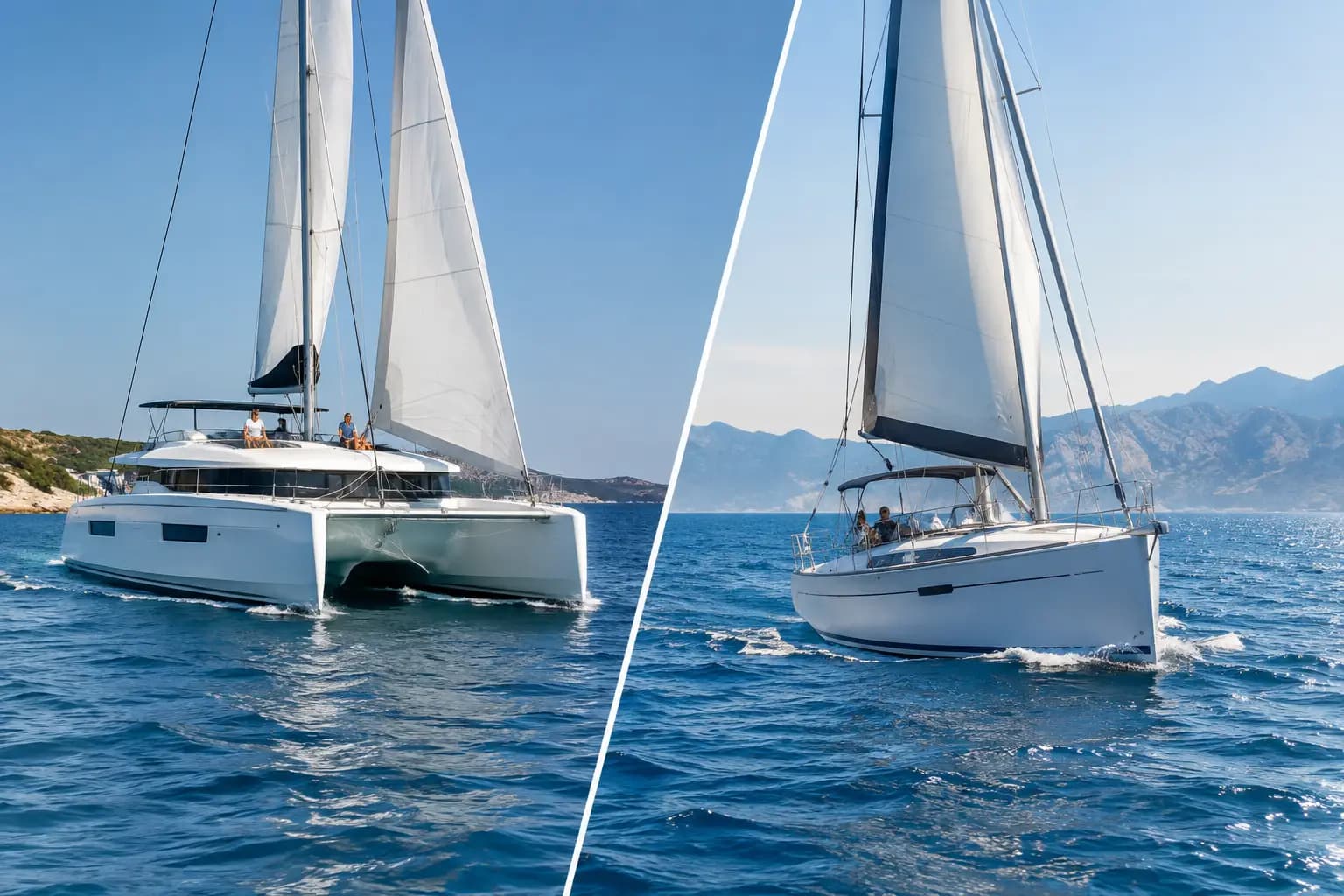
A catamaran carries its beam across two hulls, creating a wide deck plan, a large cockpit, and often a saloon that sits nearly level with the surrounding water views. A monohull concentrates its volume around a single hull, usually with a narrower footprint, deeper draft, and more traditional sailing profile.
On a calm morning at anchor, the distinction is immediately apparent. A cruising catamaran offers a broad, relatively flat platform for breakfast, children, guests, paddleboards, and easy movement between cockpit and saloon. The cabins are commonly separated between hulls, giving families and charter groups a degree of privacy that is difficult to match on a similarly sized monohull.
A monohull, however, is designed to heel under sail. Many sailors regard that heel, the feedback through the helm, and the way the boat moves through waves as central to the experience. The yacht tends to feel more connected to the sea rather than positioned above it. Neither approach is inherently better. The right choice depends on whether comfort at rest, sailing engagement, dock access, passage planning, or purchase economics leads the decision.
Space and Comfort at Anchor
For clients focused on social cruising or charter use, the catamaran's living space is often its strongest argument. A 45-foot catamaran can provide cockpit, deck, and interior volume that feels closer to a substantially longer monohull. Wide side decks, trampoline areas, and a large aft cockpit create natural zones for groups without everyone gathering in one narrow passageway.
The twin-hull arrangement also reduces rolling at anchor. A catamaran may still move in a short, confused sea, and it can react sharply when waves strike one hull at a time. Yet in typical protected anchorages, many guests find the platform notably more comfortable than a monohull. That matters on a week-long charter, during a corporate day event, or when a family expects to spend as much time stopped as sailing.
A monohull is more compact, but compact does not mean compromised. Well-designed monohulls offer secure cockpits, attractive salons, and a feeling of enclosure that some owners prefer in cooler weather or longer passages. The lower center of gravity and deeper cockpit can also feel reassuring when conditions become less settled.
Cabin Privacy and Crew Layout
Catamarans generally win on cabin separation. Guest cabins in opposite hulls create privacy for two couples, families with older children, or a charter group sharing the yacht. The trade-off is that each hull cabin may be narrower, with beds arranged across the beam or accessed from one side depending on the design.
Monohulls often offer more conventional cabin shapes and may provide a larger owner's suite within the central hull. On premium sailing yachts, the interior can be exceptionally refined, with strong storage capacity and better integration of crew areas. Buyers considering professional crew should assess not only the number of berths but also service routes, galley workflow, engine-room access, and whether crew privacy remains practical during guest use.
Sailing Performance and Motion Underway
The most meaningful difference underway is not speed alone. It is how each yacht responds to wind, waves, sail trim, and load.
A monohull heels, which can reduce wetted surface and provide clear feedback to the helm. It is usually capable of pointing higher into the wind than a comparable cruising catamaran. In strong conditions, its motion is often more predictable to experienced sailors, although the angle of heel can be tiring for guests who are not accustomed to moving around a boat under sail.
A catamaran generally sails flatter and can be very quick on reaching and downwind angles. The absence of heel makes meals, conversation, and onboard movement easier. However, a catamaran must be sailed with attention to sail area and wind strength. Unlike a monohull, it does not heel progressively to signal overload in the same way. Excess power can translate into high structural loads, so disciplined reefing and a knowledgeable skipper are essential.
In short head seas, the wide bridge deck of a catamaran can occasionally slap or pound if the yacht is driven too hard or poorly loaded. Modern designs have improved clearance considerably, but the issue should be evaluated during a proper sea trial. A monohull may slice through the same conditions with a different, often more natural rhythm, though it will roll and heel more.
Draft, Access, and Dockage
Draft can shape an entire cruising plan. Many catamarans have shallow draft, allowing access to waters and anchorages unavailable to deeper-keel monohulls. For owners who value close-in anchoring and flexibility in shallow areas, this is a practical advantage, not merely a brochure feature.
The compromise is beam. A catamaran occupies more width in a marina berth and may face limited availability in some facilities. Berthing charges can reflect that wider footprint, and maneuvering requires awareness of the yacht's considerable beam and windage. Twin engines, set far apart, make close-quarters handling highly intuitive once the operator understands the system. The yacht can often pivot effectively without building much speed.
A monohull usually fits more easily into standard slips and may have lower berth costs at the same length. Its narrower beam simplifies certain marina maneuvers, although a single-engine sailing yacht can be less forgiving when reversing in crosswind or current. A bow thruster, stern thruster, or professional skipper can materially improve confidence, but those additions should be considered within the purchase and operating plan.
Ownership Costs and Commercial Considerations
A catamaran is not automatically more expensive to own, but it has more duplicated systems. There are typically two engines, two saildrives or shafts, two hulls to maintain, and often a larger sail plan. Haul-out, antifouling, insurance, berth fees, and replacement parts can reflect the yacht's beam and complexity.
A monohull may be simpler in some respects, with one engine and less exterior surface area. Yet a larger monohull chosen to achieve equivalent living space can narrow the cost difference. The relevant comparison is not simply 45 feet versus 45 feet. It is the total ownership proposition: usable accommodation, annual operating budget, intended cruising range, crew requirement, and expected resale market.
For charter-oriented buyers, catamarans have broad appeal because they accommodate groups comfortably and photograph well in a lifestyle setting. Demand can be strong, particularly for modern layouts with multiple ensuite cabins and capable outdoor entertaining areas. But charter income should never be assumed as a guaranteed return. Seasonality, management standards, vessel age, crew quality, maintenance, regulation, and local berth availability all affect commercial performance.
Monohulls retain a loyal market among dedicated sailors and clients seeking a more traditional sailing experience. A properly specified, well-maintained monohull with documented service history can be highly attractive at resale. The key is matching the yacht's size, configuration, and equipment to a defined buyer or charter audience from the beginning.
How to Choose Between a Catamaran and a Monohull
Start with the actual use case, not the aspiration. If the yacht will host extended family, friends, or charter guests and spend long periods at anchor, a catamaran deserves close consideration. Its stability, privacy, and entertaining space can transform the experience for people who are not committed sailors.
If your priority is passage-making, close windward performance, a more involved sailing experience, and easier access to narrower berths, a monohull may be the stronger fit. It can also offer a more direct route into sailing ownership for buyers who value simpler systems and familiar handling.
Before making an offer, inspect comparable yachts in person and arrange a meaningful sea trial. Stand in the galley while underway. Test the helm sightlines. Check engine access, storage, ventilation, tender handling, sail controls, and the route from dock to cabin with provisions in hand. These details often matter more than headline specifications.
The best yacht is the one that supports the way you will genuinely use it, with a crew and operating budget that remain comfortable after the purchase. Master Ocean can help buyers compare suitable catamarans and monohulls, assess technical condition, and structure a search around cruising plans rather than assumptions. A clear brief at the outset turns a broad choice into a confident one.