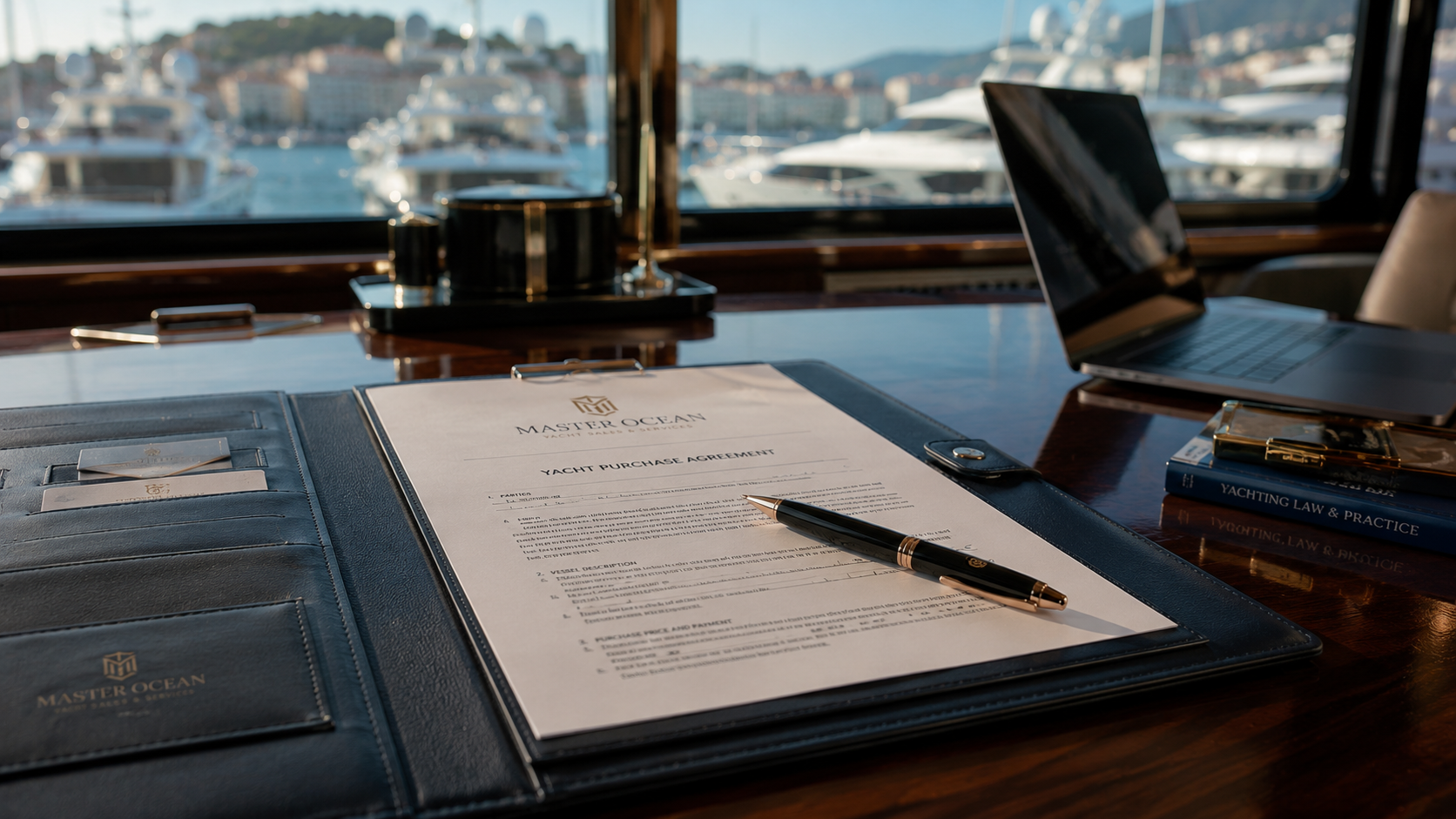
How to Buy the Right Yacht: The Ultimate Global Buyer's Guide
Discover how to navigate the international maritime market with absolute confidence. Learn how to define your cruising profile, select the perfect vessel, manage ownership costs, and execute flawless due diligence. Professional maritime advisors assist buyers worldwide in sourcing, negotiating, and acquiring prime vessels, ensuring your financial planning is sound and your lifestyle goals are achieved.
1. Introduction: The Ultimate Expression of Freedom and Privacy
To step onto the deck of your own yacht is to experience the ultimate expression of personal freedom. It is the ability to drop anchor in a secluded, translucent bay in Sardinia, to watch the golden hour illuminate the iconic cliffs of Portofino, or to host an impromptu gathering of family and friends against the vibrant backdrop of Monaco. In an increasingly fast-paced world, a luxury yacht provides a private sanctuary where time slows down, allowing you to curate unforgettable family experiences, absolute privacy, and seamless hospitality that cannot be replicated on land. Whether waking up to the stillness of a Bahamas anchorage or cruising the glamorous coastlines of Saint-Tropez, ownership is fundamentally about reclaiming your time and expanding your lifestyle.
However, entering the global maritime market demands a transition from emotion to strategic intelligence. A yacht is a magnificent lifestyle asset, but it is also a highly complex, multi-tiered acquisition strategy. The international brokerage and construction sectors have evolved into sophisticated environments where asymmetric information, varying tax structures, and distinct shipyard pedigrees directly impact your long-term satisfaction and asset preservation. Acquiring a vessel successfully is not merely about finding a beautiful hull; it is about achieving a perfect alignment between your personal aspirations, your geographic itinerary, and a data-driven ownership strategy. Professional yacht brokers regularly assist buyers in navigating these waters, transforming what can be a daunting transactional process into a seamless, rewarding journey.
2. Define Your Ownership Goals Before Looking at Yachts
The single most common error in the maritime sector is selecting a vessel based on visual appeal before defining its operational reality. Buyers frequently fall in love with lines, finishes, and brand prestige, only to discover the yacht is fundamentally unsuited for their intended lifestyle. To preserve long-term value and ensure long-term satisfaction, you must isolate and weigh your primary operational drivers.
Private Cruising and Family Use
If the primary objective is multi-generational family comfort, the focus must shift away from high top speeds toward stability, safety, and spatial volume. For family use, a vessel requires wide, secure side decks, protected flybridges, and versatile social spaces that allow different age groups to coexist without friction. Internal layouts should prioritize expansive main saloons, intuitive galley configurations, and stabilizing systems that eliminate hull roll at anchor, ensuring guest comfort. Imagine waking up in a secluded anchorage in Sardinia, the water perfectly calm, with three generations sharing breakfast on the aft deck without a hint of movement.
Weekend Boating and Coastal Day Trips
For owners seeking rapid escapes, regional coastal hops, or weekend getaways, large multi-cabin displacements are inefficient. The ideal profile centers on high-performance day boats, sport cruisers, or premium rigid inflatable boats. These vessels require minimal crew (often owner-operated), offer fast transit speeds to maximize limited time, and feature open layouts optimized for sunbathing, swimming, and al-fresco dining. Crucially, their shallower drafts allow access to secluded bays, private docks, and shallow anchorages that are entirely inaccessible to larger displacement hulls. This is the realm of the afternoon run from Monaco to Saint-Tropez for lunch at Club 55, where speed and agility are paramount.
Long-Distance Voyages and Global Exploration
True blue-water cruising and remote exploration demand an entirely different engineering philosophy. Aesthetics take a back seat to mechanical redundancy, hull integrity, and self-sufficiency. An explorer or long-range displacement yacht requires a steel or heavy-gauge aluminum hull, massive fuel and freshwater capacities, commercial-grade watermakers, and extensive cold storage. The mechanical spaces must feature redundant fuel filtration, dual generators, and accessible layouts that allow engineers to perform complex maintenance at sea without external shipyard support. This is for the owner whose sights are set far beyond the traditional milk run, seeking the rugged coastlines of the Pacific Northwest or the remote islands of the South Pacific.
Charter Income and Yield Optimization
When a yacht is positioned as an income-generating asset, personal preferences must yield to market demand. High-yield charter yachts require layouts that maximize guest cabin counts (ideally with identical VIP staterooms to prevent friction among paying guests), expansive sundecks with jacuzzis, extensive water toy inventories (tenders, jet skis, e-foils, dive centers), and completely segregated crew traffic routes to maintain the illusion of absolute privacy. To successfully offset costs through an optimized [Yacht Charter] strategy, an owner must relinquish prime weeks in July and August in the Mediterranean or Christmas and New Year in the Caribbean to paying guests.
Corporate Hospitality and Brand Activation
Vessels optimized for corporate entertaining focus on daytime capacity, flow, and prestige. These hulls require expansive main-deck saloons, professional-grade commercial galleys capable of high-end catering, state-of-the-art audiovisual systems, and open-plan decks that can accommodate large groups comfortably while moored in high-profile hubs like Cannes, Miami, or Dubai. The goal here is seamless hosting, where the yacht serves as a floating corporate headquarters during events like the Monaco Grand Prix.
3. Understanding Every Major Yacht Category
Navigating the market requires an analytical understanding of the distinct vessel types available. Each platform represents a specific set of engineering compromises affecting speed, volume, draft, operating costs, and seaworthiness.
Motor Yachts
Representing the core of the global luxury market, motor yachts typically span from 15 meters to well over 40 meters. Built primarily from fiber-reinforced plastic or aluminum, they are divided into planing, semi-displacement, and full-displacement hulls. They are ideal for traditionalists seeking speed, classic luxury, and a proven global shipyard infrastructure.
The advantages are undeniable: exceptional internal volume-to-length ratios, multiple decks for socializing, predictable handling, and a highly mature global broker and service network. The trade-offs include significant fuel consumption at planing speeds, vulnerability to rolling motions if not equipped with high-end stabilization, and higher mooring costs due to traditional marina slip requirements.
Annual operating costs hover predictably around 10% of the purchase price. They offer excellent charter market liquidity if properly configured, but face steady, predictable depreciation in line with major production cycles. Their natural habitats are the glittering coastlines of the French Riviera, the Amalfi Coast, the Balearic Islands, and the waters of Miami and The Bahamas.
Sailing Yachts
Sailing yachts, ranging from 12 meters to over 50 meters, rely on aerodynamic lift generated by sails, balanced by a weighted keel. Modern variants feature highly automated rigging, such as in-boom furling and captive winches controlled by joysticks, allowing massive sail areas to be managed by a minimal crew. This category is tailored for purists, experienced mariners, and eco-conscious owners who prioritize the romance and technicality of navigation.
They offer unmatched fuel efficiency when under sail, quiet operations, superior seaworthiness in heavy weather, and a distinct, prestigious lifestyle aesthetic. Conversely, they have limited interior volume compared to motor yachts of equivalent length due to narrower beams, experience a permanent heel while sailing, and carry deep drafts that restrict access to shallow harbors.
Maintenance costs are heavily weighted toward rigging, sail inventories, and specialized deck hardware. Resale markets are smaller and highly specialized, requiring precise brand positioning with names like Baltic, Swan, or Oyster to retain value. They are best enjoyed in the wind-rich environments of the Greek Cyclades, Sardinia, the Caribbean Leeward Islands, and New England.
Catamarans (Sailing)
Sailing catamarans, typically between 12 and 24 meters, utilize two parallel hulls connected by a central bridge deck. This architecture provides an exceptionally wide beam, creating a massive, single-level living area combining the saloon and aft cockpit. They are highly favored by families, charter investors, and cruisers seeking maximum stability and living space on a mid-range footprint.
The advantages include extreme stability at anchor and underway, shallow drafts often under 1.5 meters, and unmatched interior and exterior deck space per linear foot. However, they suffer from limited performance when sailing upwind, high windage that makes handling in tight marinas challenging, and double mooring fees in premium ports due to their excessive beam width.
Catamarans are the undisputed champions of the entry-to-mid-tier charter market, commanding exceptional rates and experiencing lower depreciation rates than equivalent monohulls due to massive global demand. They are ideally suited for the shallow, crystalline waters of the British Virgin Islands, The Bahamas, Croatia, and the Seychelles.
Power Catamarans
Placing themselves between traditional motor yachts and sailing multihulls, power catamarans eliminate the sailing rig entirely, optimizing the twin-hull architecture solely for mechanical propulsion. Typically ranging from 14 to 26 meters, they appeal to motor yacht buyers who want to slash fuel consumption without sacrificing onboard luxury or real estate.
They deliver extraordinary operational efficiency and range at cruising speeds, massive master suites that can span the entire forward beam, and substantial stability without the weight penalties of heavy stabilization fins. The primary disadvantages are their distinct aesthetic profiles that do not appeal to traditionalists, high marina dockage fees, and structural stress across the bridge deck in short, choppy seas.
This is a rapidly expanding sector; production models from premium builders hold value remarkably well due to a structural supply deficit in the brokerage market. They are exceptionally well-suited for the Exumas in The Bahamas, the Florida Keys, Thailand, and the Great Barrier Reef.
Sport Boats and Day Boats
Spanning 9 to 15 meters, these open-plan, high-performance vessels are characterized by powerful outboard configurations or high-torque sterndrives. They emphasize deck space, premium audio, and rapid acceleration over overnight accommodations, making them perfect for waterfront homeowners, performance enthusiasts, and luxury resort commuters.
They offer thrilling performance with speeds often exceeding 45 knots, ease of handling, low maintenance, and the ability to be stored on lifts or dry-stacked, eliminating permanent berthing costs. On the other hand, they provide virtually no long-range cruising capability, high exposure to elements in inclement weather, and minimal fuel efficiency.
This is a high-volume, high-turnover segment where depreciation is steep in the first 36 months, driven by rapid technological updates in outboard engines and marine electronics. They are best utilized for day trips, such as running from Ibiza to Formentera, commuting along the Dubai coastline, or exploring Sydney Harbour.
RIBs (Rigid Inflatable Boats) and Tenders
Ranging from 5 to 14 meters, modern luxury RIBs feature a rigid glass or carbon fiber hull surrounded by inflatable collars. They have evolved into high-end standalone day boats featuring cabins, teak decking, and advanced carbon-fiber hardtops, serving superyacht owners needing logistical support or coastal explorers seeking an indestructible, high-speed utility craft.
They are exceptionally safe, buoyant, and forgiving during docking maneuvers, delivering superb rough-water performance. Their drawbacks include susceptibility of the tubes to UV degradation and puncture over time, limited dry storage, and a utilitarian aesthetic that lacks traditional yacht opulence.
Tenders are viewed primarily as support assets, meaning resale value is tightly tied to engine hours and tube condition, though premium brands like Anvera, Sacs, or Williams retain consistent commercial value as elite yacht accessories worldwide.
Explorer Yachts
Encompassing vessels from 24 meters to well over 60 meters, explorer yachts feature full-displacement hulls built from high-tensile steel or heavy aluminum, often featuring Ice Class reinforcement. They utilize commercial-grade machinery, forward-slanted bridge windows to shed heavy seas, and massive sub-deck storage, making them the ultimate tool for high-net-worth adventurers, researchers, and global cruisers who reject traditional marina-centric itineraries.
They provide extreme transoceanic range, often over 5,000 nautical miles, incredible autonomous capacity for fuel, water, and food, and the structural integrity to withstand extreme sea states. The trade-offs are lower maximum cruising speeds, typically 10–12 knots, institutional interior design limitations imposed by structural bulkheads, and deep drafts preventing access to shallow coastal waters.
This is an exceptionally strong asset class, retaining value better than almost any other sector due to scarcity, high construction standards, and a surging global demand for off-the-grid travel to destinations like Antarctica, Svalbard, the Norwegian Fjords, and the Galapagos.
Luxury Yachts, Superyachts, and Megayachts
These tiers represent the pinnacle of maritime engineering, moving from luxury vessels at 24–35 meters to superyachts at 35–60 meters, and finally megayachts stretching beyond 60 to over 100 meters. This transition shifts the vessel from production or semi-custom composite platforms to fully bespoke steel and aluminum giants operating under strict international commercial codes. They are designed for ultra-high-net-worth individuals, sovereign wealth funds, and corporate entities seeking ultimate prestige and global hospitality.
The advantages are absolute: complete lifestyle customization including helipads, beach clubs, indoor swimming pools, cinema rooms, and unparalleled status. The disadvantages are equally monumental: exponential operating expenses, complex labor management for crews ranging from six to over fifty professionals, and extreme geopolitical and regulatory compliance burdens.
Transactions are highly confidential, often conducted entirely within the realm of [Off-Market Yachts]. Value retention is heavily dependent on the pedigree of the Northern European or elite Italian shipyard, alongside a flawless maintenance pedigree verified by classification societies like Lloyd's Register or ABS. They are built for the world's most exclusive stages: Monaco, Portofino, Saint-Tropez, and St. Barths.
Custom-Built Yachts
A blank-sheet engineering process typically starting at 40 meters and extending beyond 100 meters, where naval architecture, interior layout, and mechanical propulsion systems are engineered entirely from scratch for a single client. This is the choice of experienced, patient connoisseurs who refuse to accept any engineering or design compromises.
It grants complete autonomy over every millimeter of the vessel, the integration of bleeding-edge sustainable technologies, and unprecedented personal legacy creation. The challenges are extreme lead times of three to five-plus years, significant counterparty risk with shipyards, and massive upfront engineering capital expenditure that cannot be recovered if the project is aborted.
Elite pedigree builds from shipyards like Feadship or Lürssen can command premiums upon completion from buyers looking to skip multi-year shipyard waitlists, whereas overly personalized or eccentric designs can suffer catastrophic depreciation.
4. Deep Comparison: Motor Yacht vs. Sailing Yacht vs. Catamaran
For the serious buyer, deciding between a traditional monohull motor yacht, a sailing yacht, or a multi-hull catamaran is the most consequential crossroad in the entire acquisition strategy. This choice dictates how you will interact with the water, how your family will experience the vessel, and the long-term financial planning required to support the asset.
Onboard Comfort and Interior Volume
When evaluating comfort, the distinction between these three platforms comes down to a battle between linear space, beam width, and motion at sea.
• Motor Yachts: Offer exceptional, multi-level vertical real estate. The traditional monohull motor yacht utilizes its depth to create distinct decks, separating the master suite on the main deck from guest cabins below, and social spaces on the flybridge. The interior comfort is defined by residential-style head heights, expansive glass walls, and full-beam saloons. However, in heavy seas or at anchor without stabilization, their high center of gravity makes them prone to a quick, snappy roll.
• Sailing Yachts: Interior volume is structurally compromised by the aerodynamic requirements of a sailing hull. Hulls must remain relatively narrow to slice through water efficiently, resulting in deeper, lower-slung accommodations. While modern custom builders create magnificent raised-saloon layouts, guest cabins are inherently smaller, and head heights can feel restrictive compared to motor platforms. The comfort of a sailing yacht is found in its motion; under sail, the hull heels over to a steady angle, creating a predictable, fluid ride that cuts through choppy water rather than bouncing over it.
• Catamarans: Entirely redefine the concept of volume. By utilizing two hulls connected by a massive bridge deck, a catamaran provides a beam width that is often double that of an equivalent-length monohull. This allows for a massive, single-level living space where the main saloon, galley, and aft cockpit merge into one expansive indoor-outdoor terrace. Because they do not heel while sailing and sit on two separate points of buoyancy, they deliver unparalleled stability. At anchor, a catamaran experiences virtually none of the side-to-side roll that trips up monohulls, creating a stable, stress-free environment for family members who may not have strong sea legs.
Speed and Transit Performance
The ability to outrun weather systems, minimize transit times, and stick to a tight cruising itinerary depends heavily on your choice of platform.
• Motor Yachts: Are the undisputed champions of speed and scheduling predictability. A planing or semi-displacement motor yacht can easily maintain cruising speeds between 18 and 25 knots, with top speeds often exceeding 30 knots. This performance lets you breakfast in Monaco, run down to Saint-Tropez for lunch, and return to Corsica by nightfall. If a storm approaches, a motor yacht simply applies throttle to outrun the system, offering complete scheduling independence.
• Sailing Yachts: Are tied directly to the environment. While a modern 30-meter sailing superyacht can achieve 12 to 15 knots in a strong breeze, their average transit speeds under a mix of sail and auxiliary power hover around 8 to 10 knots. A sailing yacht turns the journey itself into the primary experience; you cannot force a strict timeline on a sailing hull when wind angles change, making them better suited for owners who view transit time as a luxury rather than an administrative hurdle.
• Catamarans: Sit comfortably in the middle. Under sail, power-to-weight ratios allow performance catamarans to achieve spectacular speeds downwind, often surpassing traditional sailing monohulls due to the lack of a heavy, drag-inducing ballast keel. However, when sailing upwind, their wide hulls create significant aerodynamic resistance, slowing progress. For owners who want multihull volume combined with motor-yacht speeds, the rapidly growing power catamaran segment eliminates sails entirely, utilizing twin diesels to cruise efficiently at 12 to 18 knots while maintaining an extensive cruising range.
Financial Planning: Purchase and Ongoing Running Costs
From a financial perspective, the underlying architectures of these platforms generate wildly different operational profiles.
• Motor Yachts: Have lower initial shipyard acquisition costs per gross ton due to highly optimized production lines, but they carry the heaviest ongoing operational expenses. High-horsepower marine diesels consume massive volumes of fuel, and the complexity of onboard systems—such as advanced stabilization fins or gyroscopes, multi-zone air conditioning, and hydraulic garage transoms—requires continuous, specialized maintenance.
• Sailing Yachts: Command a premium during the initial build phase due to the extreme structural engineering required to support a 40-meter mast and withstand massive rigging loads. Once acquired, their fuel costs are beautifully low, but that budget line item is replaced by rigging maintenance. Sail inventories wear out and must be replaced every few seasons, and classification societies mandate exhaustive, highly expensive un-masting and rigging NDT (non-destructive testing) inspections every five years.
• Catamarans: Represent a unique financial challenge in marinas. While their fuel burn is highly efficient due to easily driven, narrow hulls, their massive beam width means they occupy the space of two traditional slips. In premium Mediterranean hubs like Ibiza or Monaco, catamaran mooring fees are frequently surcharged by 50% to 100%, if a berth can be found at all. Furthermore, maintaining two independent engine rooms, dual rudder systems, and twin drivetrain architectures doubles the baseline mechanical upkeep.
Family Suitability, Charter Appeal, and Long-Distance Voyages
Choosing the right platform ultimately determines how successfully the vessel fulfills its primary lifestyle or financial mandate.
• Family Suitability: For multi-generational family use, catamarans are virtually unmatched. The single-level living area prevents steps from becoming safety hazards for children or older guests, and the absolute stability at anchor means family experiences—from dinners on deck to sleeping through a night-time swell—remain comfortable and relaxed. Motor yachts follow closely, offering dedicated spaces where teenagers can occupy the forward sunpads while parents relax on the flybridge. Sailing monohulls demand an active, agile lifestyle; moving around a heeling deck requires physical coordination, making them better suited for families who share a passion for active sport and seamanship.
• Charter Appeal and Asset Preservation: If maximizing rental yield to offset operational costs is your priority, the market trends are clear. Catamarans between 15 and 24 meters are the absolute powerhouses of the entry-to-mid-tier charter market, commanding exceptional weekly rates because guests demand stability and large social spaces. In the superyacht tier, motor yachts dominate the elite charter market, where high-net-worth clients willingly pay premium rates for iconic prestige, deep water-toy inventories, and high transit speeds. Sailing yachts have a smaller, highly passionate charter demographic that prioritizes classic regattas and purist navigation.
• Long-Distance Voyages and Exploration: For transoceanic crossings and blue-water independence, sailing yachts and specialized explorer motor yachts share the crown. A sailing yacht offers ultimate survival capability; as long as you have wind, your range is theoretically infinite, freeing you from a reliance on coastal fuel networks. Conversely, if you prefer mechanical propulsion for remote journeys, a full-displacement explorer motor yacht built with a steel hull and commercial-grade machinery delivers the range, heavy sea-keeping stability, and autonomous storage needed to explore high-latitude zones like the Norwegian Fjords or Antarctica in complete safety.
5. Best Yacht Types for Different Buyer Profiles
Every buyer arrives at the market with a unique set of circumstances, timelines, and personal expectations. Matching your specific profile to the correct segment of the market is essential for long-term satisfaction. Experienced advisors regularly analyze these profiles to steer clients toward the ideal asset class.
The First-Time Buyer
• Ideal Profile: Premium production day boats or mid-sized flybridge motor yachts (11–16 meters).
• The Strategy: First-time buyers should prioritize ease of operations, predictable maintenance schedules, and strong market liquidity. Opting for established brands like Princess, Sunseeker, or Pardo ensures that finding parts, securing insurance, and eventual resale remain straightforward. Keeping the vessel within an owner-operated or single-crew framework prevents the administrative friction of managing a large maritime staff during your initial seasons on the water.
The Family Owner
• Ideal Profile: Luxury production catamarans or high-volume tri-deck motor yachts (18–28 meters).
• The Strategy: For multi-generational family use, living space, onboard safety, and stability are paramount. Catamarans offer unmatched surface area and minimal roll at anchor, making them perfect for children and elderly guests. Larger motor yachts in this bracket introduce dedicated spaces where different generations can gather or find privacy simultaneously, ensuring seamless family experiences in places like the Caribbean or Croatia.
The Charter Investor
• Ideal Profile: High-volume power catamarans or commercially compliant tri-deck superyachts.
• The Strategy: This buyer prioritizes asset utilization and cost mitigation over personal design eccentricities. The focus must be on maximizing cabin count (ideally with identical layout VIP suites), expansive exterior sundecks, and a robust water-toy inventory. Incorporating a structured [Yacht Management] program allows the asset to generate premium weekly rates, successfully offsetting annual operational overhead.
The Retired Couple
• Ideal Profile: Automated sailing catamarans, semi-displacement trawlers, or pocket explorers (14–20 meters).
• The Strategy: Safety, autonomy, and long-range comfort define this profile. Couples who wish to cruise without a large crew require highly automated sail-handling systems or intuitive, low-maintenance diesel propulsion. Features like wide side decks, accessible engine rooms, and excellent stability allow for effortless, extended coastal exploration from the Greek islands to the French Riviera.
The Corporate Owner
• Ideal Profile: Wide-beam open yachts or expansive tri-deck motor yachts optimized for daytime hosting.
• The Strategy: Here, the yacht serves as a floating corporate headquarters and a tool for elite brand activation. The layout must prioritize massive main-deck saloons, professional-grade commercial galleys capable of high-end catering, and state-of-the-art audiovisual capabilities. These vessels are positioned in high-profile maritime hubs like Monaco or Miami to host large-scale events, product launches, and top-tier client entertainment.
The Ultra-High-Net-Worth Individual (UHNWI)
• Ideal Profile: Bespoke steel/aluminum superyachts or fully custom megayachts (40–100+ meters).
• The Strategy: For the apex of the market, the yacht is an extension of a global estate portfolio. This profile demands absolute customization, ultimate privacy, and elite pedigree. The acquisition strategy typically bypasses public channels entirely, focusing on confidential off-market transactions or multi-year [Yacht Construction] projects with elite Northern European or top-tier Italian shipyards, managed under strict confidentiality frameworks.
6. How Much Yacht Can You Really Afford?
One of the most critical phases of financial planning is understanding what your capital can realistically secure in the modern maritime market. Buyers routinely underestimate the gap between the purchase price and the ongoing operational capital required to sustain the asset. To guide your capital allocation, we break down what is genuinely achievable across five distinct financial tiers.
If Your Budget is €500,000
At this tier, you are looking at premium owner-operated day boats, high-end rigid inflatable boats, or entry-level weekend cruisers. In the new-build market, this secures a well-specified 10-to-11-meter sports boat from builders like Axopar, Brabus, or Pardo. In the pre-owned brokerage market, this capital allows you to step up to a 5-to-7-year-old 13-meter flybridge motor yacht from production yards like Princess or Jeanneau.
Ownership at this level is blissfully uncomplicated: no permanent crew salaries, low maintenance overhead, and the ability to utilize local dry-stacking or standard marina berths. Your annual operating budget should be kept at roughly €40,000 to €50,000. It is the perfect setup for day trips through the glamorous bays of Ibiza or coastal hops along the Florida Keys.
If Your Budget is €1,000,000
This budget introduces you to true luxury coastal cruising. In the new market, you can acquire a highly specified 14-meter sports cruiser or a premium production sailing catamaran. If you pivot to the brokerage market, this budget unlocks high-volume, 15-to-18-meter flybridge motor yachts from elite names like Azimut, Sunseeker, or Ferretti, typically around 6 to 8 years old.
At this scale, systems become more complex. You will transition from pure owner-operation to retaining a part-time seasonal captain or a dedicated deckhand to manage washing, stainless-steel polishing, and basic mechanical maintenance. Your annual running costs will escalate to between €100,000 and €150,000, particularly if you secure a permanent berth in a desirable Mediterranean hub.
If Your Budget is €3,000,000
This is the gateway to the "pocket superyacht" lifestyle. If you insist on a brand-new vessel, €3 million will secure a highly optioned 18-to-20-meter motor yacht or a luxury production catamaran like a Sunreef. However, the smart money at this level often targets the pre-owned brokerage market, where €3 million buys a magnificent, 22-to-26-meter semi-custom motor yacht from pedigree Italian yards like Sanlorenzo or a pristine pocket explorer from Benetti, roughly 5 to 10 years old.
Vessels of this size feature dedicated, separate crew quarters, meaning you will employ a full-time, year-round crew of two to three professionals. This is where you enjoy the ultimate luxury of leaving the helm, line handling, and galley duties to others while you entertain guests against the backdrop of Portofino. Expect a realistic annual operational expenditure of €250,000 to €350,000.
If Your Budget is €10,000,000
At €10 million, you enter the elite tier of global yachting. In the new-build sector, this capital allows you to commission a 28-to-32-meter semi-custom composite motor yacht from builders like Sanlorenzo or a fast-displacement aluminum hull from Heesen. In the brokerage market, this budget transforms you into a powerful buyer capable of acquiring a 35-to-40-meter tri-deck steel and aluminum superyacht from world-renowned Italian or Dutch builders, approximately 7 to 12 years old.
These vessels operate under international commercial codes, feature full-scale beach clubs, master suites with 180-degree views, and require a permanent crew of five to seven professionals. This asset allows you to host grand corporate events or private family retreats anywhere from Saint-Tropez to the Caribbean, backed by a mandatory annual operating budget of €800,000 to €1,200,000.
If Your Budget is €30,000,000+
This net worth tier belongs exclusively to the world of custom superyachts and iconic megayachts. This capital allows you to enter the elite shipyards of Northern Europe—such as Feadship, Lürssen, or Abeking & Rasmussen—to either purchase a pristine, late-model 45-to-60-meter brokerage masterpiece or initiate a fully custom new-build project.
At this level, you are not merely buying a boat; you are commissioning a floating estate tailored to your exact specifications, featuring helipads, glass-bottomed swimming pools, onboard spas, and a dedicated crew of twelve to over twenty professionals. These vessels cross oceans effortlessly, wintering in St. Barths before spending the summer season anchored off Monaco. Your annual operational capital commitment will start at €3,000,000 and scale upward depending on your global itinerary and charter configuration.
7. Should You Buy New or Used?
The choice between commissioning a new-build construction project or acquiring a pre-owned brokerage vessel is one of the most heavily debated topics in maritime circles. It is a strategic decision that shapes your financial timeline, engineering risk, and time-to-water.
The Case for New Construction
The primary allure of new construction is the acquisition of an unblemished asset engineered with the latest propulsion, hull design, and digital platforms. It allows an owner to implement specific interior layouts, select exact leathers and stones, and integrate next-generation hybrid power systems that will remain compliant with environmental laws for decades. Furthermore, a new yacht is backed by comprehensive shipyard warranties, offering a sense of security during the initial seasons.
The Challenges: The hidden risk of new construction is execution and counterparty risk. Shipyard delays are common across the industry, and a delay of even three months can completely ruin an entire summer cruising season. In a worst-case scenario, structural financial distress at a shipyard can freeze an owner’s capital indefinitely within an unfinished hull.
Additionally, the first 12 months of a new yacht's life are inevitably plagued by guarantee works—a polite industry term for fixing the hundreds of minor electrical, plumbing, and systemic glitches that appear when a complex custom vessel begins real-world operations. Finally, new builds suffer from an immediate, sharp depreciation hit of 15% to 20% the moment the vessel leaves the shipyard quay.
The Case for a Pre-Owned Brokerage Vessel
Purchasing a brokerage yacht allows immediate access to the water, skipping multi-year design and build backlogs. Financially, the primary benefit is that the initial owner has absorbed the steepest phase of the asset's depreciation curve, allowing you to enter the market at a price closer to the vessel's true replacement value.
Additionally, a brokerage vessel has already gone through its shake-down period; its systemic bugs have been identified, ironed out, and documented by the previous crew. You can review years of real-world operational data, fuel burn logs, and maintenance histories before committing your resources.
The Challenges: The trade-off lies in the unknown historical operational profile. Even the most exhaustive marine survey cannot completely detect microscopic fiberglass osmosis, internal engine block corrosion from poor winterization, or intermittent wiring faults deep behind structural bulkheads. Buyers must budget a refit and [Yacht Repair] contingency—typically 10% to 20% of the purchase price—to address immediate personalization and unforeseen mechanical remediation. If you value absolute customization and cutting-edge tech, choose new; if you value immediate delivery, financial efficiency, and a proven hull, focus on the brokerage market.
8. The Best Time to Buy a Yacht
Timing the global yacht market requires a sophisticated understanding of seasonal cycles, shipyard production schedules, and the international boat show calendar. Entering the market at the strategic moment can yield significant advantages in price negotiation, inventory availability, and timing your first summer season.
The Autumn Wave: Post-Season Realism
For brokerage vessels, the autumn months—specifically September and October—represent the absolute premier window for buyers. As the Mediterranean or North American summer season draws to a close, owners face the immediate financial reality of winterization costs, upcoming shipyard refit bills, and annualized mooring renewals.
Emotional attachments to the vessel are at their lowest point of the year. Sellers who were unyielding on price in April are often highly receptive to realistic offers in October to avoid carrying the asset's Opex through the unproductive winter months. Furthermore, this timing allows you ample months to execute a meticulous winter refit or detailed [Yacht Detailing] schedule before the spring launch.
The Boat Show Nexus: September to January
The major international autumn boat shows—Cannes Yachting Festival and Monaco Yacht Show in September, followed by the Fort Lauderdale International Boat Show in October—completely reshape market dynamics. Shipyards and brokerage houses deploy massive capital to showcase inventory.
• Before the Shows: A smart strategy involves approaching sellers a few weeks before a major boat show. Preparing a vessel for a premier show costs tens of thousands of euros in crew prep, detailing, and exhibition fees. An owner can frequently be incentivized to accept a clean offer right before the show to guarantee an exit and avoid these non-recoverable presentation expenses.
• After the Shows: If a yacht listed for sale during the autumn shows fails to secure a buyer by the end of November, the seller's anxiety increases. This creates an exceptionally fertile environment for aggressive negotiation as winter approaches.
The Winter Window: Financial Consolidation
Deep winter—December through February—is a period of quiet, high-stakes negotiation. While consumer-facing activity slows down, professional brokers utilize this window to structure complex deals. Buyers who contract during the winter benefit from undivided surveyor attention, open shipyard slots for pre-purchase haul-outs, and ample time to finalize custom flags, registrations, and corporate structures without rushing against a looming summer charter deadline.
9. Yacht Purchase Timeline: From Concept to Quay
Executing a successful yacht acquisition is a structured process that should never be rushed. When working with professional maritime advisors, the transaction moves through a disciplined four-week operational framework designed to insulate the buyer from risk.
Week 1: Sourcing, Vetting, and the Initial Offer
The journey begins with market mapping. Your broker scans global multiple listing services alongside private networks to identify target vessels matching your lifestyle brief. Once a specific hull is selected, counsel drafts a formal Memorandum of Agreement (MOA), typically utilizing standard international templates such as the MYBA agreement. This document outlines the purchase price, specific inventory inclusions, and conditions of the sale. Upon signature, the buyer deposits a fully refundable 10% of the purchase price into a secure, dedicated maritime escrow account.
Week 2: Technical Survey and Data Auditing
With the deposit secured, the vessel is legally frozen and cannot be sold to another party. The buyer’s independent marine surveyor takes control of the asset. This week involves a comprehensive technical audit: structural hull scanning, moisture testing of laminates, analysis of machinery oil samples, and a complete review of historical maintenance and service logs to uncover any hidden defects or mechanical anomalies.
Week 3: The Sea Trial and Acceptance
The vessel is launched for an intensive sea trial to stress-test all propulsion, stabilization, and onboard electrical platforms under full operational loads. Following the trial, the surveyor compiles a detailed technical report.
If major unrecorded defects are discovered, the buyer retains the legal right to either reject the vessel entirely and reclaim their 10% deposit, or negotiate a corresponding price reduction to cover the necessary shipyard remediation works. If the vessel performs flawlessly, the buyer signs a formal Notice of Acceptance.
Week 4: Title Auditing, Closing, and Handover
The final phase focuses on legal due diligence. Maritime counsel audits the flag registry to verify a clean abstract of title, ensuring there are no outstanding maritime liens, crew wage disputes, or active mortgages registered against the hull. Simultaneously, tax documentation is verified. On the designated closing day, the escrow agent releases the remaining balance to the seller, a Bill of Sale is executed, the flag registration is transferred to the buyer's corporate entity, and the keys are delivered to your new captain.
10. Top 10 Questions Every Yacht Buyer Should Ask
Before signing a Memorandum of Agreement or executing a wire transfer for a 10% deposit, every buyer must pressure-test the transaction by asking ten foundational questions:
1. What is the verified history of the vessel's engine and generator hours, and when are the next major overhauls due?
2. Is the yacht's VAT status fully documented with an original invoice or a T2L certificate, and does it hold VAT-paid status within the European Union?
3. Has the vessel ever been chartered commercially, and if so, how many weeks per year did it operate under heavy guest usage?
4. Are there any outstanding maritime liens, mortgages, or crew wage disputes registered against the hull's abstract of title?
5. Why is the current owner selling the vessel, and how long has it been actively listed on the brokerage market?
6. Does the vessel comply with modern Tier III environmental emissions regulations, and are there any upcoming regional cruising restrictions that will affect its itinerary?
7. What classification society monitors the vessel, and when is the mandatory five-year structural and technical survey scheduled?
8. What is the realistic, documented fuel consumption of the hull at eco-cruising speed versus maximum transit speed?
9. Are the crew quarters large enough to retain high-quality, licensed professionals, or does the layout suffer from high crew turnover?
10. What is the estimated market depreciation for this specific brand and model over the next three to five years?
11. Red Flags That Should Stop a Purchase Immediately
In the high-stakes arena of [Yacht Sales], certain technical, legal, or administrative discoveries should serve as definitive warnings to halt a transaction immediately. Attempting to negotiate through these issues often leads to catastrophic drains on your financial planning.
Missing or Incomplete Service Records
A complete absence of structured maintenance logs is an immediate indicator of systemic neglect. If an owner cannot produce certified records of oil analyses, generator overhauls, stabilizer servicing, and anti-fouling applications, you must assume the worst. Modern yachts are highly sensitive engineering ecosystems; missing service records mean you are inheriting a ticking mechanical clock that will inevitably manifest as massive shipyard bills during your first season.
Ambiguous VAT or Tax Documentation
Never accept a broker’s verbal assurance that a vessel is "VAT paid." If the seller cannot produce the original, certified VAT invoice from a European customs authority or an ironclad legal exemption certificate, pause the deal. Tax authorities across Monaco, France, and Italy are increasingly aggressive; inheriting a yacht with flawed tax paperwork can instantly expose you to a 20% to 22% tax penalty based on the current valuation of the vessel, alongside potential asset seizure.
Poor Survey Results and Structural Anomalies
If a structural hull survey reveals high moisture readings within a composite hull—indicating advanced osmosis—or ultrasonic scanning detects significant thinning of a steel hull's plates, step away. Structural remediation requires cutting into the core of the vessel, a process that can tie up a yacht in a shipyard for months and cost hundreds of thousands of euros. Similarly, any evidence of past structural grounding that has misaligned the propeller shafts or structurally compromised the keel bulkheads should be an absolute dealbreaker.
Unclear Chain of Ownership and Registry Liens
A yacht's title must be pristine. If the abstract of title reveals unresolved maritime liens from unpaid fuel suppliers, outstanding marina fees, or back-wages owed to former crew members, do not proceed. Because maritime liens attach directly to the hull itself rather than the individual owner, purchasing a vessel with these encumbrances means you legally inherit the previous owner's debts, exposing your new asset to immediate arrest by creditors.
12. The Real Cost of Yacht Ownership: The 10-15% Rule
A primary rule of maritime wealth preservation: The purchase price is simply the entry ticket to an ongoing financial commitment. Failing to accurately project operational expenditure is the number one reason owners exit the market prematurely.
The gold standard for estimating operating costs is the 10–15% annual ownership rule, which states that the yearly operational cost of a vessel will equal roughly 10% to 15% of its original new-build cost. This percentage does not shrink as the yacht ages or depreciates; an older, depreciated brokerage yacht acquired for €2 million that originally cost €5 million to build will still demand €500,000 annually to run and maintain correctly.
The Breakdown of Annual Opex
• Crew Payroll: Salaries, medical insurance, rotations, uniforms, and victualling. For superyachts, this is single-handedly the largest line item, often consuming 35–42% of the total annual budget.
• Marina and Mooring Fees: Premium berthing scales non-linearly. A berth in Monaco or Ibiza during peak season commands astronomical rates, and slips are charged by both linear length and total beam.
• Technical Maintenance and Class Surveys: Annual engine and generator servicing, anti-fouling applications, sacrificial anode replacement, and the mandatory 5-year classification society surveys required for larger hulls to maintain insurance validity.
• Insurance Underwriting: Premium hull and machinery protection, Protection & Indemnity liability, crew coverage, and specialized riders if the vessel crosses high-risk zones or engages in commercial chartering.
• Administrative and Management Costs: Retaining an external yacht management company to handle crew payroll, technical compliance, fiscal reporting, and logistics.
13. How to Inspect a Yacht Properly: The Due Diligence Protocol
The closing phase of a yacht acquisition requires an exhaustive, adversarial inspection protocol. You should never rely on the seller's representations or the superficial appearance of a vessel. The due diligence process is split into two rigorous phases: Technical Surveying and Legal/Title Auditing.
The Technical Survey and Sea Trial
Buyers must retain an independent, certified marine surveyor accredited by recognized global bodies.
• Hull and Structural Integrity Audits: For GRP hulls, non-destructive moisture testing and ultrasound scanning must be conducted to detect internal delamination, core rotting, or osmotic blistering. For steel and aluminum hulls, comprehensive ultrasonic thickness gauging is mandatory to verify that plating has not thinned due to galvanic corrosion.
• Propulsion Fluid Analysis: Before the sea trial, oil samples must be drawn from the main engines, gearboxes, and generators. Spectrochemical analysis of these fluids reveals trace metals, indicating internal bearing wear, piston degradation, or cooling fluid leaks that are invisible during standard operations.
• The Sea Trial Protocol: A sea trial is not a pleasure cruise; it is a stress test. The vessel must be run at wide-open throttle for an extended period to verify that the cooling systems can handle maximum load without overheating. The surveyor will monitor exhaust smoke density, record vibration profiles across the RPM band using accelerometers, and test the response profiles of bow thrusters, stabilizers, and steering hydraulics under maximum load.
Legal Due Diligence and Title Verification
Simultaneously, maritime legal counsel must audit the vessel's paperwork to ensure clean title transfer.
• Lien and Debt Checks: Mortgages and maritime liens attach to the vessel itself, not the owner. If you purchase a yacht with outstanding debts for fuel, marina docking, crew wages, or shipyard repairs, those creditors can legally seize your newly acquired asset. Counsel must pull clean abstracts from the vessel's flag registry.
• Chain of Title and VAT Verification: A flawless historical record of Bills of Sale must be presented. Crucially within European waters, the VAT status must be verified with ironclad documentation. A missing VAT document can instantly devalue a vessel by 20–22% if tax authorities demand payment upon port entry.
14. Best Yacht Brands: Market Positioning and Strengths
Navigating the global landscape of shipyard brands requires understanding where each builder sits on the spectrum of production efficiency, prestige, and custom naval architecture.
Luxury Production
In the industrialized luxury sector, brands like Princess, Sunseeker, Azimut, Prestige, and Fairline dominate. They specialize in standardized platforms with modular interior options, maximizing volume and cost efficiency. Their primary strengths include exceptional interior space utilization, predictable delivery timelines, and extensive global service and parts networks. They are ideal for first- or second-time buyers who prioritize turn-key operations, modern aesthetics, and clear entry and exit liquidity in the brokerage market.
Premium Performance and Custom Heritage
Moving up the luxury spectrum brings us to elite builders such as Ferretti, Riva, Pershing, and Sanlorenzo. This segment is defined by elite craftsmanship, high performance, and recognizable design prestige. Riva and Pershing represent the absolute pinnacle of Italian styling and high-speed propulsion engineering, commanding instant attention in any marina from Cannes to Ibiza. Sanlorenzo sets the standard for sophisticated, understated design and semi-custom personalization within fiberglass and steel architectures, appealing to owners who demand superior sea-keeping capabilities and high build quality.
Ultra-Luxury and Superyacht Pedigree
This tier represents the pinnacle of bespoke luxury, transoceanic naval architecture, and institutional-grade construction, featuring iconic shipyards like Benetti, Feadship, Heesen, Lürssen, and Gulf Craft. Feadship and Lürssen are the undisputed apex predators of global yacht building, offering unparalleled custom steel engineering and generational value retention. Heesen dominates aluminum fast-displacement engineering, while Benetti delivers world-class semi-custom and custom superyacht series. Gulf Craft provides exceptional volume and custom luxury utilizing advanced composite engineering on a grand scale. This segment is tailored for ultra-high-net-worth individuals and institutional family offices looking to deploy resources into iconic maritime assets.
Multihulls and Catamarans
Focused on spatial optimization, stability-first platforms, and modern multihull luxury, this sector features builders like Sunreef, Lagoon, and Fountaine Pajot. Lagoon and Fountaine Pajot offer highly optimized, dependable production platforms that dominate the global charter market. Sunreef represents the luxury vanguard, blending massive multihull footprints with bespoke superyacht-tier finishes and pioneering green solar/hybrid integration. This is the ideal choice for charter investors, families planning long-term warm-water cruising, and eco-conscious owners looking for maximum stable surface area in regions like The Bahamas or the Seychelles.
15. Yacht Ownership as an Investment: Realistic Financial Models
Let us be completely unequivocal: A yacht is inherently a lifestyle asset, not a traditional yield-generating financial instrument. Anyone promising risk-free, double-digit returns on a yacht purchase is misrepresenting the reality of maritime economics. However, when managed with institutional discipline and a structured [Yacht Investment] framework, a yacht can be positioned to offset its operating costs, preserve asset value, and occasionally generate net positive cash flow under specific parameters.
Charter Management Programs
Placing your vessel into a professional charter fleet is the most effective mechanism to mitigate annual Opex. In a standard structure, a central charter agency markets the vessel, handles compliance, and manages bookings.
• The Financial Reality: To successfully offset costs, an owner must relinquish prime weeks (July/August in the Mediterranean, Christmas/New Year in the Caribbean) to paying guests. A well-marketed, high-volume production motor yacht or catamaran that secures 12 to 16 weeks of charter per year can comfortably cover its annual dockage, crew payroll, and routine maintenance bills.
• The Depreciation Trade-Off: High charter utilization accelerates the vessel's physical wear and tear. High engine and generator hours, cosmetic deterioration of interior leathers and exterior teak, and crew fatigue are real costs that manifest as steeper depreciation when the vessel is eventually brought to the brokerage market.
Fractional Ownership and Fleet Participation
For buyers whose lifestyle allows only 4 to 6 weeks on the water annually, full sole-ownership is financially inefficient. Fractional ownership frameworks allow multiple vetted entities to buy shares in a specific hull, dividing both the initial Capex and the ongoing Opex proportionally. These programs require ironclad legal agreements governing scheduling algorithms, crew continuity, and exit strategies, but they provide an intelligent path to luxury yachting without the financial deadweight of an idle asset.
16. Common Mistakes Yacht Buyers Make
By studying the missteps of previous acquisitions, smart buyers can insulate themselves from operational and financial friction.
• Buying Too Large too Quickly: The temptation to maximize prestige often drives buyers to purchase a vessel that exceeds their actual operational comfort zone. A larger yacht requires more crew, deeper drafts, has fewer available marina slips, and introduces complex maritime compliance regulations. It is far wiser to buy a perfectly optimized 24-meter yacht that can access every secluded cove, than a 40-meter vessel that spends its life anchored miles offshore due to size restrictions.
• Ignoring the Human Element (Crew Turnover): Owners often overlook crew comfort when reviewing layouts. If the crew quarters are cramped, poorly ventilated, or lack a proper mess area, you will face continuous crew turnover. High turnover destroys consistency, introduces mechanical risk due to unfamiliarity with onboard systems, and severely impacts the quality of service on board.
• Emotional Purchases Without a Strategy: Falling in love with a yacht’s interior finishes or a broker’s charismatic pitch during a sunny boat show is a recipe for disaster. Every purchase must be guided by cold, data-driven analysis: verification of historical maintenance logs, strict adherence to surveyor reports, and an unyielding commitment to competitive market pricing analysis.
17. The Future of Yacht Ownership: Tech and Sustainability
The decisions made when buying a yacht today will directly impact its relevance and liquidation value in the seasons to come. The industry is undergoing an unprecedented technological evolution centered on sustainable efficiency.
Propulsion and Alternative Energy
The era of pure, unadulterated diesel propulsion is giving way to smart engineering. Hulls are increasingly specified with hybrid diesel-electric drivetrains, which allow silent, vibration-free electric cruising at low speeds and zero-emission nights at anchor powered by massive lithium-ion battery banks instead of noisy generators. Builders like Sunreef are integrating solar skins into the carbon fiber structures of their catamarans, transforming the entire surface area of the vessel into a green power-generation grid.
Digital Infrastructure and Smart Yachts
Modern yachts are highly complex, data-driven platforms. Integrated Platform Management Systems continuously monitor every onboard component—from fuel flow and hydraulic pressure to battery health and watermaker purity. Remote telematics now allow shipyards and management companies to run predictive diagnostics via satellite links, identifying and troubleshooting mechanical issues before they cause a critical system failure at sea. Hulls are also benefiting from hydrodynamic innovations like hydrofoils and fast-displacement hull forms, which significantly reduce drag and lower fuel burn by up to 30%.
18. Yacht Financing and Leasing
The decision to fund a yacht acquisition via cash liquidation or debt financing is a matter of resource efficiency and opportunity cost optimization. Premium maritime lenders and private banks offer highly structured products tailored to high-net-worth individuals and corporate entities.
Liquidity vs. Leverage
While cash transactions provide speed and negotiation leverage during closing, utilizing structured marine financing preserves your working capital, allowing it to remain deployed in higher-yielding investment portfolios. If your resources generate an 8-10% return in your core business or markets, borrowing at a lower marine loan rate represents a clear net financial gain.
Financing Instruments and Legal Structures
• Marine Mortgages: Traditional asset-backed loans where the lender registers a first preferred mortgage against the yacht. Typically requires a 20% to 30% down payment, with amortization schedules spanning 10 to 15 years.
• Financial Leasing: Highly sophisticated leasing structures operating out of premier jurisdictions. Under these frameworks, the financial institution purchases the vessel and leases it to the lessee with an option to purchase at the term's end. These structures can offer customized paths for tax and VAT optimization depending on the yacht's operational profile and registration status.
• Charter-Backed Financing: For assets entering a verified, professional charter management program, specialized lenders will underwrite the loan by factoring in projected, contracted charter revenues to offset debt service obligations.
19. Flags, Registration, and Legal Ownership
Selecting the correct flag state (jurisdiction of registration) and legal ownership structure is a foundational step that dictates your tax exposure, operational privacy, and freedom of navigation.
Flag State Comparison
• The Red Ensign Group (Cayman Islands, UK, Isle of Man, Gibraltar): The gold standard for global superyacht registration. They offer exceptional diplomatic protection, recognized elite maritime legal frameworks, and highly efficient handling of crew employment disputes under English law. The Cayman Islands remains the preferred flag for UHNW individuals and institutional financiers.
• Malta: The premier jurisdiction for commercial charter yachts operating within the European Union. Malta provides highly organized commercial registration systems alongside clear structures for structural VAT optimization via corporate leasing mechanisms.
• Marshall Islands and Panama: Highly efficient, cost-effective registries offering rapid processing times and excellent anonymity for private vessels operating primarily in the Americas or Asia-Pacific regions.
Commercial vs. Private Registration
• Private Registration: The vessel is designated solely for the owner’s pleasure use. The primary requirement is that VAT must be fully accounted for if cruising within EU waters. It features lower regulatory burdens regarding crew certifications and safety equipment.
• Commercial Registration: The yacht operates as a commercial charter business. It must comply with strict international safety codes and classification society rules, which increases operating costs. However, it allows the vessel to import into the EU under VAT exemption frameworks, and enables the duty-free purchase of fuel and marine provisions.
20. How Off-Market Yacht Deals Work
A significant percentage of the highest-value superyacht and premium brokerage transactions never appear on public multiple listing services or consumer-facing websites. These are off-market transactions, conducted within a closed, highly confidential ecosystem.
Why Sellers and Buyers Choose the Off-Market Route
High-profile owners, corporate boards, and ultra-high-net-worth individuals often reject public marketing due to privacy concerns. A public listing invites media scrutiny, speculation regarding the owner’s financial stability, and a deluge of unqualified looky-loos. Off-market sales preserve complete confidentiality. For buyers, the off-market sector represents an exclusive repository of pristine assets. Many owners who are not actively selling can be induced to exit their vessels if approached by a highly qualified, vetted buyer through a trusted broker network.
The Mechanics of an Off-Market Acquisition
These transactions rely entirely on the deep personal networks and institutional relationships of senior yacht brokers. The buyer retains an advisory firm with a specific operational and aesthetic profile mandate. The broker then approaches closed communication desks, family office representatives, yacht management companies, and shipyard directors to identify matching hulls whose owners are open to private exit strategies. Before any technical data or media is shared, both parties execute strict, legally binding NDAs. Inspections are coordinated privately, ensuring the transaction remains entirely invisible to the broader market until closing.
21. Yacht Crew Considerations
A yacht is only as good as the crew that operates it. Inadequate staffing or toxic crew dynamics will ruin the luxury experience and actively endanger the vessel’s mechanical health and market value.
Crew Requirements by Vessel Scale
Vessels up to 15 meters are engineered for direct handling by the owner, leveraging modern joystick dock-assist technologies. From 15 to 24 meters, operating transitions into a full-time demand, making it ideal to retain a permanent Captain paired with a seasonal stewardess or deckhand to manage logistics, provisioning, and daily upkeep. Once a vessel crosses into true superyacht territory at 24 to 40 meters and beyond, it demands a structured corporate hierarchy requiring a permanent Captain, a Chief Stewardess managing interior luxury, a Chief Engineer responsible for mechanical redundancy, a Michelin-caliber Chef, and multiple deckhands.
Accommodations, Payroll, and Management
When reviewing a yacht's layout, sophisticated buyers pay close attention to the crew quarters. If the crew cabins are poorly configured, lacking storage, or if the crew mess is nonexistent, you will struggle to retain high-quality talent. Crew management companies should be retained to oversee continuous background screening, international payroll compliance, medical insurance provisioning, and structured rotation schedules. Investing in crew welfare pays direct dividends in the form of flawless asset maintenance and an elite level of service on board.
22. Best Regions for Yacht Ownership
The geographical deployment of your yacht dictates your cruising lifestyle, seasonal weather risks, and the availability of premium support infrastructure.
Western Mediterranean (France, Monaco, Italy, Spain)
The historic heart of global luxury yachting. The season runs from May to September. While the marina infrastructure is world-class, it is highly congested; securing a berth in Monaco, Saint-Tropez, Porto Cervo, or Ibiza during peak season requires advanced booking and commands premium pricing. Operationally, it offers unmatched access to elite luxury lifestyle hubs, Michelin-starred gastronomy, and world-class refit shipyards, making it the premier location for high-yield charter potential.
Eastern Mediterranean (Greece, Croatia, Turkey)
An extraordinary cruising ground defined by cultural depth and natural geography, with an extended warm season running from May to October. The marina infrastructure is rapidly modernizing, with Turkey offering some of the finest superyacht-capable facilities globally, such as Yalıkavak Marina. It provides exceptional island-hopping capability, pristine waters, more relaxed mooring regulations, and access to elite construction and refit facilities at highly competitive cost structures.
The Caribbean and The Bahamas (USA East Coast Hub)
The definitive winter playground for the global fleet, operating from November to April, safely outside the Atlantic hurricane window. Marina infrastructure centers around key hubs like Sint Maarten, Antigua, and Nassau, with Fort Lauderdale and Miami serving as the primary technical refit bases. Shallow drafts are critical here; catamarans and shallow-draft pocket superyacht platforms thrive in the turquoise waters of The Bahamas, while deep-displacement hulls are limited to specific deep-water channels.
The UAE and Middle East (The Emerging Hub)
A rapidly expanding, year-round maritime center centered around Dubai and Doha. The peak season spans October to April, as extreme summer heat makes summer cruising challenging. The region features brand-new, state-of-the-art facilities with ultra-luxury amenities like Dubai Harbour and Yas Marina, offering exceptional safety, premium security, tax-free fuel environments, and a strategic position connecting Mediterranean fleets with Asian cruising grounds.
23. Yacht Insurance Explained
Maritime insurance is a complex, specialized underwriting market. Standard corporate or residential insurance principles do not apply to high-value marine assets.
Core Policy Architecture
• Hull and Machinery Insurance: Covers physical damage to the vessel’s hull, superstructure, propulsion systems, and onboard equipment caused by heavy weather, collisions, fire, or grounding. Policies must be written on an Agreed Value basis rather than Market Value to prevent arbitrary depreciation deductions during a total loss claim.
• Protection and Indemnity Coverage: Specialized third-party liability insurance managed primarily by mutual P&I Clubs. This covers major liabilities including environmental oil spill remediation, wreck removal obligations, and third-party bodily injury or property damage claims.
• Crew and Charter Liability Riders: If your vessel welcomes charter guests or employs professional crew, specialized extensions are mandatory to cover international maritime labor convention compliance, medical evacuation coverages, and third-party liabilities.
24. Yacht Construction Timeline
Commissioning a custom or semi-custom new-build yacht is an intricate journey that transforms strategic investment and engineering concepts into a floating reality.
The journey begins with the Conceptualization and General Arrangement phase, spanning the first one to three months. Here, the owner defines the operational brief, budget parameters, and lifestyle objectives, while designers generate initial exterior profiles and layout blueprints. This transitions into Naval Architecture and Engineering during months four to six, where architects calculate hull dynamics, weight distribution, and stability coefficients, using computational fluid dynamics to verify hull efficiency.
Between months six and nine, the project enters Shipyard Selection and Contract Execution. This involves competitive bidding across vetted shipyards and intense contract negotiations, establishing progress milestones backed by bank guarantees. Once executed, the physical build begins with Keel Laying and Structural Hull Construction, typically consuming months ten to twenty-two. During this phase, the hull is welded, bulkheads are positioned, and the main deck plates take shape.
The most intricate stage follows with Technical Outfitting and Interior Integration from months twenty-three to thirty-six. Machinery spaces are populated with engines, generators, stabilizers, and watermakers, while interior artisans build out guest cabins and install luxury finishes. The final phases include Launch and Sea Trials during months thirty-six to thirty-eight, testing all platforms under real-world maritime conditions, culminating in the formal Handover and Delivery beyond month forty, transferring clean title and activating the shipyard warranty program.
25. Case Studies: Real-World Acquisition Scenarios
Case Study 1: First-Time Buyer — 12m Motor Yacht
A European technology entrepreneur wanted a vessel for weekend coastal cruising and family swimming trips around Mallorca. The acquisition centered on a late-model pre-owned Pardo 43 day boat, secured privately for €580,000. By selecting an owner-operated day boat configured with intuitive joystick controls, the client avoided the immediate need for a full-time captain. The vessel was dry-stacked during winter months to minimize mooring overhead and preserve hull longevity.
Case Study 2: Family Catamaran Owner
An American corporate executive planned extended winter cruising through the Caribbean Leeward Islands with family and friends. The acquisition resulted in a new-build Lagoon 55 sailing catamaran, specified with a shallow 1.5-meter draft and an expansive flybridge layout. To balance operational costs, the owner placed the vessel into a premium charter fleet during the summer hurricane season, successfully offsetting annual insurance and docking fees while retaining six weeks of personal winter usage.
Case Study 3: 25m Charter Yacht Investor
A Middle Eastern family office sought a high-yielding maritime asset to deploy into the competitive Western Mediterranean charter market. They acquired a semi-custom Sanlorenzo SX88 crossover motor yacht for €5,800,000. The vessel was registered under the Maltese commercial flag to secure VAT exemption status. Configured with identical forward VIP staterooms and an extensive water-toy inventory, the yacht secured fourteen weeks of high-season charter bookings, covering its entire annual Opex and professional crew payroll.
Case Study 4: Superyacht Owner
An experienced international financier looked to transition from semi-custom hulls to full superyacht autonomy. The acquisition focused on a brokerage Benetti Oasis 40M, acquired privately under an NDA for €22,500,000. Registered under the Cayman Islands flag with full yacht management oversight from day one, the vessel features a state-of-the-art beach club layout that commands premium rates in both Monaco and St. Barths, preserving long-term asset value through flawless pedigree maintenance.
Case Study 5: Custom Yacht Construction Project
A prominent industrialist sought a fully bespoke transoceanic explorer yacht to undertake high-latitude global voyages. They commissioned a 50-meter custom steel displacement explorer project at an elite Northern European shipyard. The client retained an independent expert owner's representative and maritime counsel to oversee the multi-year shipyard build timeline. The vessel integrates an Ice Class reinforced hull with next-generation hybrid diesel-electric propulsion, securing an iconic, legacy-grade maritime asset engineered for the next thirty years of global exploration.
26. Why Buyers Work With Master Ocean
Navigating the global yachting market requires more than access to public listings; it requires a sophisticated advisory partner operating with institutional discipline. Buyers partner with Master Ocean to insulate their financial planning from risk and gain an elite tactical advantage across every phase of the acquisition lifecycle.
Global Sourcing and Off-Market Intelligence
The modern superyacht market is highly asymmetric, with an immense percentage of prime vessels traded completely outside public listing channels. Master Ocean’s global advisory desk bypasses public networks entirely, tapping into deeply entrenched, private relationships with shipyard directors, central charter managers, and private family offices. This allows our team to map the market exhaustively, presenting clients with pristine, unadvertised assets whose owners are open to confidential exit strategies.
Absolute Confidentiality and NDA Transactions
For high-profile individuals, corporate boards, and ultra-high-net-worth buyers, operational privacy is a non-negotiable prerequisite. Master Ocean operates as your secure firewall. We manage every transaction under strict, legally binding confidentiality frameworks and robust NDAs. This guarantees that your identity, personal data, and financial movements remain entirely shielded from media speculation and market observers from initial discovery through to final title transfer.
Comprehensive Technical Survey Coordination
A luxury yacht is a highly complex engineering ecosystem wrapped in bespoke luxury. Master Ocean acts aggressively to protect your asset preservation interests by organizing, directing, and evaluating full-scale technical audits. We deploy independent, certified marine surveyors to conduct non-destructive hull scanning, spectrochemical fluid analysis of engine blocks, and comprehensive sea-trial stress testing. This ensures that any hidden mechanical faults or structural anomalies are exposed before closing, giving you the hard data needed to reject a compromised vessel or demand precise financial remediation.
Expert Negotiation and Valuation Modeling
Asking prices in the brokerage market are notoriously inflated and rarely reflect actual realized settlement data. Master Ocean applies rigorous replacement-cost algorithms, historical transaction analysis, and market depreciation models to deconstruct a vessel's list price. Our senior advisors manage the entire adversarial negotiation process on your behalf, removing emotion from the discussion to secure the true market valuation of the asset while positioning your initial deposit safely within heavily insulated maritime escrow structures.
Yacht Construction Advisory and Shipyard Oversight
For buyers entering the multi-year timeline of custom new-build projects, direct shipyard interaction carries massive execution and counterparty risk. Master Ocean provides expert, end-to-end technical construction advisory. We draft protective milestone contracts backed by elite bank guarantees, review naval architecture data, and place independent owner's representatives directly on the shipyard floor. This guarantees that your build remains strictly on schedule, complies with global maritime codes, and matches your exact custom finish expectations without unauthorized structural compromises.
Maximizing Yield: Charter Strategy and Yacht Management
An intelligent ownership strategy relies on operational efficiency and effective asset utilization. Master Ocean doesn't simply close the deal; we prepare the asset for its operational future. We structure tailored charter mitigation programs, positioning your vessel within high-volume fleets to generate premium weekly rates that offset annual running costs. Simultaneously, we transition your vessel into professional yacht management programs, auditing crew payroll, overseeing ongoing [Yacht Repair] tasks, coordinating [Yacht Detailing] preservation, and ensuring absolute regulatory compliance across global cruising grounds.
27. Conclusion: The Philosophy of Yacht Acquisition
In the rarefied world of international yachting, the ultimate metric of a successful acquisition is not the length of the hull, the audacity of the exterior lines, or the sheer magnitude of the financial deployment. The true measure of success lies in the profound concept of alignment. The grandest superyacht, built by a legendary Northern European yard and outfitted with the finest Italian marbles, becomes a source of administrative friction if its deep draft debars it from entering the shallow, translucent bays of The Bahamas where the owner truly wishes to spend their winter months. Conversely, a high-speed, open day boat, no matter how flawless its performance, represents a profound engineering mismatch if the owner's true ambition is to gather three generations of family for extended, peaceful summer weeks cruising the rugged, wind-swept perimeters of Sardinia or the historic, cliffside ports of the Amalfi Coast.
Acquiring a yacht must be approached not as an emotional consumer purchase, but as an exercise in highly tailored capital allocation and lifestyle engineering. The modern maritime market is too technically intricate, and the regulatory and fiscal environments too adversarial, to permit decisions guided by sentiment or superficial aesthetic appeal. A yacht is a floating city in miniature—a complex, moving intersection of naval architecture, marine engineering, international labor law, cross-border tax structures, and high-end hospitality. Navigating this landscape successfully requires a clear-eyed analysis of your actual operational profile, an unyielding commitment to rigorous technical and legal due diligence, and the strategic support of trusted maritime advisors.
When you achieve perfect alignment between your lifestyle objectives, your acquisition strategy, your chosen flag registration, and the physical engineering of the hull, a yacht transforms into something far grander than an asset. It becomes the ultimate instrument of personal freedom and an irreplaceable catalyst for family experiences. It is a private sanctuary where time is entirely under your control, a mobile estate that can position itself against the backdrops of Saint-Tropez, Monaco, or Portofino at your command, delivering an unparalleled level of privacy, safety, and bespoke luxury.
Ultimately, you are not merely purchasing a vessel; you are acquiring a canvas for the most valuable moments of your life. You are securing an environment where your family can gather away from the noise of the world, where cross-generational memories are forged against the rhythm of the ocean, and where true privacy is maintained absolutely. Achieving this flawless outcome is a matter of discipline, data, and uncompromising standards. The goal is not merely to buy a yacht, but to acquire the precise vessel that integrates with your life, protecting your resources and elevating your experience of the water.
Master Ocean: Your Global Maritime Advisors
Master Ocean assists clients worldwide with [Yacht Sales], yacht acquisitions, off-market opportunities, [Yacht Investment] advisory, [Yacht Construction] projects, technical due diligence, [Yacht Charter] strategy, [Yacht Repair] coordination, [Yacht Detailing] preservation, and complete transaction management across the global yachting market under professional [Yacht Management] oversight.
Whether you are seeking to secure a discreet off-market superyacht transaction under strict NDA, navigate the technical complexities of an advanced composite new-build project, or optimize a high-yield international charter fleet under expert management, our global advisory desk delivers the unfiltered intelligence and transactional security required to deploy capital with total confidence.
Contact a senior advisor at Master Ocean today to schedule a private, confidential consultation regarding your maritime portfolio strategy.